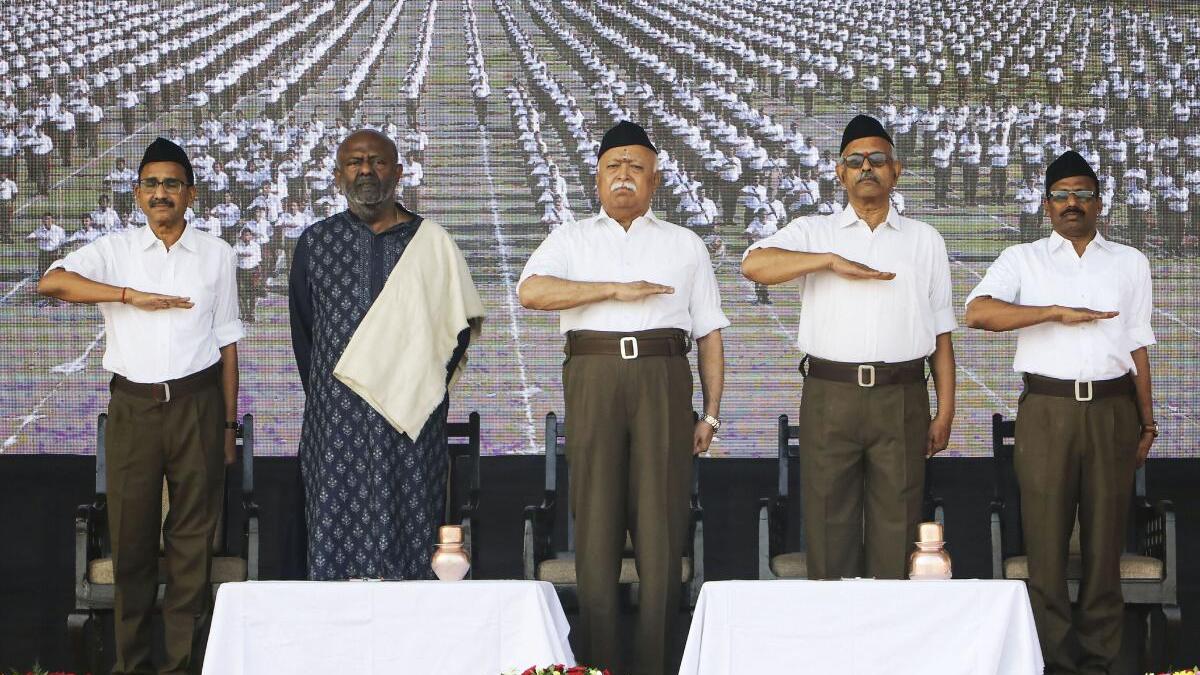
Tracing the historical journey of the RSS from its founding by K.B. Hedgewar in 1925 to its evolution into a dominant ideological force in India.
- The RSS was founded by Keshav Baliram Hedgewar on Vijayadashami in 1925.
- The organization aims to establish a 'Hindu Rashtra' through cultural and religious revival.
- The ideology is deeply influenced by V.D. Savarkar's concept of Hindutva.
- It has grown from a single shakha to over 1,27,000 shakhas nationwide.
The Rashtriya Swayamsevak Sangh (RSS) stands as a cornerstone of contemporary Indian politics and social discourse. Founded in 1925 by Keshav Baliram Hedgewar, a Maharashtrian Brahmin physician, the organization emerged during the turbulent era of the British Raj. Prime Minister Narendra Modi, a former RSS pracharak, recently described the organization as 'India’s banyan tree of immortal culture and modernisation.'
Foundational Roots and the Concept of Shakhas
In the early 20th century, as the Indian National Congress sought independence, there was a growing demand for alternative nationalist platforms. Hedgewar, once an active member of the Congress, became disillusioned with its inclusive approach to nationalism. He believed that the Hindu community was fragmented by caste and regional identities, weakening its ability to resist colonial rule. To remedy this, he introduced the 'shakha'—a daily gathering designed to instill discipline, unity, and a sense of community among young Hindu men.
Ideological Pillars: Hindutva and Akhand Bharat
The ideological framework of the RSS is inextricably linked to the writings of V.D. Savarkar. His treatise on 'Hindutva' posits that while anyone can be a citizen of India, the nation holds a unique civilizational claim for Hindus. Furthermore, the RSS envisions the concept of 'Akhand Bharat' (Undivided India), a geopolitical ideal spanning from Afghanistan to Myanmar and Sri Lanka, aiming to restore India as a 'Vishwa Guru' or global leader.
Why This Matters
BozokMedia analysis shows that the RSS serves as the ideological fountainhead for the Bharatiya Janata Party (BJP). Its influence extends far beyond religious circles, shaping the socio-political fabric of the nation and driving the narrative of cultural nationalism that defines modern Indian governance.
The evolution of the RSS represents a massive shift from localized cultural activism to a centralized force of national identity.
Despite its massive growth—now operating over 1,27,367 shakhas across 51,570 locations—the organization's journey has not been without controversy. The RSS has faced bans at least three times in independent India, reflecting the deep-seated tensions between its vision of a Hindu nation and the secular principles of the Indian Constitution.
Frequently Asked Questions
1. Who was the founder of the RSS?
The RSS was founded by Dr. Keshav Baliram Hedgewar in Nagpur in 1925.
2. What is the core ideology of the RSS?
The core ideology is centered around Hindutva and the establishment of a Hindu Rashtra.