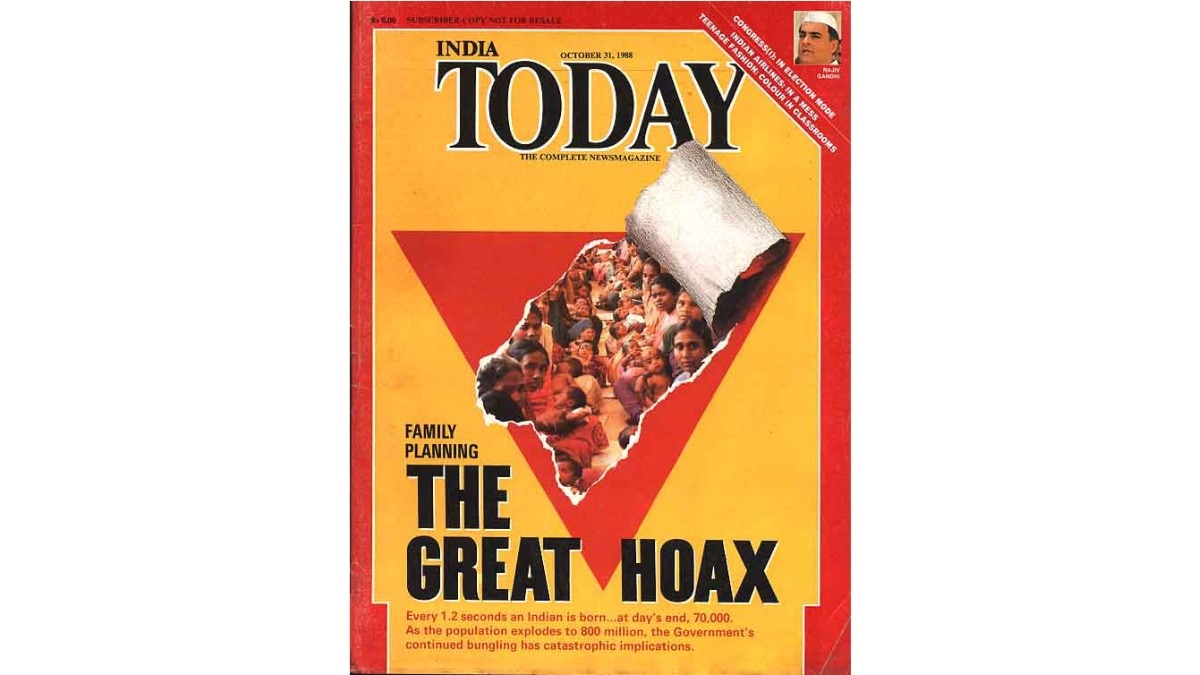
A deep dive into the 1988 India Today archives, revealing the massive gap between government family planning statistics and the ground reality of India's population explosion.
- In the 1980s, India's population grew at a staggering 2.13% annually.
- Despite spending ₹3,000 crore, the crude birth rate remained stagnant.
- Government 'success' was often driven by 'targetitis'—a mania for meeting numbers.
- Incentives led to unethical practices, including repeat sterilizations for cash.
Reflecting on the India Today archives from 1988, we encounter a haunting reality of a nation struggling to outpace its own growth. In a darkened hall in Chembur, a clock ticked not just seconds, but lives—marking a new Indian birth every 1.2 seconds. By the end of an hour, 3,000 people had been added to the national tally.
During this era, India was adding approximately 16 million people every year. As Professor P.N. Srivastava of the Planning Commission noted, the nation was essentially adding the equivalent of an entire 'Australia' to its population annually. Despite a massive infusion of ₹3,000 crore into family planning programs, the results were statistically invisible.
Why This Matters
BozokMedia analysis shows that the disconnect between expenditure and outcome is a classic sign of systemic inefficiency. While the government claimed a dramatic rise in contraceptive use, the Crude Birth Rate—the most sensitive indicator of program success—remained stuck at 33 births per 1,000 people. This discrepancy highlighted a fundamental failure in policy implementation.
The success claimed by the Government actually shows only the progress of its expenditure. In its calculations, everything has to go up. Unfortunately, so has the population.
The article identifies a phenomenon termed 'Targetitis'—an acute mania for meeting numerical targets at any cost. This led to absurdities in rural health centers. In places like Lucknow and Pune, individuals were reportedly undergoing repeat vasectomies and tubectomies not for family planning, but simply to claim the small government cash incentives provided for the procedures.
Historical Background
India holds the distinction of being the first country to launch a national family planning program in 1951. From the coercive measures seen during the Emergency to the modernized slogans of the Rajiv Gandhi era in the mid-80s, the struggle to balance development with demographic shifts has been a defining challenge of modern Indian history.
Frequently Asked Questions
1. What was the primary criticism of the family planning program in 1988?
Answer: Critics argued that the government focused on spending money and meeting numerical targets rather than actually reducing the birth rate.
2. What does 'Targetitis' mean in this context?
Answer: It refers to the administrative obsession with meeting statistical goals, often leading to fraudulent or superficial results on the ground.