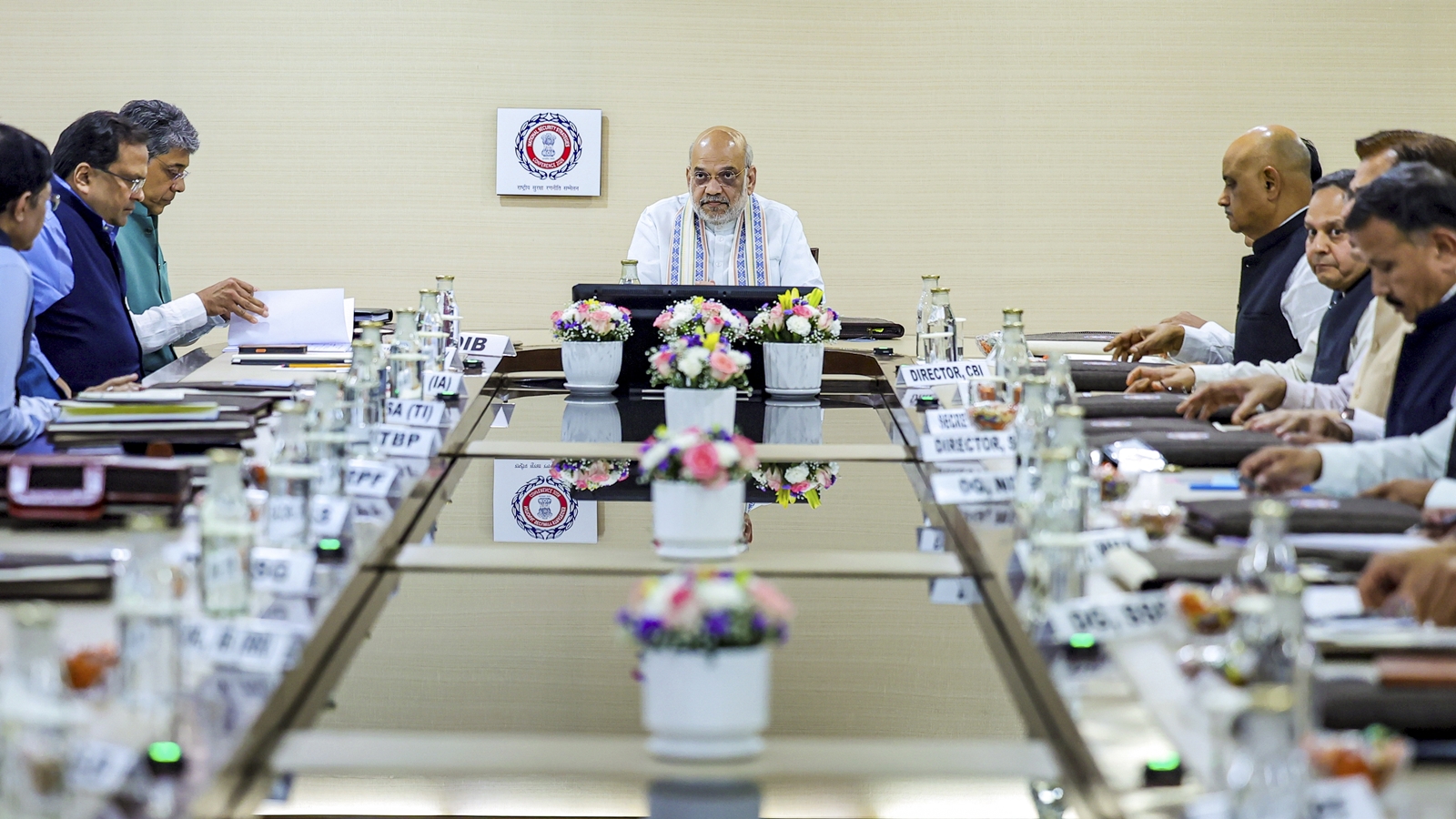
Union Home Minister Amit Shah inaugurated the 9th National Security Strategies Conference-2026, targeting illegal migration, cybercrime, and Pakistan's proxy warfare. The summit emphasizes the integration of AI into intelligence analysis to fortify India's national security framework.
- Focus on detection and deportation of illegal migrants and countering Pakistan's proxy warfare.
- Directive to implement AI-based analysis on MAC platforms for creating advanced SOPs.
- Emphasis on the PRAHAAR scheme for counter-terrorism and utilizing trial-in-absentia for fugitives.
- Day 2 focus: Sub-aerial threats (drones), Blue Economy security, and Bio-security frameworks.
Union Home Minister Amit Shah on Monday inaugurated the 9th National Security Strategies Conference-2026 in New Delhi. This high-level two-day summit serves as a critical forum for addressing pressing national security concerns, ranging from border infiltration to the sophisticated realms of cyber warfare. The event commenced with a solemn tribute at the Martyrs’ Column to the Intelligence Bureau personnel who sacrificed their lives for the nation.
The first day of the conference was characterized by intense discussions on counter-terrorism and the operationalization of intelligence. A major highlight was the emphasis on the Multi-Agency Centre (MAC), where the Home Minister directed that AI-based analysis be integrated into the platform. This move is intended to develop Standard Operating Procedures (SOPs) that can preemptively tackle diverse security challenges.
Why This Matters
BozokMedia analysis shows that India is transitioning from a reactive security posture to a predictive one. By leveraging AI and fusion-based intelligence, the government is attempting to bridge the gap between raw data and actionable intelligence, which is crucial in fighting asymmetric warfare.
"The shift toward AI-integrated intelligence marks a new era in India's defense strategy, moving beyond physical borders to secure digital and biological frontiers."
To combat radicalization and terrorism, Shah highlighted the PRAHAAR scheme of the Ministry of Home Affairs (MHA), urging rigorous training for its implementation. He further called for the acceleration of legal trials by leveraging 'trial-in-absentia' provisions to ensure that fugitives cannot evade justice. A comprehensive and integrated approach to investigating UAPA cases was also mandated.
The second day of the conference is set to address the evolving threat landscape. Key topics include countermeasures against sub-aerial systems (drones), the protection of the Blue Economy, and the implications of information warfare. Furthermore, the necessity of a robust bio-security framework was identified as a priority for future national safety.
The conference, conducted in a hybrid format, saw participation from over 850 stakeholders. Attendees included Ministers of State for Home Affairs, the Union Home Secretary, Deputy National Security Advisers, and heads of Central Armed Police Forces (CAPF). Additionally, Directors General of Police (DGPs) from various states and domain experts joined virtually to provide grassroots insights.
Frequently Asked Questions
Q1: Why is AI being integrated into the MAC platforms?
A: AI is being used to analyze vast amounts of data available on MAC platforms to identify patterns and create standard operating procedures (SOPs) to counter national security threats more efficiently.
Q2: What is the significance of the 'trial-in-absentia' provision mentioned?
A: It allows the legal process to proceed against fugitives who have fled the country, ensuring that justice is not delayed due to the absence of the accused.