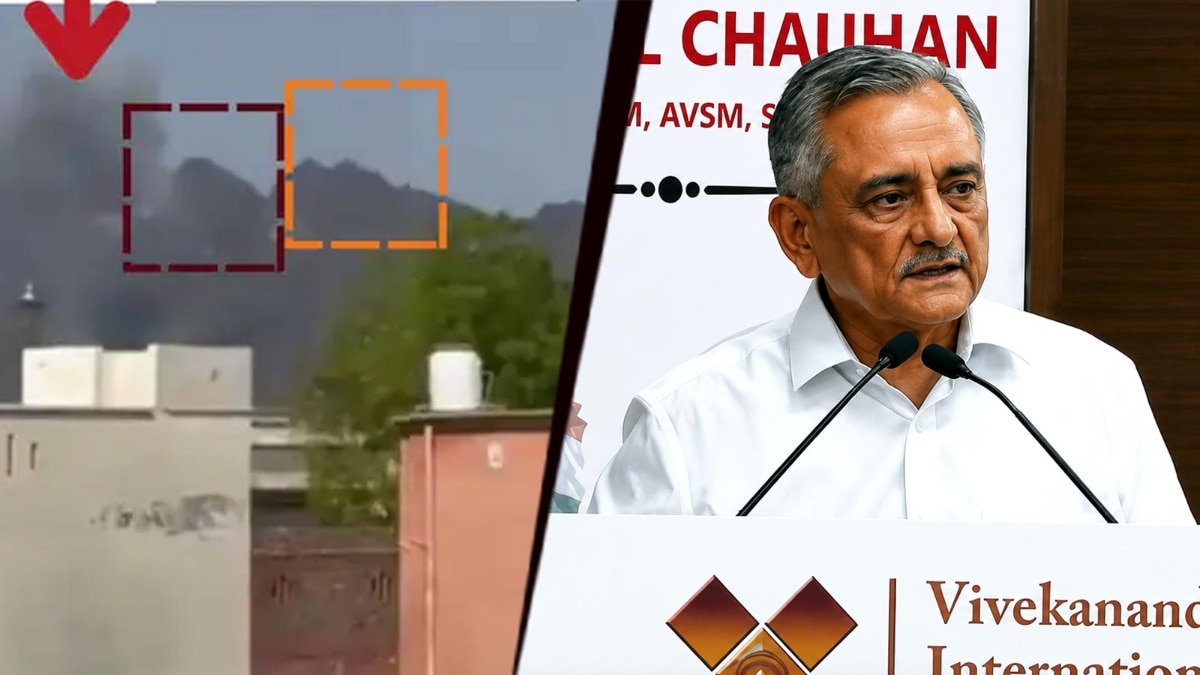
Former Chief of Defence Staff General Anil Chauhan has debunked claims of an Indian strike on Pakistan's Kirana Hills, explaining that a drone collision caused the smoke seen in media reports.
- Former CDS General Anil Chauhan denied any attack on Kirana Hills or nuclear sites.
- He clarified that loitering munitions (drones) crashed into hills after failing to find targets.
- Operation Sindoor was described as a unique 'third option' in India's military doctrine.
- India authorized strikes even as Pakistan attempted to initiate diplomatic talks.
The long-standing speculation regarding an Indian strike on the Kirana Hills in Sargodha, Pakistan, has finally been addressed. Former Chief of Defence Staff (CDS) General Anil Chauhan has categorically denied that India targeted the hills or any nuclear installations located in the region during 'Operation Sindoor'.
Speaking at an event organized by the Vivekanand International Foundation, General Chauhan explained the technical reality behind the visual evidence seen by the Pakistani media. He stated that India had deployed several loitering munitions (suicide drones) to locate and destroy Pakistani radar systems near Sargodha. "These munitions can stay airborne for nearly two hours searching for a target. If no target is found within the set time, they descend," the General explained. He added that a drone likely collided with a hill in the Kirana range, which caused the smoke that was later misreported as an explosion.
Why This Matters
BozokMedia analysis shows that this distinction is crucial in understanding modern electronic and aerial warfare. By utilizing low-altitude tactics and loitering munitions, India demonstrated a shift toward high-precision, low-signature strikes that bypass traditional radar detection, complicating the enemy's ability to verify damage.
"Our core strategic principle was that the final blow and the decisive strike must always come from our side, not Pakistan's." — General Anil Chauhan
General Chauhan characterized Operation Sindoor as a 'third option', distinguishing it from the ground operations following the Uri attack and the massive airstrikes following Pulwama. This strategy focused on utilizing low airspace—employing drones, loitering munitions, and attack helicopters—to ensure surprise and minimize the escalation tempo while maximizing success.
In a revealing detail, the former CDS mentioned that the decision to strike was made despite Pakistan's attempts at diplomacy. "At around 10 AM, when Pakistan called to initiate talks, the Air Force Chief asked me if we should strike Sargodha. I said—go ahead," Chauhan revealed. He further instructed the Air Force to identify additional targets, including Bholari, after weather conditions prevented a strike on Skardu.
Frequently Asked Questions
1. Was there an attack on Pakistan's nuclear facilities?
No, according to General Anil Chauhan, there was no targeting of nuclear sites in Kirana Hills.
2. What was the objective of Operation Sindoor?
The operation aimed to destroy radar systems and military assets using low-altitude, high-precision drone technology.