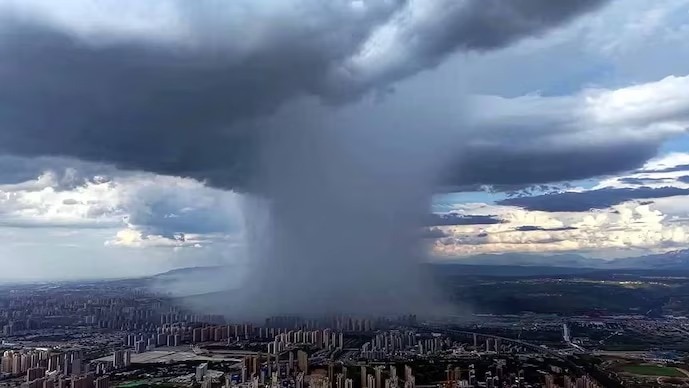
A devastating cloudburst in Kargil's Stakpa-Sanku region has triggered flash floods, leaving streams choked with debris. Meanwhile, Nepal faces a massive crisis with hundreds dead following glacial bursts.
- Cloudburst in Kargil's Stakpa-Sanku area triggers severe flash flooding.
- Nepal reports 788 deaths and 2,500 missing due to glacial-induced floods.
- Rising river levels in Uttar Pradesh and Bihar raise flood alerts.
- IMD issues heavy rainfall warnings for West Bengal, Jharkhand, and Odisha.
A massive cloudburst in the Stakpa-Sanku area of Kargil, Ladakh, has unleashed devastating flash floods. The sudden deluge has sent torrents of water rushing through local streams, carrying immense amounts of mud, silt, and massive boulders that have completely choked the drainage channels.
The catastrophe in the high-altitude region of Ladakh follows a series of devastating events in neighboring Nepal. In Nepal, the bursting of glaciers near the Chinese border sent catastrophic waves of water and debris into the Bhote Koshi and Trishuli river systems. According to recent reports, the death toll in Nepal has climbed to 788, with approximately 2,500 people still missing. The infrastructure, including homes, roads, and bridges, has suffered irreparable damage.
Why This Matters
BozokMedia analysis shows that the interconnectedness of the Himalayan river systems means that disasters in the upper reaches, like Nepal and Ladakh, directly impact the flood safety of the Indo-Gangetic plains in India.
The increasing frequency of cloudbursts in the Himalayan belt is a direct indicator of the accelerating climate crisis in South Asia.
As a direct consequence of the flooding in Nepal, the Uttar Pradesh region is on high alert. The rising levels of the Narayani-Gandak river have put several villages in Maharajganj and Kushinagar on edge. Authorities have even recovered several bodies in these districts that were washed down from Nepal.
In Bihar, the situation remains critical as the Ganga, Gandak, Kosi, and Budhi Gandak rivers continue to swell. Current monitoring data indicates that the Budhi Gandak in Khagaria and the Ganga in Sahibganj are flowing well above the danger mark. The India Meteorological Department (IMD) has warned of heavy to extremely heavy rainfall in West Bengal, Jharkhand, and Odisha in the coming days.
Historical Background
The Himalayan region has become increasingly prone to 'cloudburst' events over the last decade. These localized, intense rainfall events are often triggered by sudden changes in atmospheric pressure and temperature, leading to rapid snowmelt and devastating landslides.
Frequently Asked Questions
1. What caused the floods in Kargil?
A sudden cloudburst in the Stakpa-Sanku region triggered a flash flood carrying heavy debris.
2. How is the situation in Bihar?
Several major rivers in Bihar, including the Ganga and Kosi, are flowing above the danger mark due to heavy rains in Nepal.