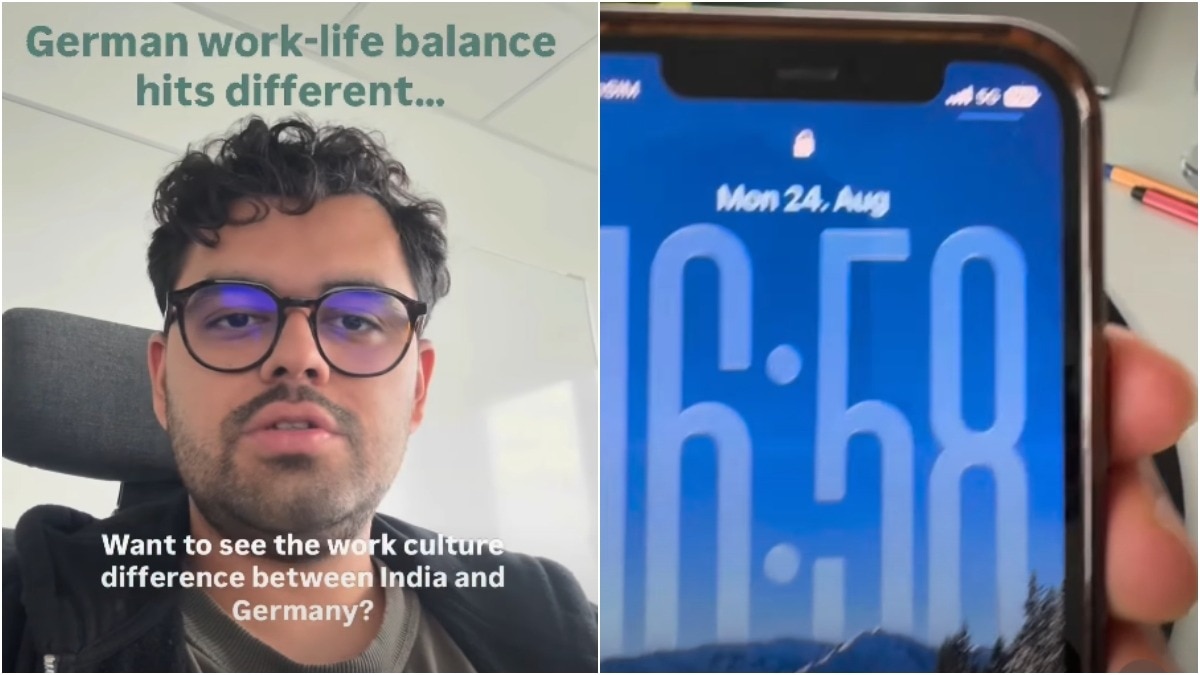
An Indian expat working in Germany has sparked a global debate on work-life balance after sharing a video of his nearly deserted office floor just before 5 PM on a Monday.
- A viral video highlights the drastic difference between Indian and German workplace expectations.
- Employee Mohit showcased a vacant office floor at 4:58 PM on a Monday.
- The incident reignites discussions on 'hustle culture' versus professional efficiency.
In an era where 'hustle culture' is often glorified as the only path to success, a viral video from Germany is providing a refreshing—and shocking—counter-narrative. Mohit, an Indian professional residing in Germany, took to Instagram to document a scene that feels alien to many working in the Indian corporate sector: an office that is almost entirely empty before the official workday has even concluded.
The clip begins with a close-up of a digital clock displaying 16:58 (4:58 PM) on a Monday. As Mohit pans his camera across the office floor, the viewer is met with a sea of empty ergonomic chairs and vacant desks. There are virtually no colleagues in sight, suggesting that the workforce had already transitioned from their professional roles to their personal lives the moment their scheduled hours ended.
Why This Matters
BozokMedia analysis shows that this discrepancy is rooted in deep-seated cultural philosophies regarding labor and leisure. In India, staying late is frequently viewed as a sign of loyalty, ambition, or indispensable value to the company. Conversely, the German model prioritizes Leistung (performance) over presence. If a task is completed efficiently within the allotted time, there is no cultural or professional incentive to linger in the office.
"The transition from a presence-based productivity model to a result-based model is essential for preventing employee burnout and fostering long-term innovation."
Mohit’s caption added a poignant layer to the visual evidence: "Work is important part of life, but emphasis on part! It’s just a part, and it should be treated as one." This sentiment strikes a chord with millions of employees worldwide who struggle with 'availability creep'—the expectation to respond to emails and messages long after the sun has set.
Historically, European labor markets, particularly in Germany, have been governed by strong unions and strict legal frameworks that protect the boundary between work and home. In contrast, India's rapid economic ascent and its role as a global outsourcing hub have created a culture of hyper-availability to cater to Western time zones, often at the cost of the employee's mental well-being.
| Feature | Indian Work Culture (Typical) | German Work Culture (Typical) |
|---|---|---|
| Working Hours | Fluid and often extended | Strictly defined and respected |
| Primary Metric | Hours logged / Availability | Efficiency / Output |
| Philosophy | Work as a central life pillar | Work as a component of life |
Frequently Asked Questions
Q1: Is this trend applicable to all companies in Germany?
A: While some startups or high-pressure sectors may differ, the general societal and legal expectation in Germany is a strict adherence to work-life balance.
Q2: Why is the 'stay-late' culture so prevalent in India?
A: It is a combination of intense competition, a cultural tendency to equate long hours with hard work, and the logistical demands of serving global clients across different time zones.


