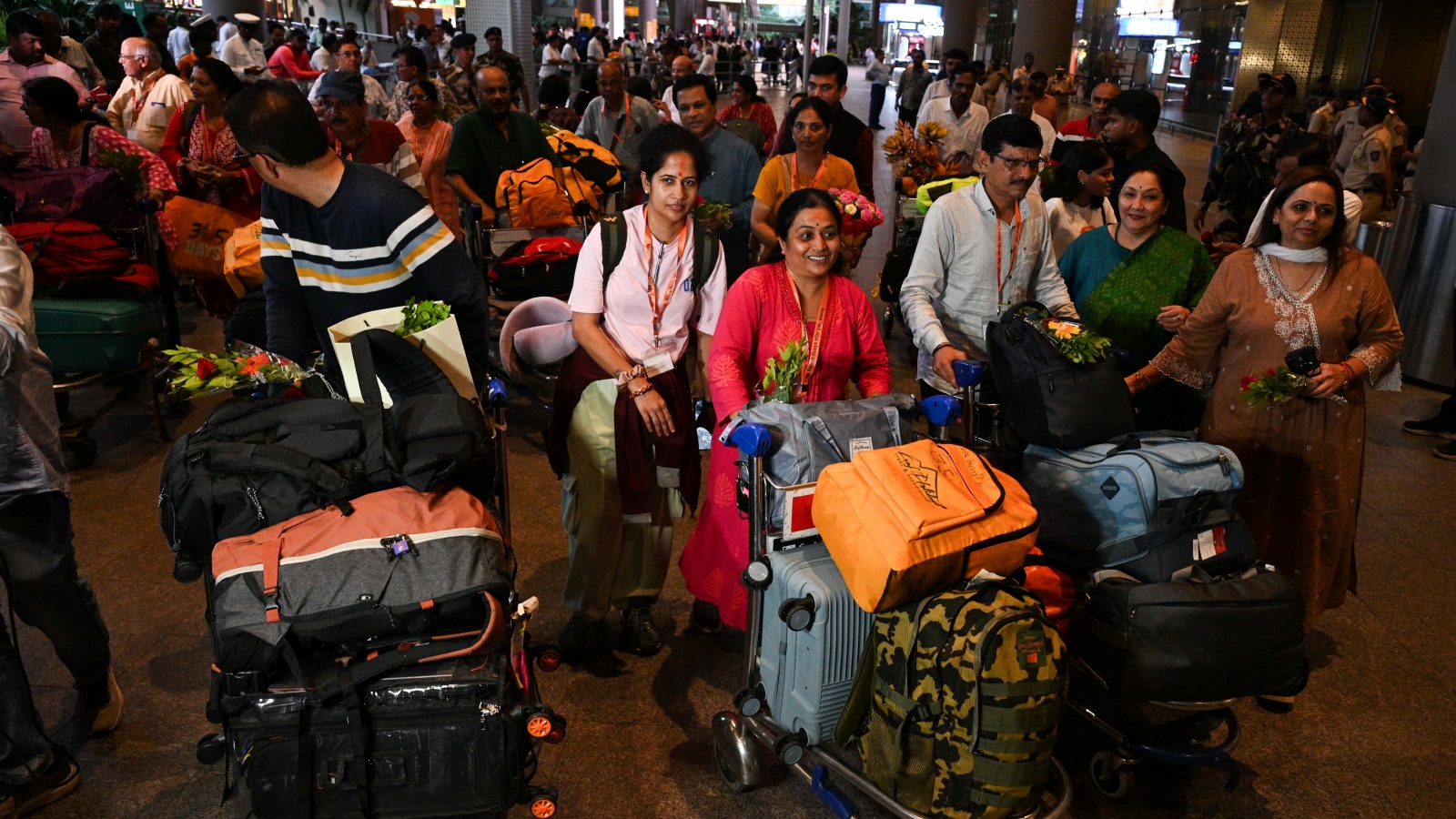
Following days of intense panic and severe flash floods in Nepal and Tibet, 41 pilgrims from Maharashtra and Karnataka have safely returned to Mumbai. The rescue operations, coordinated by state authorities and the Ministry of External Affairs, brought immense relief to anxious families.
- 41 Kailash-Mansarovar pilgrims safely landed at Mumbai's international airport on Saturday.
- Intervention by Maharashtra CM Devendra Fadnavis facilitated their evacuation via Kathmandu.
- Search operations continue for several other tourists from Pune and Mumbai who remain unreachable.
For families who had spent the past 48 hours waiting in agony, Saturday evening brought profound relief. Forty-one pilgrims from Maharashtra and neighboring states, stranded in Tibet and Nepal after completing the arduous Kailash-Mansarovar Yatra, arrived safely at Mumbai’s Chhatrapati Shivaji Maharaj International Airport (CSMIA). Their journey was disrupted by devastating flash floods that killed hundreds and paralyzed transportation networks across the trans-Himalayan region.
"For the past two days, I was in a constant state of panic. But seeing my wife in person has finally put me at ease," said Subodh Sathe, a resident of Borivali, whose wife, Shama, was among those who returned. "I have nothing but absolute gratitude for the state authorities and the Ministry of External Affairs for their swift coordination."
A Narrow Escape from Disaster and Illness
Among the returnees was Smita Pawar, the Revenue Commissioner of Pune division, who was traveling with three family members. During the journey, Pawar and her sister-in-law, Yogini Patil, fell severely ill. With oxygen levels dropping rapidly at high altitudes, Pawar developed hypoxia, and her body began turning bluish-black. "We were scheduled to cross the border on the exact day the floods struck, but because of our medical emergency, we had to go to the hospital instead," Patil recalled. This unexpected delay ultimately saved their lives from the brunt of the floods.
The pilgrimage group, organized under the Jai Girnari Shivdutt Mandir Trust, included travelers from across the Mumbai Metropolitan Region, Pune, and Karnataka. Among them was 70-year-old Varsha Currey from Hubli, who had been stranded in Tibet since the floods began on August 16.
| Pilgrim Group / Origin | Stranded Location | Current Status / Destination |
|---|---|---|
| 41 Pilgrims (Mumbai/Pune/Hubli) | Saga, Tibet | Safely arrived at Mumbai Airport |
| 45 Tourists (Pune/Ahilyanagar) | Chitwan, Nepal | Safely crossed into Indian territory |
| 106 Tourists (Maharashtra) | Kathmandu, Nepal | Arrived in Nagpur via Patna |
| 8 Tourists (Borivali/Andheri) | Nepal | Currently unreachable (Search ongoing) |
Why This Matters
BozokMedia analysis shows that the escalating frequency of cloudbursts and landslide-induced barrier lakes in the Himalayas poses an existential threat to religious tourism. As thousands embark on trans-border pilgrimages annually, there is an urgent need for India and Nepal to establish a unified, satellite-enabled real-time tracking registry to monitor and evacuate travelers during climate emergencies.
"The rescue of these pilgrims highlights the critical importance of swift diplomatic coordination and the necessity of real-time tracking for high-altitude expeditions."
Historical Background of the Pilgrimage Route
The Kailash-Mansarovar Yatra is one of the most sacred and physically demanding pilgrimages for Hindus, Buddhists, and Jains. Traversing the high-altitude terrains of Nepal and the Tibet Autonomous Region of China, the route is highly susceptible to extreme weather. Historically, the Himalayan region has witnessed severe ecological degradation, making it a hotspot for sudden flash floods and landslides during the monsoon season, often leaving thousands of tourists stranded without communication or basic amenities.
Frequently Asked Questions
Q1: How were the stranded pilgrims evacuated from Tibet?
Answer: Following the intervention of Maharashtra Chief Minister Devendra Fadnavis and the Ministry of External Affairs, the pilgrims were safely guided through the Nyalam check-post into Kathmandu, from where they flew back to Mumbai.
Q2: Are there still Indian tourists missing or stranded in Nepal?
Answer: Yes, authorities are still trying to establish contact with eight tourists from Borivali and Andheri, alongside a group of 60 travelers associated with a private tour operator who remain unreachable.