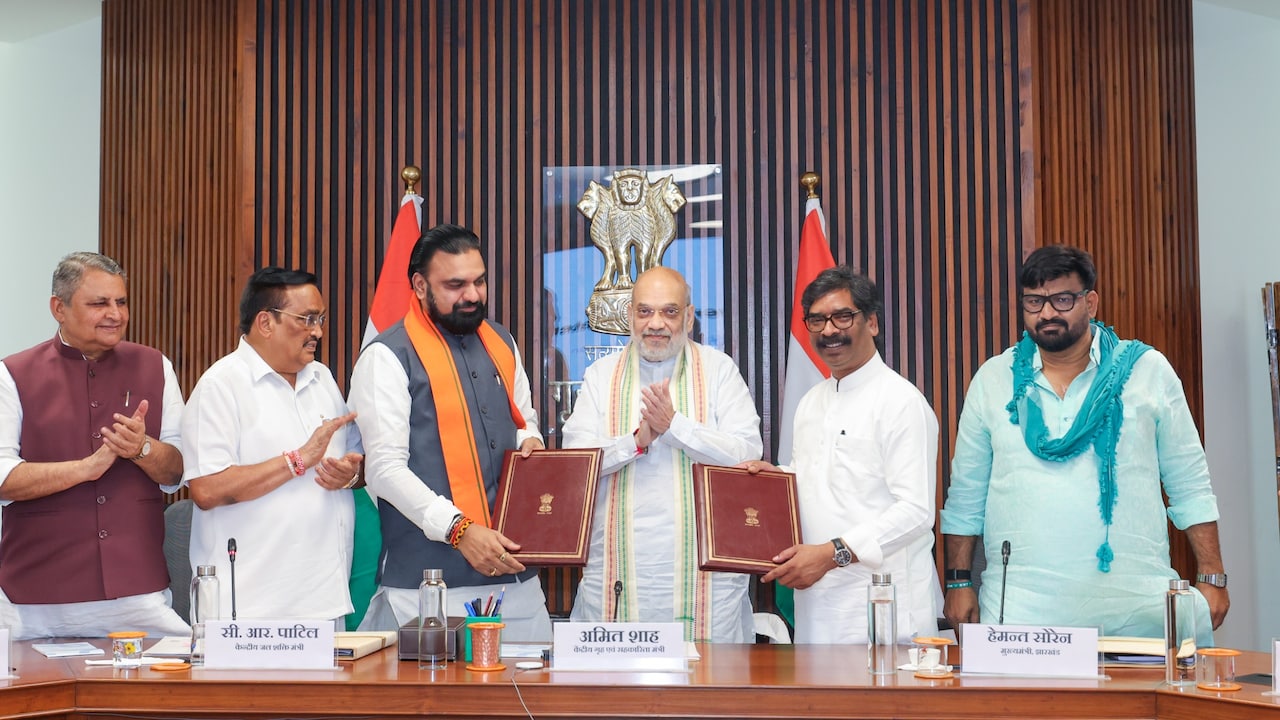
In a landmark move towards cooperative federalism, Bihar and Jharkhand have signed a Memorandum of Understanding (MoU) to resolve their long-standing Sone River water dispute in the presence of Union Home Minister Amit Shah.
- Formal resolution of a 25-year-old water sharing dispute between Bihar and Jharkhand.
- MoU signed in the presence of Union Home Minister Amit Shah and Jal Shakti Minister CR Patil.
- The agreement is hailed as a benchmark for 'Cooperative Federalism' in India.
In a significant breakthrough for inter-state diplomacy, the states of Bihar and Jharkhand have officially put an end to their 25-year-old dispute over the waters of the Sone River. The signing of the Memorandum of Understanding (MoU) took place under the supervision of Union Home Minister Amit Shah and Jal Shakti Minister CR Patil, marking a pivotal shift from conflict to cooperation.
The Sone River, a vital tributary of the Ganges, has been a point of contention for over two decades. The dispute primarily revolved around the equitable distribution of water for irrigation, the management of dams, and the impact of water diversion on downstream agriculture. By signing this MoU, both states have agreed to a structured framework for water sharing that prioritizes sustainable usage and mutual benefit.
Why This Matters
BozokMedia analysis shows that this resolution is a strategic victory for the central government's push toward 'Cooperative Federalism'. By acting as a mediator, the Union government has demonstrated that political will can bypass the sluggishness of judicial litigation. For the agrarian economies of Bihar and Jharkhand, this means guaranteed water security, which is directly linked to crop yields and rural economic stability.
"The transition from litigation to negotiation in water disputes is the only sustainable path toward national resource security."
Historically, river water disputes in India—such as the Cauvery or Krishna disputes—have lasted for generations, often escalating into regional tensions. The Bihar-Jharkhand agreement serves as a blueprint for other states, proving that technical data and political consensus can resolve issues far more efficiently than protracted legal battles in the Supreme Court.
Frequently Asked Questions
Q1: Which states were involved in the Sone River agreement?
Answer: The agreement was signed between the states of Bihar and Jharkhand.
Q2: Who witnessed the signing of the MoU?
Answer: The MoU was signed in the presence of Union Home Minister Amit Shah and Jal Shakti Minister CR Patil.