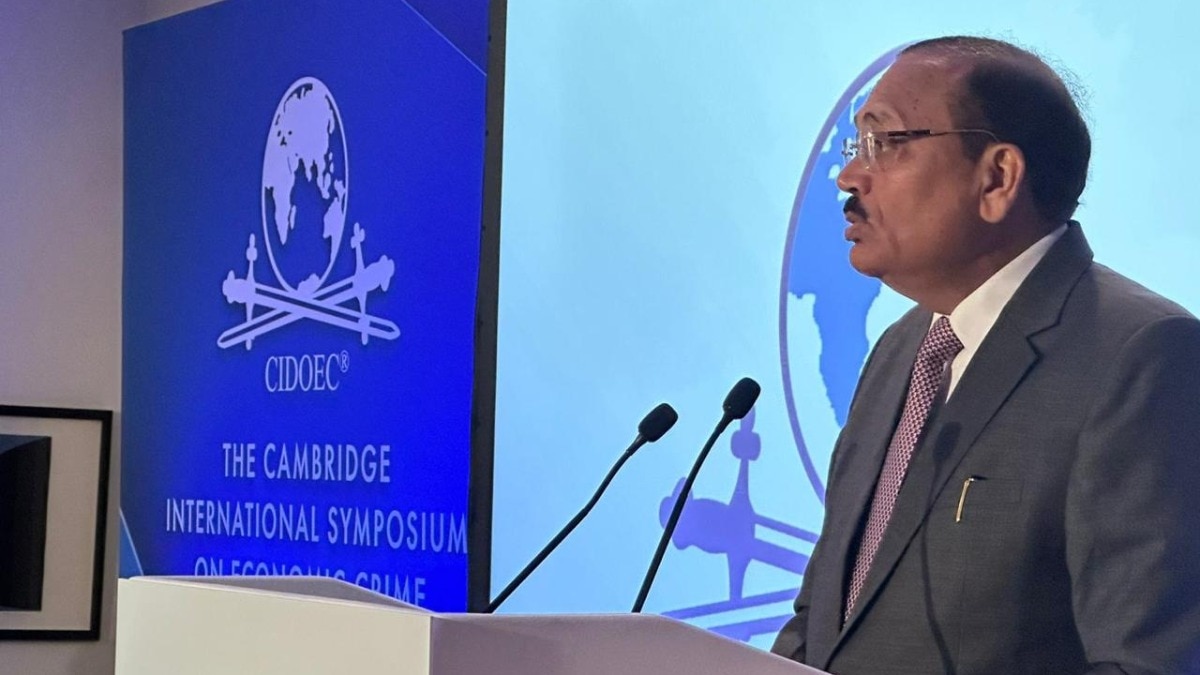
Chief Justice of India Surya Kant has sounded a global alarm over money laundering, stating that while illicit wealth is vast enough to buy laptops for everyone on Earth, less than 1% is ever recovered.
- Global money laundering volumes could theoretically fund a laptop for every person on Earth (8 billion).
- Less than 1% of illicitly gained wealth is actually recovered by authorities.
- CJI Surya Kant emphasizes tracing and freezing assets over mere rhetoric in reports.
- India utilizes PMLA (2002) and the Fugitive Economic Offenders Act (2018) to combat financial crimes.
Addressing the closing session of the 43rd International Symposium on Economic Crime in Cambridge, Chief Justice of India (CJI) Surya Kant delivered a scathing critique of the global community's inability to reclaim stolen wealth. The CJI used a powerful analogy to illustrate the scale of the crisis, noting that the amount of money laundered annually is sufficient to provide a modest laptop to every one of the eight billion people on the planet, with surplus funds still remaining.
The most alarming revelation, however, was the recovery rate. Justice Surya Kant pointed out a stark disparity between the identification of financial crimes and the actual reclamation of assets. He noted that for every hundred units of illicit wealth, 99 remain untouched, existing only as statistics in speeches and official reports, while only a single unit is ever effectively recovered.
Historical Context of Economic Fraud
The CJI noted that economic crime is not a byproduct of the digital age but an ancient vice. He cited the 4th-century BC Greek merchant Hegestratos, who allegedly plotted to sink his own ship for insurance fraud, as an early example. Furthermore, he referenced Kautilya's Arthashastra, which detailed 40 distinct methods officials used to siphon state revenue, alongside the audits and informants used to stop them.
Why This Matters
BozokMedia analysis shows that the CJI's remarks signal a shift in judicial priority from mere prosecution to asset recovery. In an era of cryptocurrency and shell companies, the ability to trace 'beneficial ownership' is the only way to break the cycle of systemic corruption. The emphasis on 'tracing, freezing, and returning' suggests that the judiciary is pushing for more aggressive international cooperation.
The success of the fight against economic crime should not be measured by how effectively the problem is described, but by how effectively stolen wealth is returned.
Regarding India's domestic strategy, CJI Kant highlighted the Prevention of Money Laundering Act (PMLA), 2002, and the Fugitive Economic Offenders Act, 2018. He argued that while extradition is often a slow and political process, Mutual Legal Assistance Treaties (MLATs) are far more reliable for bringing recovered assets back to their home country.
The CJI also warned about the rise of modern threats, specifically 'digital arrest' scams, where fraudsters impersonate law enforcement to extort citizens. He called for stronger financial intelligence sharing and transparent beneficial ownership registries to track the flow of illicit funds across borders.
Frequently Asked Questions
Q1: What is the recovery rate of black money according to the CJI?
According to CJI Surya Kant, less than 1% of illicit wealth is ever actually recovered.
Q2: Which Indian laws are used to fight money laundering?
The primary frameworks include the Prevention of Money Laundering Act (PMLA), 2002, and the Fugitive Economic Offenders Act, 2018.