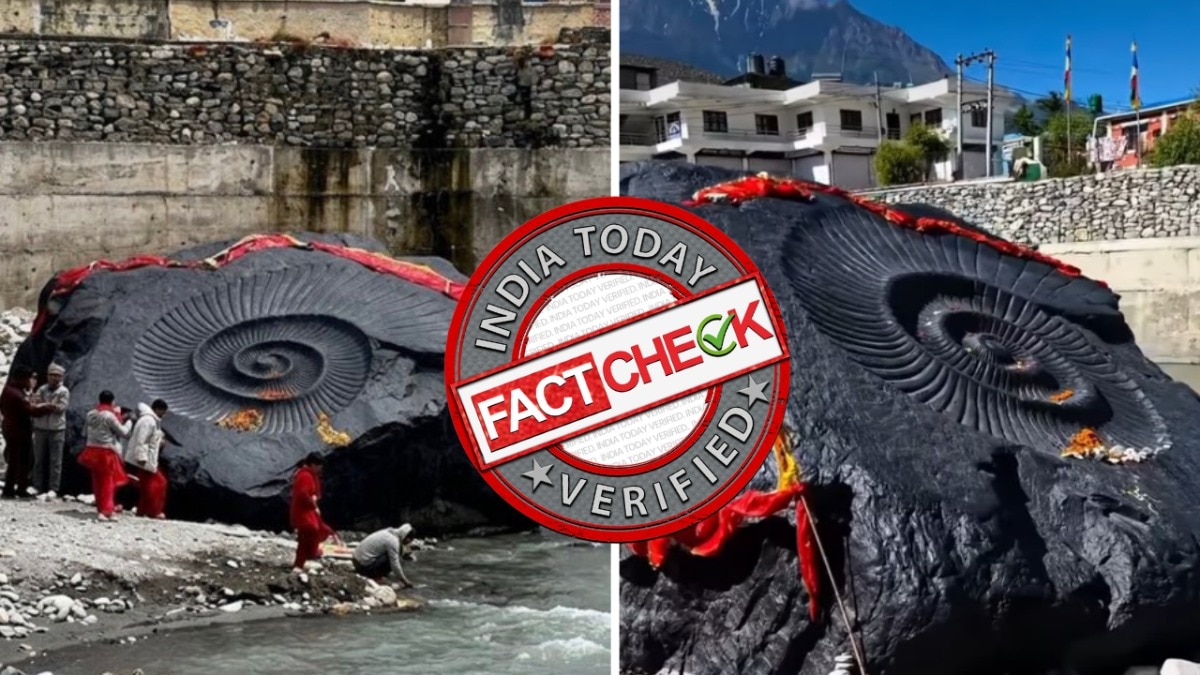
Viral claims suggest a 31-ton, 175-million-year-old Shaligram emerged after deadly floods in Nepal. However, investigations reveal the 'discovery' is actually a man-made sculpture carved in 2026.
- The viral video does not show a natural fossil discovery but a carved sculpture.
- The artwork was created during a workshop in Jomsom, Nepal, between April and May 2026.
- There is no connection between this sculpture and the recent devastating floods in Nepal.
Following the catastrophic flash floods in Nepal, which tragically claimed over 900 lives, a video began circulating on social media platforms, particularly X. The post claimed that a 31-ton, 175-million-year-old Shaligram stone had emerged from the earth as a result of the disaster.
Shaligrams are ammonite fossils naturally found in the Kaligandaki River Valley of Mustang, Nepal. Due to their deep significance in both Hinduism and Buddhism, the claim quickly gained traction among religious communities and social media users.
The Investigation: Uncovering the Truth
A detailed probe into the footage reveals that the claim is entirely baseless. According to a report by the Himalaya Times dated June 30, the massive rock was actually carved into a Shaligram during a 15-day artistic workshop held in Jomsom from April 20 to May 4, 2026. More than 36 skilled sculptors from the Nepal Academy of Fine Arts participated in this project.
The workshop, organized by the Gharpjhong Rural Municipality and co-financed by the Integrated Service Office Mustang, aimed to showcase local art. In addition to the giant Shaligram, the artists carved figures of Lord Shiva, Parvati, Vishnu, Buddha, and local wildlife such as the Himalayan snow leopard and sheep from rocks along the Kaligandaki River.
Why This Matters
BozokMedia analysis shows a recurring pattern where man-made landmarks are rebranded as 'miracles' or 'ancient discoveries' during times of crisis to generate engagement. By linking a sculpture to a natural disaster, the creators of the post exploited both the tragedy of the floods and the spiritual reverence for the Shaligram to mislead the public.
"The weaponization of faith during natural disasters is a growing trend in misinformation, turning art into alleged miracles for viral clicks."
Further reports from Desh Sanchar indicate that the sculpture was officially inaugurated by Jagadguru Shankaracharya Mahaswami Vidushekhara Bharati Maharaj of the Sringeri Sharada Peeth. The project was explicitly designed to boost religious tourism in the Mustang region, not as a result of geological shifting caused by floods.
| Viral Claim | Verified Fact |
|---|---|
| 175-million-year-old fossil found after floods | Man-made sculpture carved in 2026 |
| Naturally emerged from the surface | Created during a 15-day art workshop |
| Linked to disaster recovery | Designed to promote religious tourism |
Frequently Asked Questions
1. Is the stone itself ancient?
The raw rock may be ancient, but its form as a Shaligram was created by human sculptors in 2026.
2. Where is this sculpture located?
It is located on the banks of the Kaligandaki River in Jomsom, Nepal.