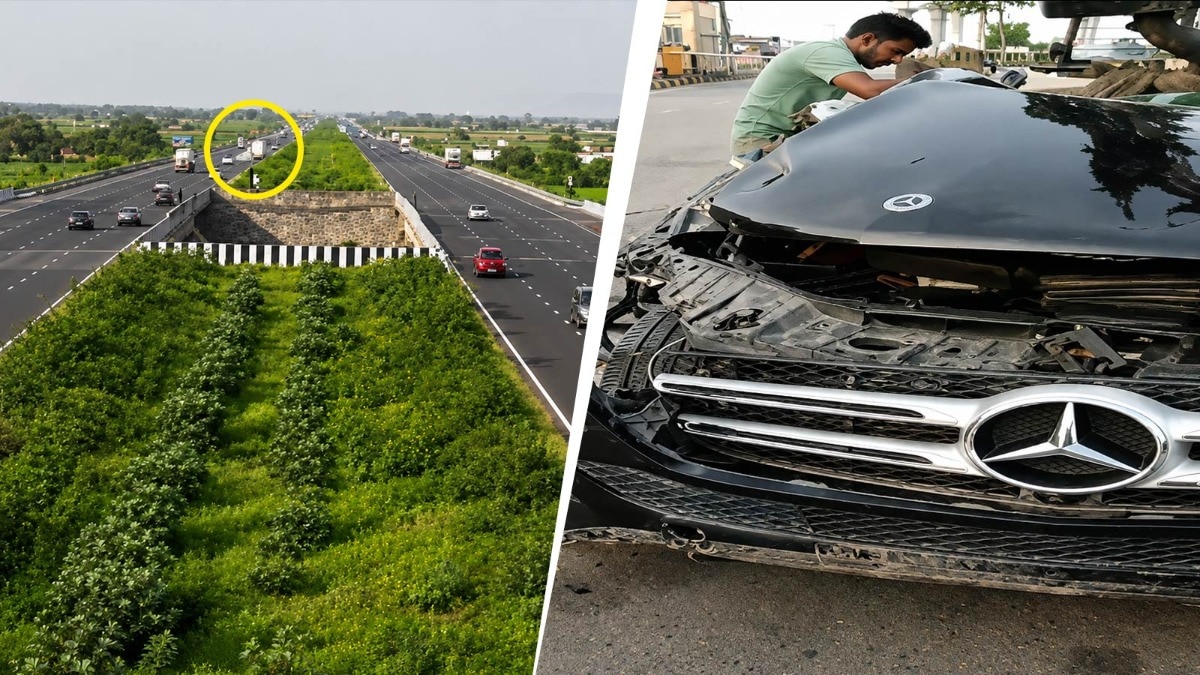
A 22-year-old engineering student lost his life in a devastating accident after his speeding Mercedes suffered a tire blowout and crashed into a shipping container, as captured on CCTV.
- A high-speed Mercedes suffered a sudden tire blowout.
- The vehicle lost control and collided violently with a stationary container.
- The victim was a 22-year-old engineering student.
A chilling sequence of events has been captured on camera, illustrating the lethal combination of high speed and mechanical failure. A Mercedes, traveling at an extreme velocity, experienced a sudden tire burst, which stripped the driver of all steering control. The vehicle veered sharply off course and slammed directly into a heavy shipping container.
The impact was catastrophic, causing the front end of the luxury sedan to crumple instantly upon contact with the rigid steel structure of the container. The driver, identified as a 22-year-old engineering student, sustained fatal injuries and died on the spot. The sheer force of the collision was felt by bystanders in the immediate vicinity.
Why This Matters
BozokMedia analysis shows that this incident highlights a critical intersection of high-performance vehicle capabilities and the catastrophic risks of tire failure at high speeds. When a tire bursts at 100+ km/h, the aerodynamic stability of even a luxury car like a Mercedes is compromised instantly, leaving the driver with zero reaction time.
"High-speed tire blowouts create an immediate loss of steering control, making any obstacle in the path a lethal weapon."
Emergency responders and police arrived shortly after the crash, but the damage to the vehicle was so severe that extracting the body required specialized equipment. The entire horror was recorded by a nearby CCTV camera, providing a stark visual reminder of how quickly a commute can turn into a tragedy.
Historical Context and Safety Standards
Historically, tire blowouts at high speeds have been among the most difficult accidents to survive. While modern vehicles are equipped with Advanced Driver Assistance Systems (ADAS), Electronic Stability Control (ESC), and multiple airbags, these cannot counteract the physical reality of a tire disintegrating under pressure. Automotive experts emphasize that maintaining correct tire pressure and replacing worn-out treads is non-negotiable for high-performance cars.
Frequently Asked Questions
Q1: What was the primary cause of the accident?
A: Initial reports indicate that a tire burst at high speed caused the driver to lose control of the vehicle.
Q2: Could the car's safety features have prevented this?
A: While Mercedes features world-class safety, the kinetic energy involved in a high-speed impact with a stationary steel container often exceeds the protective capacity of airbags and crumple zones.