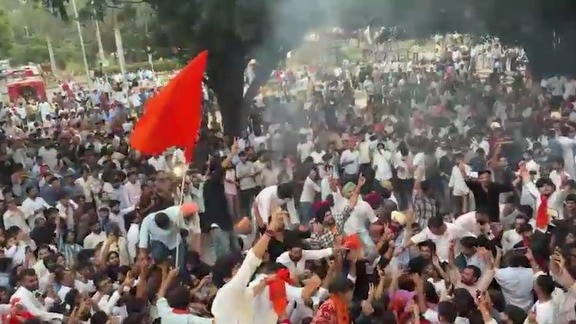
The ABVP has secured the Punjab University Students' Council presidency for the second consecutive year. The unexpected support from the SAD-affiliated SOI has sparked intense political debate regarding a potential revival of the Akali-BJP alliance ahead of the 2027 elections.
- ABVP's Ankit Bidhan wins the Presidential post for the second year running.
- Unexpected support from SOI (SAD student wing) fueled rumors of a BJP-SAD political rapprochement.
- The election results were split, with ASAP and NSUI winning other key council positions.
- The victory provides a psychological boost to ABVP ahead of the upcoming DUSU polls.
In a significant political development at one of North India's premier educational institutions, the Akhil Bharatiya Vidyarthi Parishad (ABVP) has successfully defended its hold on the presidency of the Punjab University Students’ Council. Candidate Ankit Bidhan emerged victorious, polling 3,149 votes, comfortably defeating Adil Brar of the AAP-linked ASAP, who secured 2,637 votes. The NSUI-backed candidate, Gurman Singh Sidhu, trailed in third place with 2,263 votes.
While the presidential win is a major victory for the RSS-affiliated student wing, the overall results indicate a fragmented campus electorate. The ABVP did not achieve a clean sweep, as the Vice-President and Joint Secretary posts were captured by ASAP-backed candidates, while the Secretary post went to an NSUI-backed independent. This distribution of power suggests that while the ABVP has a strong leadership mandate, the university remains a competitive multi-polar political arena.
BozokMedia analysis shows that the most critical aspect of this election is not the victory itself, but the strategic alignment between the ABVP and the Student Organisation of India (SOI). Traditionally, the SOI (the student wing of the Shiromani Akali Dal) contests independently. However, after their candidate's nomination was rejected on technical grounds, they threw their weight behind the ABVP. This tactical shift has reignited discussions about a possible thaw in relations between the BJP and SAD, who parted ways over the 2020 farm laws.
The convergence of SOI and ABVP at the grassroots level often serves as a bellwether for larger political realignments in Punjab's complex caste and religious landscape.
Historically, Punjab University was a bastion for the Congress-backed NSUI and regional outfits like SOPU. The ABVP's ability to win the presidency two years in a row marks a paradigm shift in campus politics, signaling an increase in the appeal of the 'saffron' ideology among the youth in Chandigarh and surrounding regions.
| Position | Winner | Affiliation |
|---|---|---|
| President | Ankit Bidhan | ABVP |
| Vice-President | Armaan Singh Bhinder | ASAP |
| Secretary | Dhyan Singh | Independent (NSUI backed) |
| Joint Secretary | Vishal Bamal | Independent (ASAP backed) |
As the political gaze shifts toward the Delhi University Students’ Union (DUSU) elections on September 18, the NSUI faces a challenging narrative. The failure to secure the top post at PU may be framed as a decline in the influence of the Congress-affiliated wing among Gen Z voters, although the local dynamics of Delhi and Chandigarh differ significantly.
Q1: Why did the SOI support the ABVP candidate?
The SOI's own presidential candidate was disqualified due to technical errors in the nomination process, leading them to back Ankit Bidhan to prevent a rival victory.
Q2: Does this result guarantee a BJP-SAD alliance in 2027?
No, while the student-level support creates buzz, official party alliances depend on higher-level strategic negotiations and the political climate regarding the farm laws.


