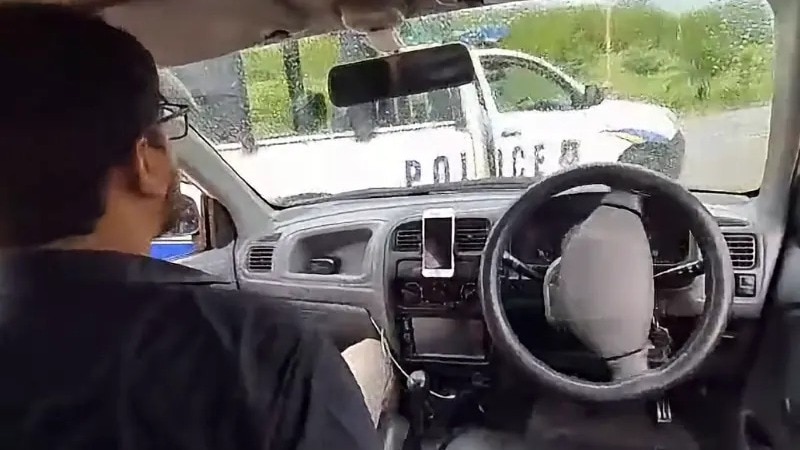
A remote-controlled driverless car crashed into a parked police van during a live demonstration in Islamabad's D-Chowk. The accident was attributed to a sudden loss of internet connectivity, raising serious concerns about the safety of experimental autonomous vehicles.
- A live test of a driverless car failed spectacularly in Islamabad's D-Chowk.
- The vehicle lost control after a disruption in internet and satellite connectivity.
- The car collided with a stationary police van parked on the roadside.
- Journalist Muhammad Alizah warned against neglecting safety in tech experimentation.
In a shocking turn of events in Islamabad, Pakistan, a demonstration of autonomous driving technology resulted in a public accident. The vehicle, which was operating in 'auto mode' and being steered by a remote operator via satellite and internet links, suddenly malfunctioned and crashed into a police van parked by the road.
Journalist Muhammad Alizah was seated in the front passenger seat, documenting the car's features for a report. As the vehicle accelerated, the remote steering system failed. The viral footage captures the moment of panic as Alizah desperately attempts to engage the handbrake, but the momentum of the malfunctioning car leads to an inevitable collision with the police vehicle.
Why This Matters
BozokMedia analysis shows that this incident highlights a critical vulnerability in remote-operated autonomous systems: the absolute dependency on stable network connectivity. When the 'digital umbilical cord' (internet) is severed, the vehicle becomes a kinetic weapon without a fail-safe mechanism. This underscores the danger of testing experimental AI-driven hardware in public spaces without rigorous physical overrides.
"Autonomous vehicles cannot rely solely on cloud connectivity; they must possess edge-computing capabilities to ensure a safe stop during network outages."
The project was spearheaded by Ehsan Zafar, a technology enthusiast from Abbottabad. Following the crash, Alizah clarified that his intent was not to discredit the young innovator but to emphasize the necessity of prioritizing safety. He noted that had the accident occurred on a densely populated street, the consequences could have been fatal.
From a historical perspective, global leaders in autonomy like Tesla and Waymo utilize 'Sensor Fusion' and localized AI processing to ensure that the vehicle can navigate or stop safely even if the external connection is lost. The Pakistani prototype's reliance on a remote link represents a fundamental flaw in its safety architecture.
Frequently Asked Questions
Q1: What caused the driverless car to crash?
A: A disruption in the internet connection severed the link between the remote operator and the car, causing it to lose steering control.
Q2: Were there any casualties in the incident?
A: No serious injuries were reported, though the police van sustained damage.