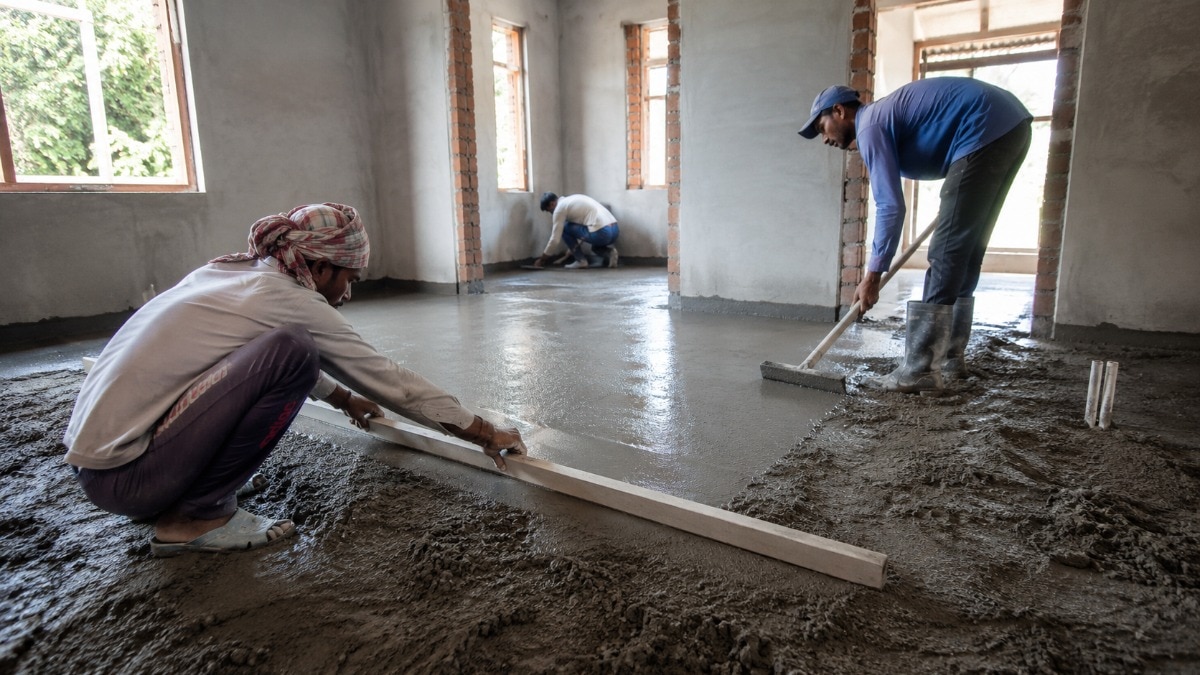
Building your dream home? Discover how floor screeding creates a perfectly level base, preventing future cracks and ensuring your tiles or marble last a lifetime.
- Floor screeding is a mixture of cement and fine sand used to level the floor surface.
- It is a mandatory step before installing tiles, marble, or wooden flooring.
- It effectively conceals and protects underground plumbing and electrical conduits.
Constructing a home is one of the most significant investments in a person's life. While most homeowners focus on the aesthetics of the walls and the quality of the paint, a critical yet often overlooked element is Floor Screeding. This process is fundamental to the structural integrity and visual appeal of any interior space.
What Exactly is Floor Screeding?
In technical terms, floor screeding is the application of a thin layer of cement and fine sand mixture over the primary concrete slab. Its primary purpose is to create a perfectly flat and level surface. It acts as the bridge between the raw structural slab and the final floor finish, such as marble, ceramic tiles, wooden planks, or modern epoxy coatings. Skipping this step often leads to uneven floors, which can cause tiles to crack or peel over time.
Why This Matters
BozokMedia analysis shows that a vast majority of flooring failures—such as hollow sounds under tiles or sudden cracking—are rooted in poor screeding. A well-executed screed layer absorbs structural stresses and ensures that the final flooring material is supported uniformly across the entire area, preventing localized pressure points.
"Floor screeding is the invisible foundation of your home's aesthetics; without a precise base, even the most expensive Italian marble will eventually fail."
Key Benefits and the Modern Process
One of the most practical advantages of screeding is its ability to hide and protect the complex network of plumbing pipes and electrical wires that run beneath the floor. Without a screed layer, these utilities would be too close to the surface, risking damage during the installation of the final flooring.
While traditional screeding relies on cement and sand, modern construction has evolved. The integration of Polymers into the mix has become a gold standard. Polymers enhance the bonding strength, reduce shrinkage, and provide a degree of flexibility that prevents the floor from cracking during temperature fluctuations.
| Feature | Without Screeding | With Screeding |
|---|---|---|
| Surface Quality | Uneven and Rough | Perfectly Level and Smooth |
| Durability | Low; High risk of cracks | High; Lifetime stability |
| Utility Protection | Pipes potentially exposed | Pipes securely embedded |
Frequently Asked Questions
Q1: Can I lay tiles directly onto the concrete slab?
A: While possible, it is not recommended. Without screeding, any slight dip or bump in the slab will translate to the tiles, leading to uneven joints and potential cracking.
Q2: Why should I add polymers to my floor screed?
A: Polymers increase the tensile strength of the mix, make it more water-resistant, and significantly reduce the likelihood of shrinkage cracks.


