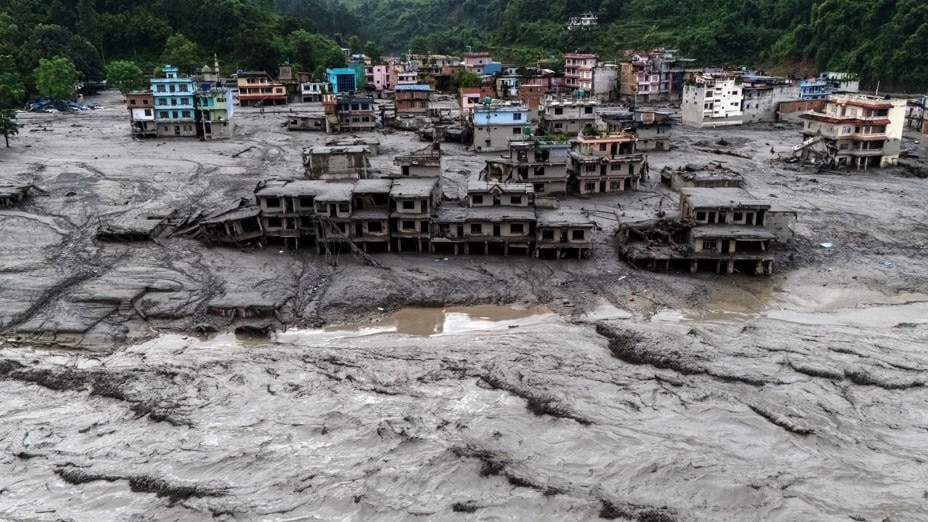
In a somber development, the bodies of five Nepali nationals swept away by devastating flash floods were recovered from the Gandak river in Uttar Pradesh and handed over to the Nepal Police at the Sonauli border.
- Five bodies (two women and three men) were recovered from the Gandak river in Kushinagar, UP.
- The remains were officially handed over to Nepal Police at the Sonauli border.
- Flash floods in Nepal and Tibet have claimed over 1,000 lives so far.
- High alert remains in effect due to 1,50,200 cusecs of water being released from the Gandak barrage.
The devastating impact of flash floods in the Himalayan region continues to claim lives. On Tuesday, authorities confirmed that the bodies of five Nepali nationals, who were swept away during the recent deluge, were recovered from the Gandak river in the Kushinagar district of Uttar Pradesh. The remains were subsequently handed over to the Nepal Police at the Sonauli border.
According to official reports, the recovered individuals include two women and three men. The bodies were transported from Kushinagar to Sonauli, arriving around 4 PM, where they were handed over to Sub-Inspector Hariram Dangi, the in-charge of Nepal's Belahiya police station. The deceased are expected to be transported to Butwal for formal identification and eventual repatriation to their families.
Why This Matters
BozokMedia analysis shows that the hydrological stability of the Indo-Nepal border region is under extreme stress due to unprecedented monsoon patterns. The discharge of 1,50,200 cusecs of water from the Valmikinagar Gandak barrage, combined with heavy rainfall in both Nepal and Uttar Pradesh, has created a high-risk environment for downstream communities in Maharajganj and Kushinagar.
The convergence of high-altitude flash floods and massive barrage discharges necessitates a synchronized trans-boundary disaster management approach.
The rainfall data paints a grim picture. Maharajganj has recorded a cumulative rainfall of 655.5 mm, while the B-Gap area has seen staggering totals reaching 1,064.4 mm. While major rivers like the Rapti and Chandan remain below danger levels, the Mahav drain has breached its danger mark, flowing at nine feet against a five-foot threshold.
Historical Background
The Gandak river system is prone to sudden surges due to its catchment area in the high-altitude regions of Nepal and Tibet. Historically, monsoon-induced flash floods in this belt have caused significant loss of life and property, often complicating cross-border relations due to the shared management of riverine resources and the sudden release of water from barrages.
Frequently Asked Questions
Question 1: Where were the bodies handed over?
Answer: The bodies were handed over to the Nepal Police at the Sonauli border.
Question 2: What is the current flood status in Maharajganj?
Answer: Authorities are on high alert; while most rivers are below danger marks, some drains like the Mahav are currently above the danger level.