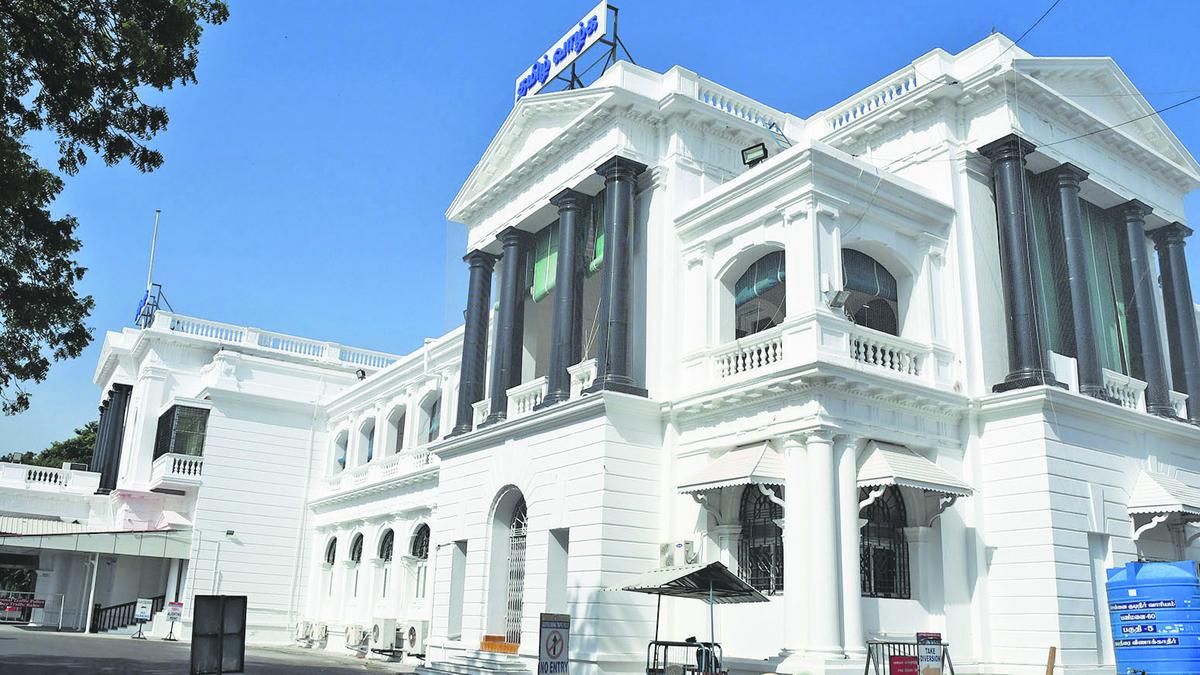
From MGR's 1983 proposal to the modern-day debates under MK Stalin, the struggle to relocate Tamil Nadu's seat of power has spanned generations.
- Fort St. George has served as the legislative seat since the colonial era.
- MGR first proposed a new structure in 1983 to accommodate a growing government.
- Jayalalithaa proposed an 'Administrative City' near Mamallapuram and a site at Queen Mary's College.
- M. Karunanidhi eventually established the complex at Omandurar Government Estate.
The 102-year-old Tamil Nadu legislature has long been anchored at Chennai’s Fort St. George, a prominent vestige of the colonial era. While the Fort has remained the primary seat of state power, the idea of shifting the Assembly-Secretariat complex has resurfaced periodically, fueled by administrative necessity and political ambition.
Historical Context: The MGR Era
The inadequacy of the Fort was first formally recognized over 40 years ago. In May 1983, the government led by M.G. Ramachandran (MGR) issued an order to construct a new structure to house the Secretariat. As the government's welfare initiatives expanded, the need for more space became evident. However, this initial attempt was eventually abandoned due to shifting political priorities.
Jayalalithaa’s Vision and the Queen Mary’s College Controversy
Nearly two decades later, MGR’s successor, J. Jayalalithaa, reignited the debate. She floated the ambitious idea of an 'Administrative City' near Mamallapuram. She argued that the existing Secretariat was 'unfit for human habitation,' noting that a significant portion of the land was controlled by the defense forces and the Archaeological Survey of India (ASI).
In 2003, Jayalalithaa proposed the 30-acre Queen Mary’s College complex as the new site. She envisioned a structure that combined the aesthetic grandeur of Bengaluru’s Vidhana Soudha with the modern interiors of New Delhi’s Vigyan Bhavan. This proposal met fierce resistance from students, heritage lovers, and educationists. Notably, then-opposition MLA M.K. Stalin supported the protesting students, leading to his arrest.
The Karunanidhi Era and the Omandurar Estate
The political pendulum swung again in May 2006 when M.K. Karunanidhi returned to office. He pivoted away from the controversial college site and chose the Omandurar Government Estate. The foundation for this massive 1.2 lakh square metre complex was laid in 2008, and it was officially inaugurated by Prime Minister Manmohan Singh in 2010.
Why This Matters
BozokMedia analysis shows that the recurring debate over the Secretariat is more than a logistical issue; it is a manifestation of the struggle between preserving colonial heritage and meeting the demands of a modern, expanding state bureaucracy. Each administration attempts to leave a physical legacy through monumental architecture.
The relocation of a state's administrative heart is a profound statement of political identity and modernization.
Frequently Asked Questions
1. Why is Fort St. George considered inadequate?
It suffers from limited space, and much of the surrounding area is under the control of the defense forces and the ASI.
2. Who built the current Omandurar Secretariat?
The complex was initiated by the M. Karunanidhi administration in 2006.

