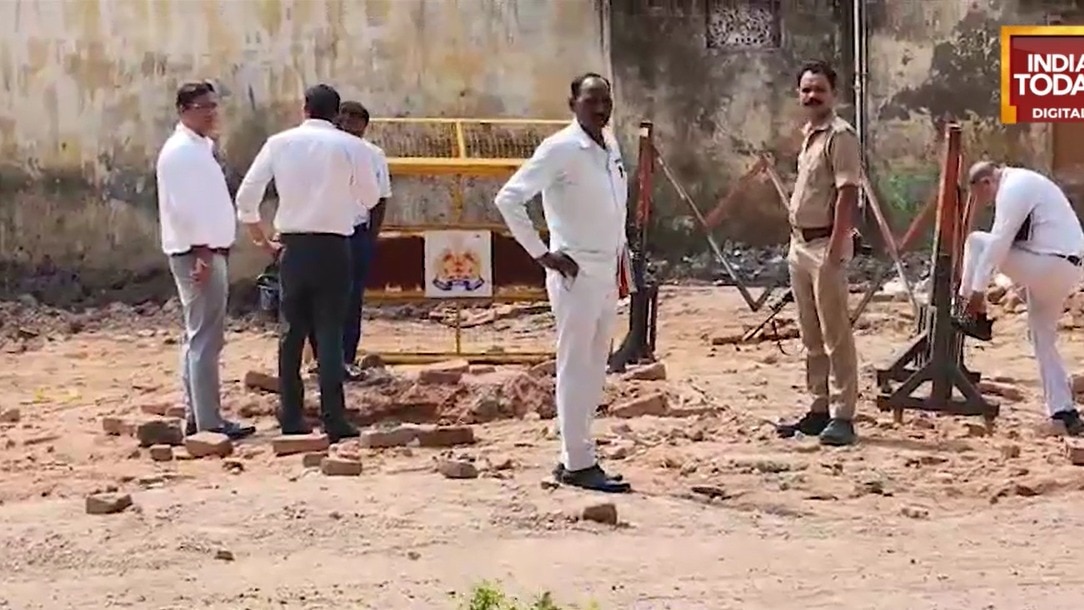
An Archaeological Survey of India (ASI) official descended 20 feet into a mysterious well-like structure discovered under a demolished mosque in Saharanpur to investigate its origins.
- A 20-foot deep, 3-foot wide structure was found beneath a mosque in Saharanpur.
- ASI officials identified the use of medieval-style Lakhori bricks.
- The structure is estimated to be between 200 to 250 years old.
- Scientific evidence is required to confirm any religious or historical links.
The mystery surrounding a structure discovered beneath a mosque in the Saharanpur Collectorate premises has intensified. Following the demolition of the mosque, an Archaeological Survey of India (ASI) official descended nearly 20 feet into a deep, well-like formation to conduct an on-site inspection.
Manoj Kumar Yadav, an Assistant Archaeological Officer from Lucknow, entered the structure using a ladder to inspect the interior. His preliminary assessment suggests that the construction, made of thin Lakhori bricks, resembles an ancient well. These specific bricks are a hallmark of late medieval and early modern Indian architecture.
Why This Matters
BozokMedia analysis shows that such discoveries often act as a catalyst for re-evaluating the urban history of a region. The presence of Lakhori bricks and lime plaster suggests a sophisticated construction method that could provide vital clues about the water management systems or architectural layouts of the 18th and 19th centuries in Uttar Pradesh.
"History cannot be written on the basis of possibilities; authentic evidence like coins or seals is essential before reaching a conclusion."
Despite the excitement, the investigation faces challenges. The interior of the 20-foot structure is currently filled with approximately three feet of soil and debris, obscuring any distinctive shapes or archaeological artifacts that could definitively identify its purpose. Traces of lime plaster have been noted, hinting at its former utility.
Historical Background
Lakhori bricks are characterized by their small, thin dimensions, which allowed architects to create intricate designs and sturdy walls using lime mortar. This style was prevalent during the Mughal era and continued through the colonial period. The estimated age of 200-250 years places this structure in a significant transitional period of Indian history.
The discovery has sparked intense local speculation, with some suggesting links to the Shahjahan era or even a former religious site. However, the ASI has maintained a strictly scientific stance, cautioning against any claims regarding religious or royal connections without tangible material proof.
| Feature | Preliminary Findings |
|---|---|
| Depth | Approximately 20 feet |
| Diameter | Approximately 3 feet |
| Material | Lakhori bricks & Lime plaster |
| Estimated Age | 200 - 250 years |
Frequently Asked Questions
1. Could this be part of a temple?
The ASI has stated that no evidence has been found yet to support any religious connection, including a temple.
2. Will there be more excavation?
A decision regarding further excavation depends on the upcoming reports and instructions from the government and district administration.