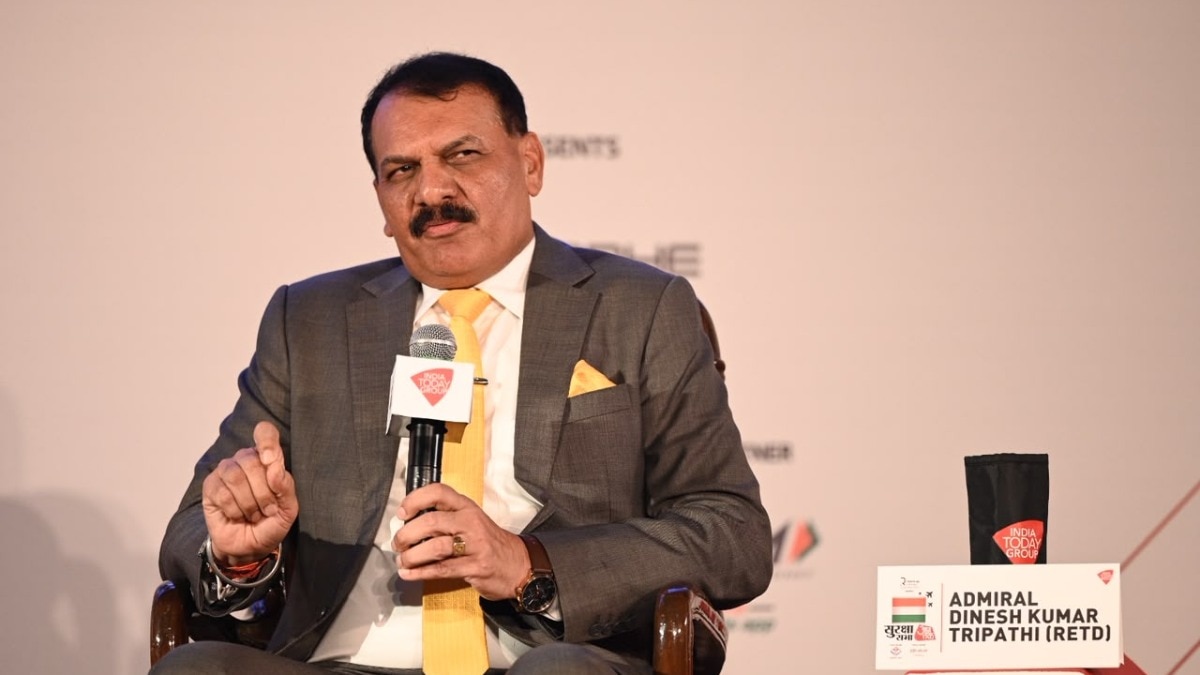
Former Chief of Naval Staff Admiral Dinesh Kumar Tripathi discusses China's growing presence in the Indian Ocean, the role of technology in modern warfare, and strategic lessons from 'Operation Sindoor'.
- China's increasing footprint in the Indian Ocean remains a persistent strategic challenge for India.
- Operation Sindoor demonstrated the critical importance of synergy between political and military leadership.
- Autonomous systems and unmanned platforms will be decisive in the wars of the future.
- Technology serves as an 'enabler'; the final decision-making must remain human-centric.
During a special session of 'Suraksha Sabha' titled 'Taqat Watan Ki', former Chief of Naval Staff Admiral Dinesh Kumar Tripathi provided a profound analysis of the Indian Navy's strategic framework and the evolving nature of naval warfare. He emphasized the imperative of keeping the Navy 'combat-ready' at all times to protect national maritime interests under any circumstances.
Operation Sindoor: A Model of Civil-Military Synergy
Reflecting on Operation Sindoor, Admiral Tripathi highlighted that the operation's success was rooted in the seamless coordination between the political executive and military command. He noted that the military leadership was granted significant operational flexibility, allowing them to determine the 'how, when, and where' of the action while maintaining a calibrated level of escalation.
The balance between political oversight and military autonomy is the cornerstone of successful strategic operations.
Why This Matters
BozokMedia analysis suggests that operations like 'Sindoor' signal India's shift from a reactive security posture to a proactive strategic stance. This synergy serves as a deterrent not only to regional adversaries like Pakistan but also to global powers like China, asserting India's role as a dominant force in the Indian Ocean Region (IOR).
The Technological Revolution in Warfare
Admiral Tripathi warned that technology is evolving faster than the human capacity to conceptualize it. Citing conflicts such as the Russia-Ukraine war and the Armenia-Azerbaijan clash, he pointed out the increasing reliance on unmanned platforms and autonomous systems, which have fundamentally altered traditional combat dynamics.
He revealed that the Indian Navy anticipated this shift as early as 2005, introducing B.Tech degrees into officer training to ensure that the leadership is technologically savvy and capable of handling high-tech warfare environments.
| Feature | Traditional Warfare | Modern Warfare |
|---|---|---|
| Decision Speed | Slow and Hierarchical | Rapid and Data-Driven |
| Primary Assets | Manned Ships/Aircraft | Drones & Autonomous Systems |
| Strategy | Direct Engagement | Grey Zone & Hybrid Warfare |
Human Intelligence vs. Artificial Intelligence
Despite the surge in automation, Admiral Tripathi maintained that technology must be viewed as an 'enabler' rather than a replacement for human judgment. While sensors and networks provide critical inputs and accelerate the decision cycle, the final command to engage a target must remain a human decision.
Frequently Asked Questions
Q1: What was the primary lesson from Operation Sindoor?
A: The operation underscored that close coordination between political and military leadership, coupled with operational freedom for commanders, is essential for mission success.
Q2: How will technology impact future naval battles?
A: Future battles will be characterized by the use of autonomous systems and unmanned platforms, though strategic oversight will remain firmly in human hands.