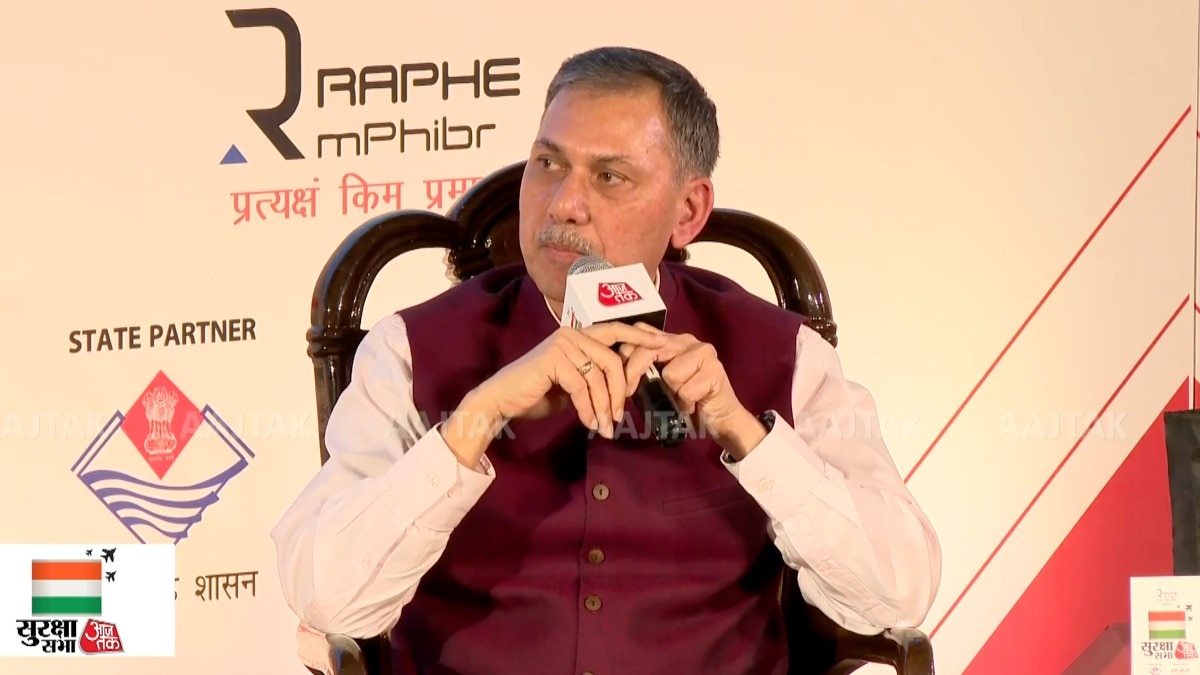
Former IAF Vice Chief Air Marshal Narmadeshwar Tiwari warns that space-based systems are transitioning from supporting roles to becoming the central command of future conflicts. Citing the Russia-Ukraine war, he highlights how satellite constellations and AI are redefining combat edges.
- Space is evolving from a supporting utility to the primary driver of modern warfare.
- The Russia-Ukraine conflict proves that satellite connectivity (like Starlink) is a decisive combat factor.
- Miniaturization and AI are enabling a 'mesh' network of autonomous drones and naval systems.
At the Aaj Tak Suraksha Sabha, Air Marshal Narmadeshwar Tiwari (Retd), the 49th Vice Chief of the Indian Air Force, delivered a stark assessment of the evolving nature of global conflict. He asserted that the next great war will not merely be supported by space assets but will be actively led and guided from space, marking a paradigm shift in military strategy.
Drawing parallels from the ongoing Russia-Ukraine war, Air Marshal Tiwari emphasized that space-based connectivity has become the backbone of modern resilience. He specifically pointed to Starlink, noting that Ukraine's ability to maintain operational command despite the destruction of ground-based infrastructure is almost entirely due to satellite networks. This shift demonstrates that whoever controls the orbital layer controls the flow of information on the ground.
Why This Matters
BozokMedia analysis shows that the shift toward Low Earth Orbit (LEO) constellations is creating a new 'arms race' in space. When connectivity becomes a weapon, the vulnerability of satellites becomes a primary strategic weakness. The integration of AI and autonomous platforms means that a single orbital failure could potentially blind an entire army, making space security as critical as border security.
The former Vice Chief also highlighted the 'dark side' of this technology, mentioning how smuggled satellite terminals have been used to coordinate drone strikes, forcing nations to implement strict whitelisting and digital restrictions to prevent non-state actors or adversaries from hijacking these networks.
"The space segment will not be a supporter in the next war. It will be the main player in warfare."
According to Air Marshal Tiwari, the acceleration of this trend is driven by the convergence of artificial intelligence, increased computing power, and miniaturization. He explained that the era of massive tracking dishes is over; modern terminals are now the size of laptops and can scan signals electronically.
This technological leap allows for the creation of a 'combat mesh.' Imagine a scenario where an unmanned aerial vehicle (UAV) identifies a target and communicates in real-time via satellite to an unmanned surface vessel hundreds of kilometers away at sea. This interconnected ecosystem of autonomous platforms creates a seamless, lethal network that operates with minimal human intervention.
Frequently Asked Questions
Q1: How did Starlink change the Russia-Ukraine war?
A1: It provided a redundant, space-based communication network that allowed Ukrainian forces to coordinate attacks and maintain command even after their terrestrial towers were destroyed.
Q2: What is a 'Combat Mesh' in the context of space warfare?
A2: It is a network where satellites, drones, and autonomous sea/land vehicles communicate directly with each other to execute missions without needing a central ground-based hub.