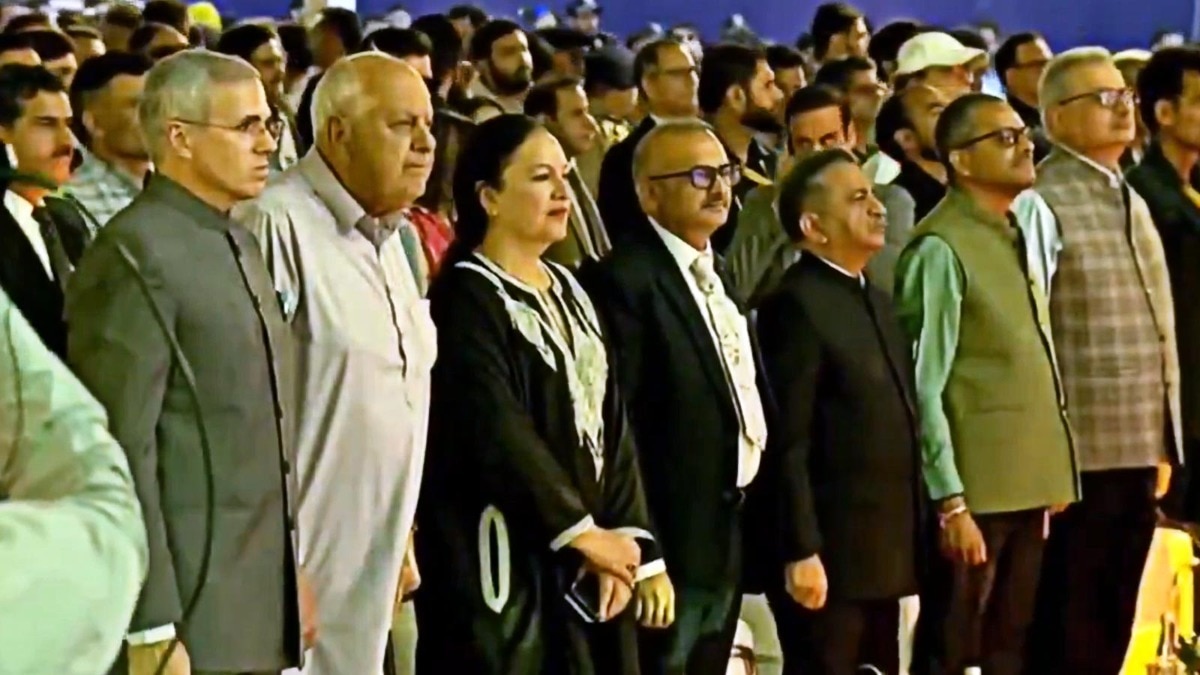
In a significant departure from the Congress party's long-standing position, CM Omar Abdullah and Farooq Abdullah stood for the entire six stanzas of 'Vande Mataram' at the Srinagar Film Festival, sparking a debate on ideological unity within the INDIA bloc.
- CM Omar Abdullah and Farooq Abdullah stood for the full duration of 'Vande Mataram' at the Srinagar International Film Festival.
- The Congress party adheres to a 1937 resolution limiting the song to the first two stanzas.
- The event highlighted a clear divergence in perspective between two key allies of the INDIA coalition.
- The Abdullah family followed the latest Ministry of Home Affairs guidelines for the national song.
The inaugural Srinagar International Film Festival has unexpectedly become the center of a national political debate. During the protocol-mandated playing of the national song, 'Vande Mataram', Chief Minister Omar Abdullah and former CM Farooq Abdullah remained standing throughout the entire composition. This act stands in stark contrast to the official stance of the Indian National Congress, their ally in the INDIA coalition.
Adhering to the latest guidelines issued by the Ministry of Home Affairs, the Abdullah family and other dignitaries stood for the full duration of 3 minutes and 10 seconds. The visual of the Abdullahs standing in the front row, showing full respect to the national song, has since gone viral, raising questions about the internal ideological coherence of the opposition alliance.
Why This Matters
BozokMedia analysis shows that this is more than a mere formality; it is a symbolic shift in the political optics of Jammu and Kashmir. While the Congress party maintains that its 1937 resolution to limit the song to two stanzas was intended to preserve communal harmony, the National Conference's (NC) decision to embrace the full version suggests a move toward a more integrated national identity. This creates a visible 'ideological gap' within the INDIA bloc on the issue of national symbols.
The National Conference's acceptance of the full Vande Mataram may be a calculated move to signal a new era of mainstream integration for the valley.
The controversy was further ignited by recent events in Delhi, where Sonia Gandhi reportedly expressed displeasure during an Independence Day celebration at the Congress headquarters when the singers proceeded beyond the first two stanzas. The Congress continues to defend its historical decision as a measure of inclusivity.
Journalist Zafar Choudhary pointed out the irony of the situation, noting that while Delhi is embroiled in a dramatic debate over how much of the song should be sung, Kashmir has settled the matter effortlessly. He described the event as 'just music,' devoid of the political drama typically seen on television news channels.
| Entity | Congress Party Stand | National Conference (NC) Stand |
|---|---|---|
| Duration of Song | First two stanzas only (1937 Resolution) | Full song (All six stanzas) |
| Core Rationale | Communal harmony and historical precedent | Protocol adherence and national honor |
| Recent Action | Sonia Gandhi's objection to full singing | Omar Abdullah standing for the full song |
Frequently Asked Questions
Q1: Why does the Congress party limit the singing of Vande Mataram?
The party refers to a 1937 Working Committee resolution that adopted the shorter version to maintain communal harmony across diverse sections of society.
It signals a divergence from the Congress's cautious approach and suggests that the National Conference is aligning more closely with current national protocols.