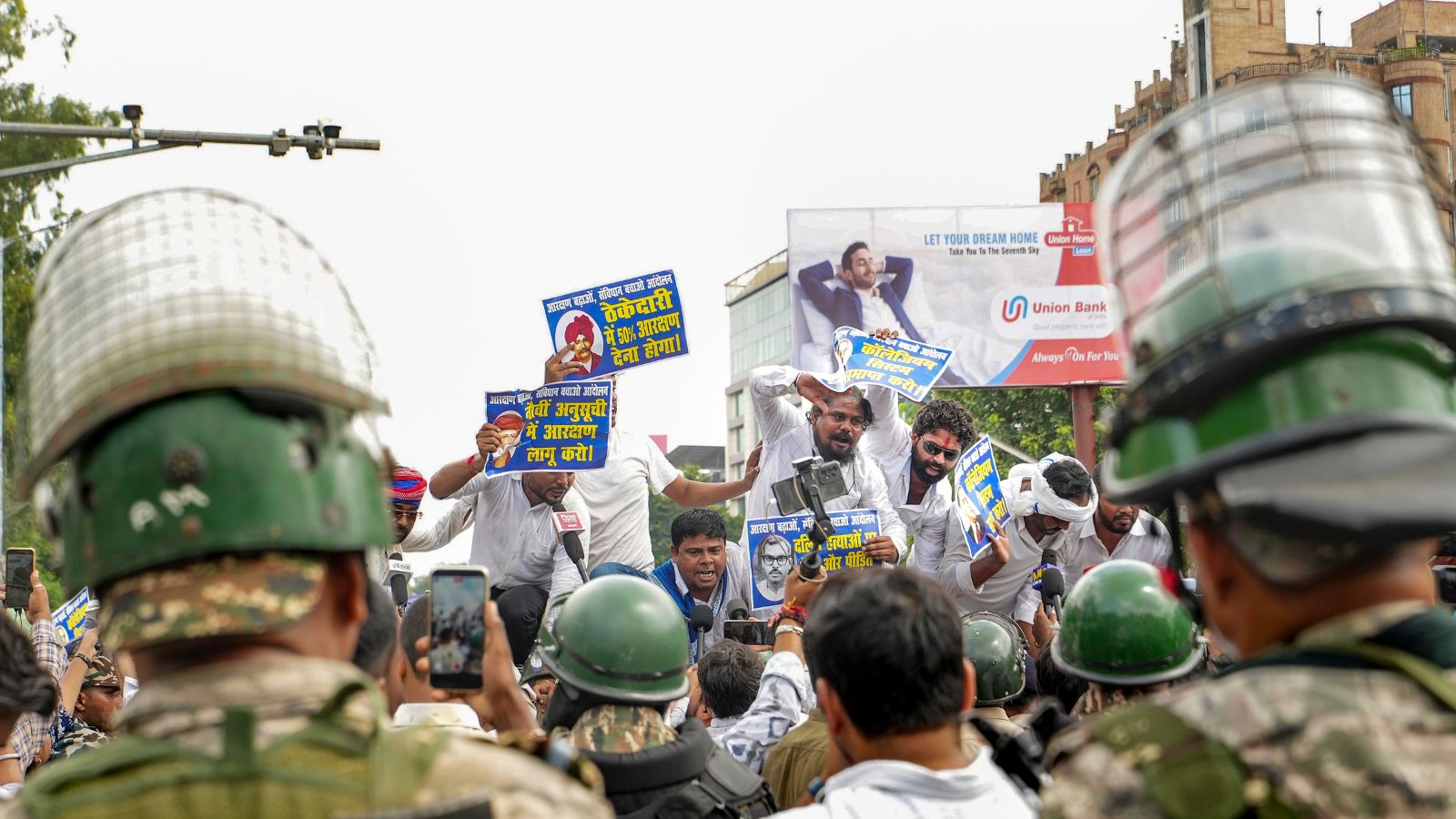
Hundreds of Dalit and OBC activists clashed with police in Patna while demanding the restoration of a 65% reservation ceiling. The protest highlights a growing legal and social battle over caste-based quotas in Bihar.
- Protesters demand a 65% reservation quota, challenging the current 50% limit.
- The 'Arakshan Badhao Samvidhan Bachao Sangharsh Samiti' led the march from Gandhi Maidan.
- Police deployed personnel from 20+ stations to block the march toward Raj Bhavan.
- Key demands include private sector reservation and legal immunity via the Ninth Schedule.
The streets of Patna turned into a battlefield of ideologies on Tuesday as hundreds of activists from Scheduled Caste (SC) and Other Backward Class (OBC) organizations converged to demand a significant increase in reservation quotas. The protesters, organized under the banner of the 'Arakshan Badhao Samvidhan Bachao Sangharsh Samiti', sought the implementation of a 65% quota, arguing that the existing 50% ceiling is insufficient to represent the state's demographic reality.
Led by prominent Dalit rights activist Amar Paswan Azad, the march began at the historic Gandhi Maidan. However, the momentum was halted at Dak Bungalow Chowk, where the Bihar Police had erected massive iron barriers and makeshift gates. In a bid to maintain law and order, security forces from over 20 police stations were deployed, resulting in the detention of seven activists who were later released after tensions subsided.
Why This Matters
BozokMedia analysis shows that this is not merely a local protest but a systemic clash between judicial mandates and political promises. The 65% quota was a landmark move by the government of former CM Nitish Kumar following the 2022-23 Caste Survey. However, the Patna High Court declared this move unconstitutional in 2024, and the Supreme Court's refusal to stay that order has left a vacuum that activists are now trying to fill through street agitation.
The demand to place the quota in the Ninth Schedule is a strategic legal move to shield the policy from judicial review, mirroring historical attempts to protect land reforms.
Beyond the percentage increase, the protesters raised critical socio-economic grievances. They demanded an immediate end to the diversion of SC/ST sub-plan funds and called for a halt to 'bulldozer actions' targeting Dalit households. Furthermore, the movement is pushing for 50% reservation in contractual works and promotion quotas for SC/ST employees to ensure upward mobility within the government machinery.
The current reservation structure in Bihar remains a point of contention. The state currently provides 16% to SCs, 1% to STs, 18% to Extremely Backward Classes, 12% to OBCs, and 3% to Backward Class women. Protesters argue that these figures do not reflect the actual population density revealed by the recent caste census.
| Category | Current Quota (%) | Proposed/Demanded (%) |
|---|---|---|
| Overall Ceiling | 50% | 65% |
| Scheduled Castes | 16% | Increased Proportion |
| Extremely Backward Classes | 18% | Increased Proportion |
Frequently Asked Questions
Q1: Why was the 65% quota declared unconstitutional?
The Patna High Court ruled that exceeding the 50% ceiling set by the Supreme Court in the Indra Sawhney case is unconstitutional unless extraordinary data justifies it.
Q2: What is the role of the 'Arakshan Badhao Samvidhan Bachao Sangharsh Samiti'?
It is a coalition of Dalit and OBC rights organizations fighting for increased representation and constitutional protections for marginalized castes.