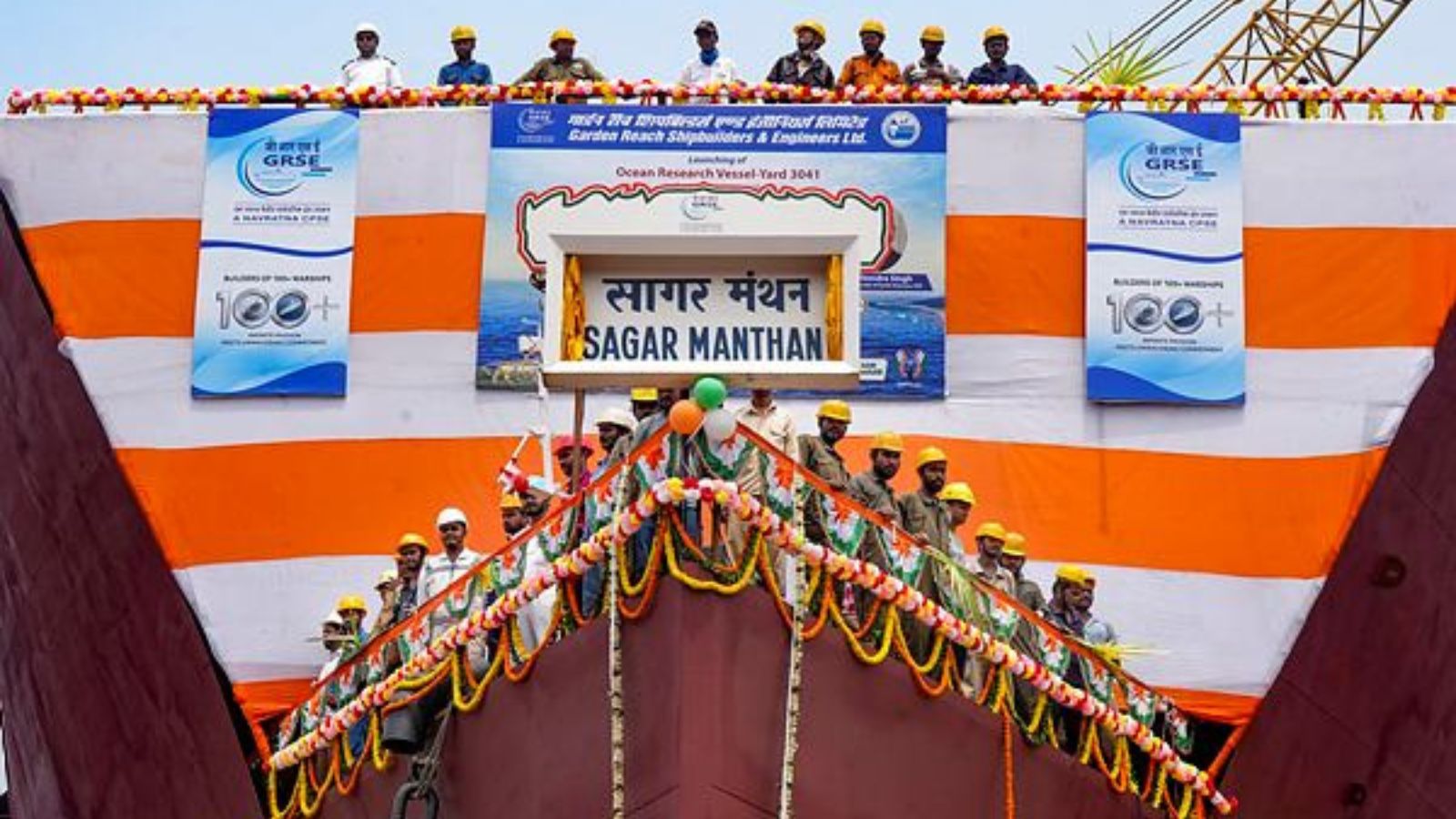
The Kolkata-based GRSE has launched the indigenous ocean research vessel 'Sagar Manthan' for the Ministry of Earth Sciences, significantly boosting India's deep-sea exploration capabilities.
- Indigenous ORV 'Sagar Manthan' launched by GRSE for the National Centre for Polar and Ocean Research (NCPOR).
- The ₹840-crore vessel is designed for deep-sea surveys up to 6 km depth.
- Expected to be fully operational by early 2028 as part of the 'Deep Ocean Mission'.
In a landmark achievement for India's maritime engineering, Garden Reach Shipbuilders and Engineers (GRSE) Ltd in Kolkata launched the Ocean Research Vessel (ORV) 'Sagar Manthan' on Wednesday. Built for the National Centre for Polar and Ocean Research (NCPOR) under the Union Ministry of Earth Sciences, this vessel is poised to revolutionize India's approach to deep-sea scientific exploration.
The vessel, which carries a price tag of ₹840 crore, is a massive engineering feat. Measuring 89.5 meters in length and 18.8 meters in width, with a gross tonnage of 5,900 tonnes, 'Sagar Manthan' can reach speeds of up to 14 knots. The launch ceremony was graced by the families of Dr. Jitendra Singh, MoS for Science and Technology, and Dr. Srinivas Kumar Tummala, Secretary of the Ministry of Earth Sciences.
Why This Matters
BozokMedia analysis shows that the deployment of 'Sagar Manthan' is a strategic pivot toward securing India's interests in the 'Blue Economy'. By enhancing the ability to map the seabed and identify polymetallic nodules, India is positioning itself as a global leader in marine biotechnology and sustainable resource extraction, reducing dependence on foreign research infrastructure.
The launch of 'Sagar Manthan' epitomizes India's transition from a buyer to a builder of complex scientific platforms, ensuring strategic autonomy in oceanography.
The operational capabilities of the ORV are extensive. It is designed to conduct underway swath multibeam and geophysical seismic surveys in coastal and deep waters at depths of up to 6 km. Additionally, the vessel will perform conductivity, temperature, and depth (CTD) profiling, alongside biological sampling using advanced vertical and horizontal netting methods.
Beyond basic sampling, the vessel will handle surface and deep-sea mooring, data buoy operations, and seabed sampling using corers, grabs, and chain bag dredges. It will also function as a floating laboratory, allowing scientists to conduct real-time analytical work and data processing on board, while providing training to the next generation of oceanographers.
A critical feature of 'Sagar Manthan' is its ability to launch and recover Autonomous Underwater Vehicles (AUVs) and Remotely Operated Vehicles (ROVs). These high-tech drones, developed by the National Institute of Ocean Technology (NIOT), will allow India to explore the most inhospitable depths of the ocean floor without risking human life.
GRSE's track record in this sector is formidable. Having built survey ships for the Indian Navy since the 1980s, including the INS Sagardhwani, the shipyard has evolved into a hub for specialized vessels. Currently, GRSE is managing a diverse portfolio of 9 warships and 32 other platforms, including significant export orders, further cementing its role in the 'Atmanirbhar Bharat' initiative.
| Specification | Details |
|---|---|
| Project Cost | ₹840 Crore |
| Dimensions | 89.5m (L) x 18.8m (W) |
| Max Survey Depth | 6 Kilometers |
| Delivery Timeline | Early 2028 |
Frequently Asked Questions
1. What is the primary role of the ORV Sagar Manthan?
Its primary role is to conduct deep-sea exploration, geophysical surveys, and scientific research under the 'Deep Ocean Mission' of the Government of India.
2. When will the vessel be ready for deployment?
The vessel is expected to be completed and ready for use by early 2028.