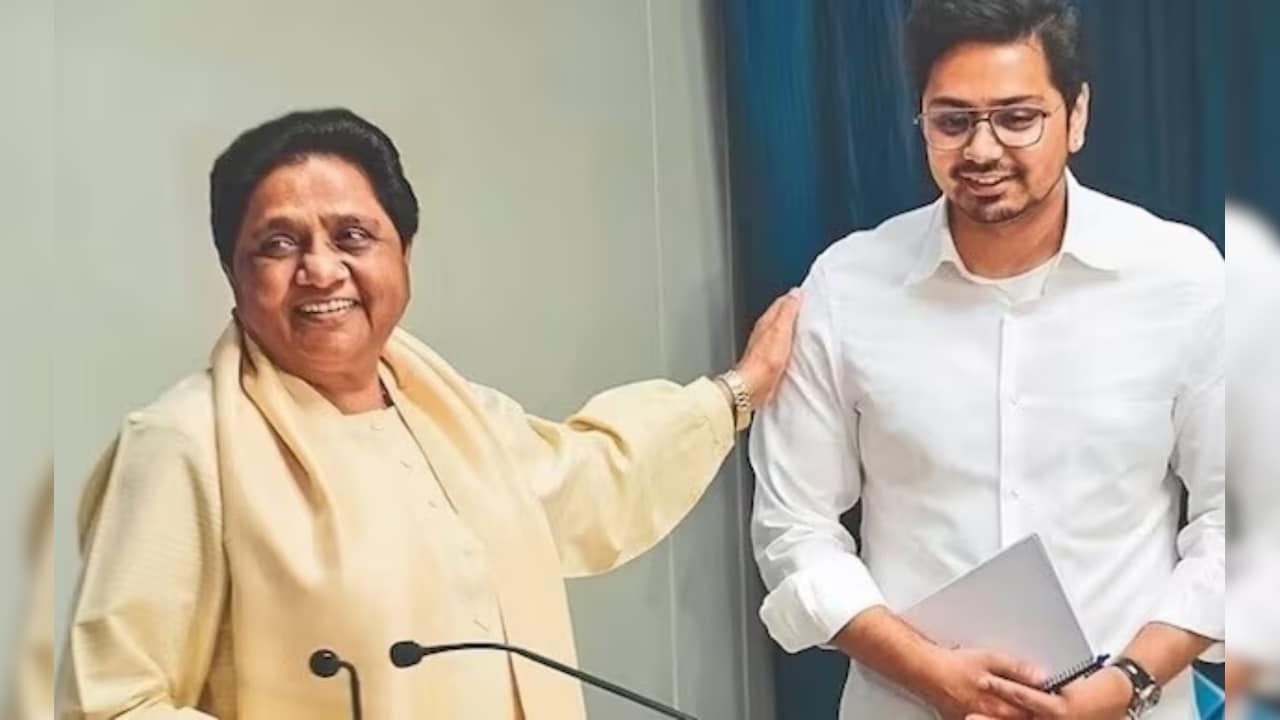
BSP Chief Mayawati has reportedly imposed a stringent condition on her nephew Akash Anand for his return to the party, targeting his father-in-law's influence. This move signals a deep internal rift within the Bahujan Samaj Party's leadership.
- Mayawati demands 'Sanyas' (renunciation) from Akash Anand's father-in-law as a condition for return.
- The father-in-law was previously expelled from the BSP in August.
- The conflict highlights a struggle for control and ideological purity within the party.
The internal dynamics of the Bahujan Samaj Party (BSP) have taken a dramatic turn as party chief Mayawati sets a hardline condition for the return of her nephew and former party face, Akash Anand. Sources indicate that the BSP supremo is unwilling to allow Anand back into the fold unless his father-in-law, who was expelled from the party in August, accepts a state of 'Sanyas' or total political detachment.
This ultimatum comes after a period of visible tension between the aunt and nephew, who were once seen as the primary architects of the party's future strategy. The expulsion of the father-in-law in August served as a precursor to this current standoff, suggesting that Mayawati views his influence over Akash Anand as a threat to her absolute authority and the party's core organizational structure.
Why This Matters
BozokMedia analysis shows that this is not merely a family dispute but a strategic power struggle. By demanding 'Sanyas' from the father-in-law, Mayawati is effectively testing Akash Anand's loyalty. If Anand chooses his family ties over the party's mandate, it could lead to a permanent schism in the BSP, potentially alienating the younger cadre that looked up to Anand as a modernizing force.
The BSP's survival depends on a seamless transition of leadership, but Mayawati's insistence on absolute loyalty over familial ties creates a precarious vacuum.
Historically, the BSP has operated under a centralized command structure. Mayawati's leadership style has always been characterized by a zero-tolerance policy toward dissent. The inclusion of Akash Anand was initially seen as a way to rejuvenate the party's image, but the subsequent fallout proves that the 'sycophancy' culture of the BSP remains intact, even for close relatives.
The broader regional implications are significant. With other parties like the SP and BJP consolidating their hold over the Dalit vote bank, an internally fractured BSP may find it impossible to regain its former glory in the upcoming electoral cycles. The 'Sanyas' condition is a symbolic move to purge any external influence that could steer the party away from Mayawati's vision.
Frequently Asked Questions
Q1: Why was Akash Anand's father-in-law expelled from the BSP?
While specific reasons weren't detailed in the official notice, it is widely believed to be due to disciplinary issues and perceived interference in party affairs.
Q2: Will Akash Anand return to the BSP?
His return depends on whether he is willing to accept Mayawati's condition regarding his father-in-law's political renunciation.


