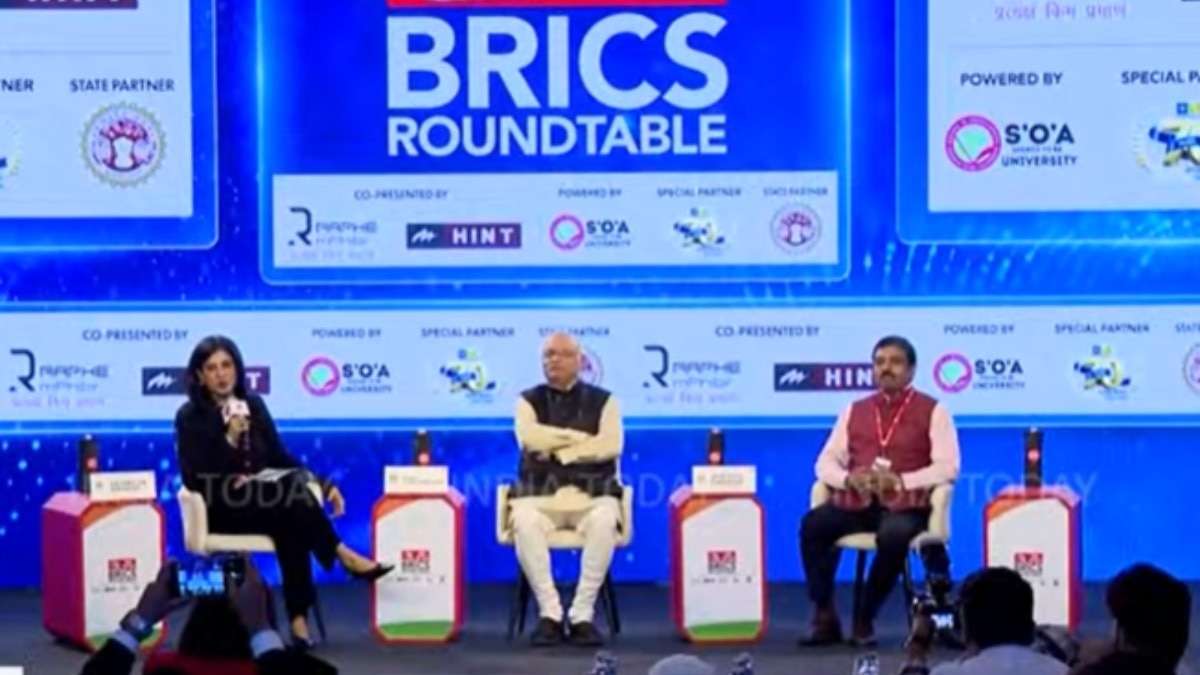
BJP leader Vinay Sahasrabuddhe asserts that BRICS nations are actively rejecting a unipolar world order, advocating for the use of local currencies to end the hegemony of the US dollar.
- BRICS nations are actively moving away from a single-superpower global order.
- The shift to Rupee-Ruble trade is a strategic rejection of hegemonic thinking.
- BRICS now controls nearly 40% of global GDP and represents 50% of the world's population.
Vinay Sahasrabuddhe, a member of the BJP national executive and president of the Asiatic Society of Mumbai, has stated that BRICS countries are systematically rejecting a global order dominated by a single superpower. He argued that no single currency should maintain absolute dominance over global trade and economic affairs, calling for a more diverse international economic landscape.
Speaking at the India Today BRICS Roundtable 2026, Sahasrabuddhe highlighted the strategic transition in India-Russia trade. He noted that the move from the US dollar to the rupee-ruble mechanism is not merely a financial adjustment but a broader ideological rejection of 'hegemonic thinking' in global relations.
Why This Matters
BozokMedia analysis shows that the push for de-dollarization is a response to the weaponization of finance. By diversifying reserve currencies and trade mechanisms, BRICS nations are insulating themselves from unilateral sanctions and the volatility of US monetary policy, effectively shifting the center of gravity from the West to the Global South.
“What we are witnessing is a rejection of hegemonic thinking in global relations - one becoming the superpower and others listening to them.”
The discussion underscored that every nation possesses its own aspirations and seeks an equitable seat at the table of global politics. This shift occurs amidst extreme geopolitical volatility, including the Russia-Ukraine conflict, instability in West Asia, and escalating trade wars involving tariffs.
The sheer scale of BRICS' influence was emphasized during the forum. With the bloc representing nearly 50 percent of the world's population, 40 percent of global GDP, and 26 percent of global trade, its capacity to redefine economic norms is unprecedented.
Interestingly, Sahasrabuddhe connected this economic shift to the "democratisation of cartography." He critiqued the Mercator projection, noting that it historically exaggerated the size of the Northern Hemisphere, while the Southern Hemisphere is significantly larger in reality—a metaphor for the overlooked power of the Global South.
| Feature | Traditional Order (Unipolar) | BRICS Vision (Multipolar) |
|---|---|---|
| Primary Currency | US Dollar (USD) | Diversified Local Currencies |
| Power Dynamic | Single Superpower Dominance | Equitable Distribution of Power |
| Trade Focus | Western-Centric Policies | South-South Cooperation |
Frequently Asked Questions
Q1: What is the Rupee-Ruble mechanism?
It is a bilateral trade agreement allowing India and Russia to settle payments in their own currencies, bypassing the US dollar.
Q2: Why is BRICS pushing for a new global order?
To reduce dependence on a single superpower and ensure that global economic and political decisions reflect the current demographic and GDP weight of emerging economies.