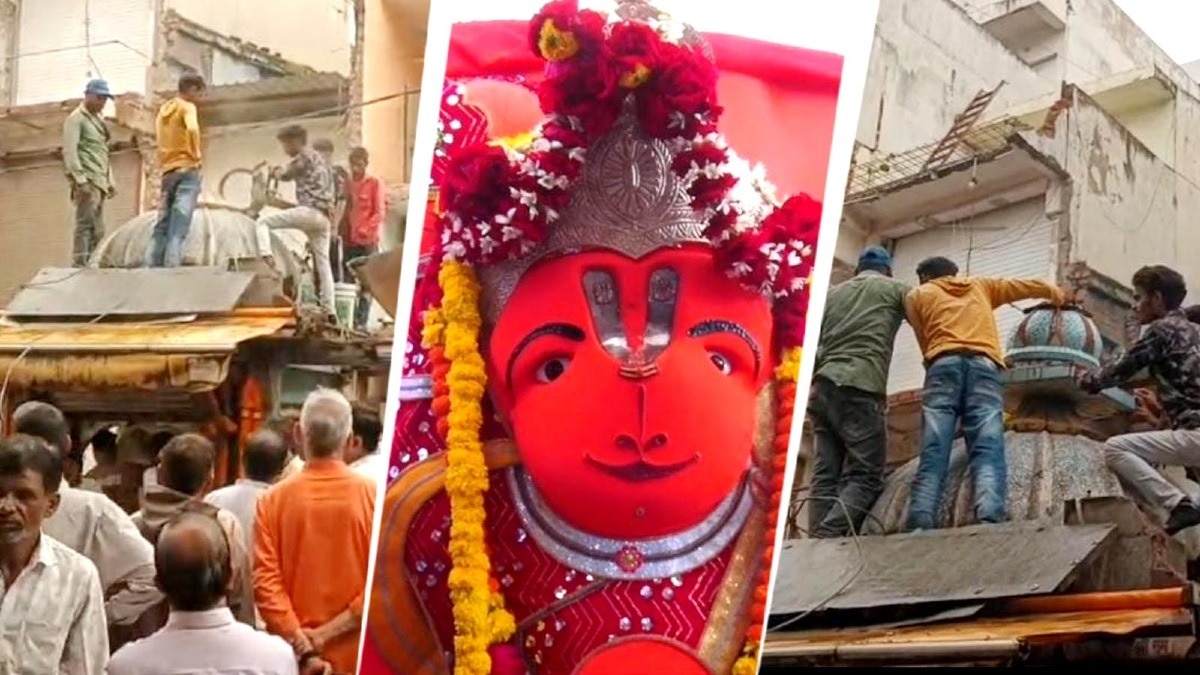
Amid preparations for Simhastha 2028 in Ujjain, a controversy erupted over claims that a Hanuman idol refused to move. While devotees call it a divine miracle, the administration has now denied any attempt to relocate the deity.
- The boundary wall of a 170-year-old Hanuman temple was demolished for road widening ahead of Simhastha 2028.
- Devotees claim the idol remained immovable despite attempts to shift it, labeling it a divine miracle.
- The district administration and SDM have officially denied any attempt to relocate the idol.
- The Archaeology Department is investigating the idol, which may be up to 1,000 years old.
In the spiritual heart of Madhya Pradesh, Ujjain, a clash between urban development and religious faith has sparked a massive debate. As part of the infrastructure upgrades for the Simhastha Mahakumbh 2028, road widening is underway from Kanthal Chauraha to Chhatri Chowk. During this process, parts of a 170-year-old standing Hanuman temple were demolished, leading to a volatile situation.
Reports quickly spread among locals and on social media that the administration attempted to move the idol of Lord Hanuman, but the deity remained immovable. This phenomenon has been hailed as a divine miracle by thousands of devotees, leading to a surge in visitors to the temple. The issue soon took a political turn, with Congress leaders and workers protesting with saffron flags, demanding that the idol remain in its original position.
Why This Matters
BozokMedia analysis shows that this incident highlights the delicate balance between urban infrastructure development and deep-rooted religious sentiments in India. In cities like Ujjain, where every stone has a spiritual narrative, any administrative action perceived as 'anti-faith' can quickly escalate into a socio-political movement, forcing the government to backtrack.
"When faith clashes with administration, a lack of communication often fuels controversy; the claim of a miracle here is a reflection of the intensity of public emotion."
The religious community has also stepped in. Prominent saints, including Mahant Raghavendra Das and Mahant Vineet Giri, emphasized that while development is necessary, it should not be built upon the ruins of faith. They have urged the administration to prioritize dialogue and respect the emotional connection the local population has with the temple.
Adding another layer to the story, the Archaeology Department has begun an investigation into the idol's antiquity. Preliminary assessments suggest the statue could be approximately 1,000 years old. If proven, the idol would transition from a point of religious faith to a protected historical artifact, making its relocation legally and ethically complex.
Frequently Asked Questions
Q1: What is the administration's official stance on the idol's removal?
A: The district administration and SDM have clarified that no attempt has been made to move or relocate the idol.
Q2: Is the idol historically significant?
A: Yes, the Archaeology Department is investigating, and it is suspected to be around 1,000 years old.

