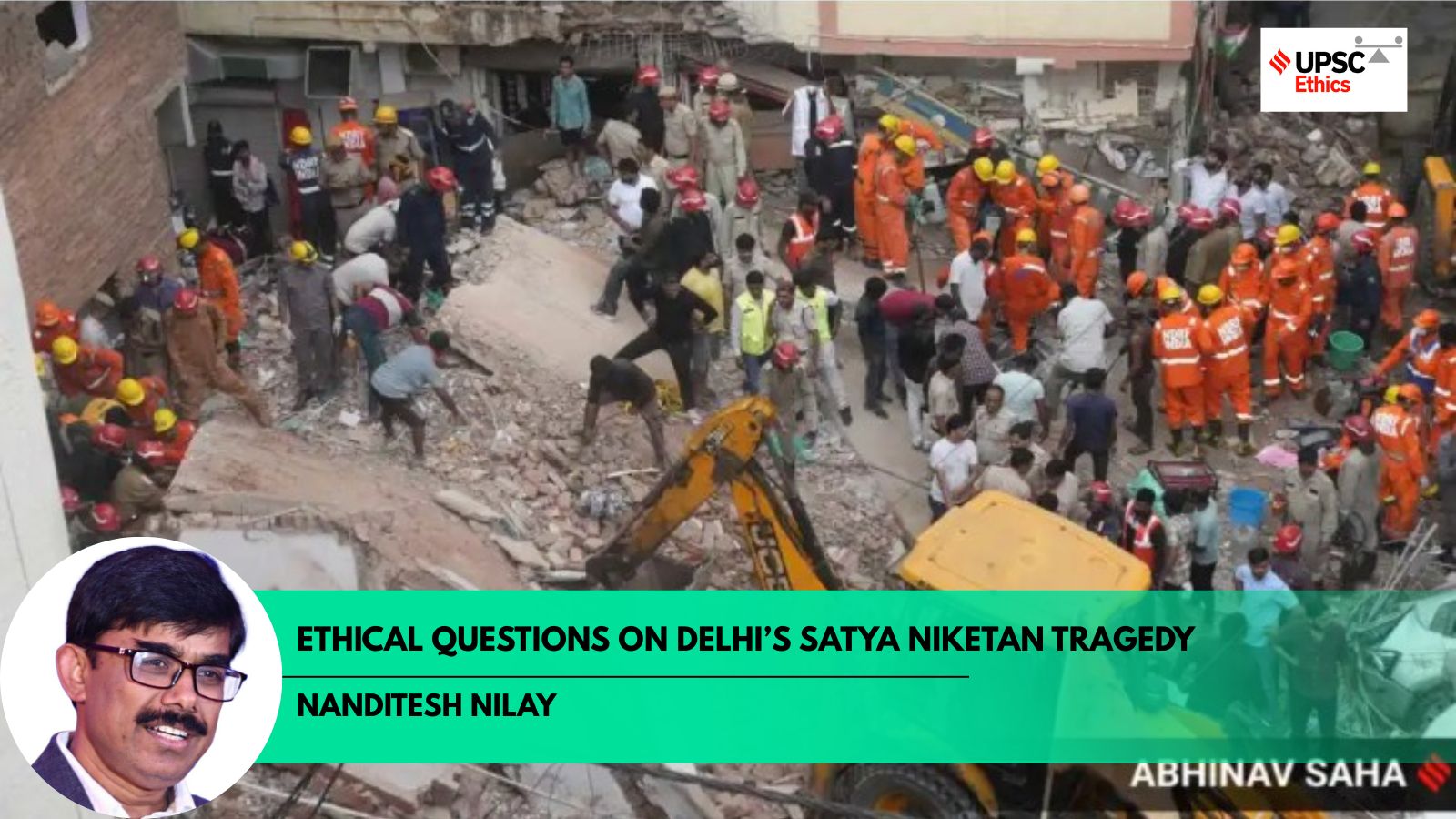
The tragic building collapse in Delhi's Satya Niketan serves as a profound case study for UPSC Ethics, highlighting the intersection of administrative negligence, socioeconomic vulnerability, and institutional accountability.
- The Satya Niketan tragedy highlights systemic failures in urban governance and safety regulation.
- The concept of 'Hobson’s Choice' illustrates the constrained decision-making of vulnerable students.
- Public service ethics must transcend mere rule-following to encompass proactive compassion and accountability.
The recent tragedy in Satya Niketan, Delhi, where a five-storey building converted into a student hostel collapsed, resulting in multiple fatalities, is more than just a structural failure. For students preparing for the Civil Services, it represents a profound ethical dilemma regarding the conditions under which human aspirations exist.
Hobson’s Choice and the Vulnerability of Aspirants
At the heart of this tragedy lies the concept of 'Hobson’s Choice'. For many aspirants, the choice is not between safety and danger, but between accepting substandard, risky accommodation or facing financial ruin. When all realistic alternatives carry inherent risks, the concept of 'choice' becomes an illusion. This vulnerability is often invisible to the state until a catastrophe makes it glaringly obvious.
Why This Matters
BozokMedia analysis shows that the intersection of economic necessity and regulatory negligence creates a 'danger zone' for the youth. When students are forced by limited resources into unsafe living conditions, the state's failure to regulate these spaces becomes a direct violation of the social contract and the ethical duty to protect the vulnerable.
Compassion is more than being nice; it is about quieting the 'monkey mind' and considering the most hopeful perspective regarding another person.
Drawing from the philosophy of writer George Saunders, compassion requires awareness and attention. The Satya Niketan incident reveals a catastrophic lack of both in our administrative and institutional frameworks. The absence of 'administrative compassion'—the proactive effort to prevent harm—is what turned a building into a death trap.
Institutional Accountability vs. Rule-Following
A critical question for any public administrator is: Where does responsibility lie when rules exist but fail to protect life? The ethical duty of the State is not merely to draft regulations, but to ensure their effective implementation. Public administration cannot be reduced to the mechanical enforcement of codes; it must be driven by the 'Ethics of the Sovereign Good'—the pursuit of what is ultimately beneficial for society.
The gap between stated values (integrity, compassion, responsibility) and actual conduct is evident in the recurring nature of such tragedies. Whether it is fire safety, structural integrity, or drainage issues, the failure often lies in what was not done—the administrative inaction and the tendency to ignore warning signs in favor of convenience or economic interests.
Frequently Asked Questions
1. How does this tragedy relate to the UPSC Ethics paper?
It provides a real-world context for studying concepts like accountability, administrative negligence, and the ethical dilemmas faced by vulnerable populations.
2. What is the difference between rules and ethical governance?
Rules are formal guidelines, while ethical governance involves the proactive application of values like compassion and responsibility to ensure those rules actually serve the public good.