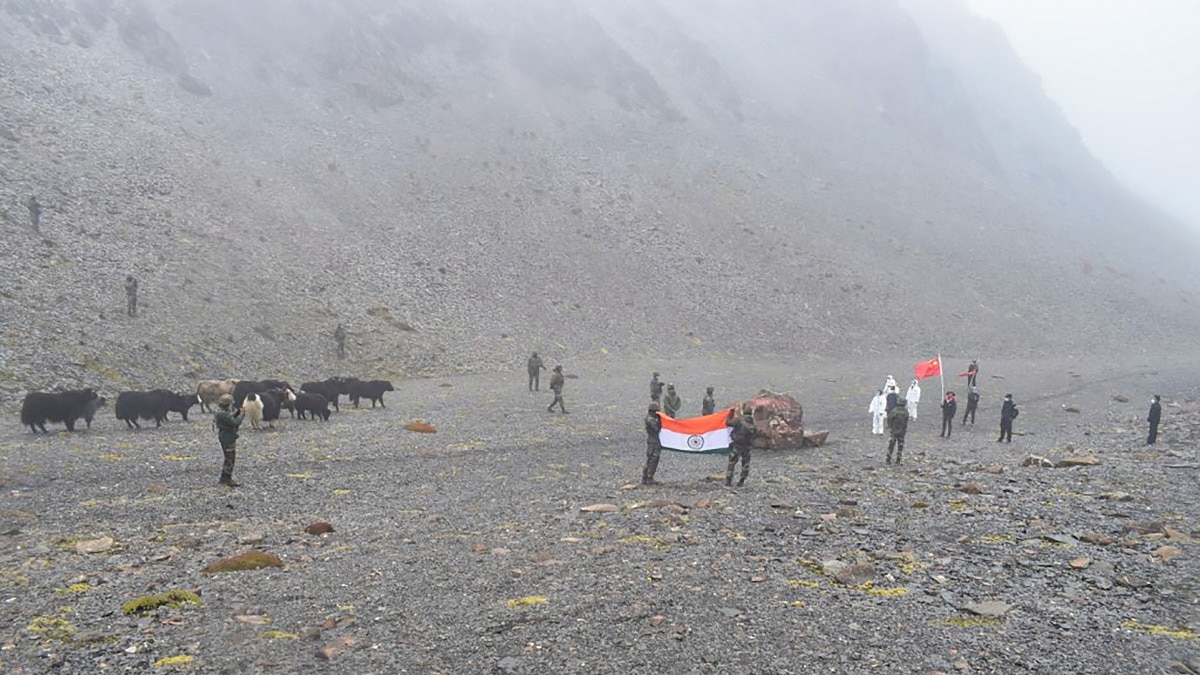
The Indian Army's Annual Report 2025-26 reveals a significant reduction in Chinese PLA deployment along the LAC. Improved military dialogues and diplomatic engagements have contributed to enhanced border stability.
- China has reduced its PLA deployment to approximately 10 Combined Arms Brigade-sized forces along the LAC.
- Resumption of military dialogues, including Corps Commander meetings, has improved border stability.
- The Indian Army maintains a robust deployment to counter any emerging contingencies.
- A surge in drone intrusions (863 incidents) has been reported along the western border.
New Delhi: In a significant development, the Indian Army's Annual Report 2025-26 has revealed that China’s People’s Liberation Army (PLA) has significantly scaled down its troop deployment along the Northern Borders. According to the report, around 10 Combined Arms Brigade-sized forces are now positioned opposite the Line of Actual Control (LAC) and in traditional training areas, marking a shift from previous high-tension periods.
Diplomatic Breakthroughs and Military Dialogue
The report attributes the improved stability along the Northern Borders to positive political, diplomatic, and military engagements between India and China. A key milestone was the 23rd Corps Commander-level meeting held in Eastern Ladakh in October 2025. Furthermore, Border Personnel Meetings (BPM) have continued across all sectors in a cordial environment, providing a vital mechanism for both nations to address localized concerns.
The resumption of high-level military dialogues serves as a critical de-escalation tool in the complex India-China border standoff.
Lessons from Operation Sindoor
The Army highlighted the strategic lessons derived from Operation Sindoor, which showcased India’s multi-domain capability, intelligence dominance, and technological edge. Following the operation, the Indian Army initiated a comprehensive review of capability gaps, focusing on force restructuring, enhanced jointness, and the rapid induction of emerging technologies to maintain a qualitative edge.
Security Situation in Jammu & Kashmir
Regarding Jammu and Kashmir, the Army stated that the security situation remains "firmly under control." The report noted a decline in violence and protests, with zero incidents of stone pelting recorded during the year. However, while infiltration attempts along the Line of Control (LoC) have declined, the Army observed a shift in terrorist tactics toward the International Border, focusing on the smuggling of narcotics and war-like stores.
The Growing Drone Threat
A major concern highlighted in the report is the surge in unmanned aerial vehicle (UAV) activity. A total of 863 drone intrusions were reported in 2025, with the vast majority occurring in Punjab and Rajasthan. Indian security forces successfully neutralized 237 drones, many of which were being used for the delivery of narcotics and illegal arms.
Why This Matters
BozokMedia analysis shows that while the reduction in Chinese troops is a positive sign for regional stability, the shift in adversary tactics—from conventional troop buildup to asymmetric drone warfare—requires India to aggressively invest in electronic warfare and anti-drone technology to secure its borders effectively.
Frequently Asked Questions
1. Has the tension at the LAC decreased?
Yes, the report indicates greater stability due to resumed military dialogues and diplomatic engagement.
2. What is the main new threat identified by the Army?
The report identifies a significant rise in drone-assisted smuggling and reconnaissance along the western border.