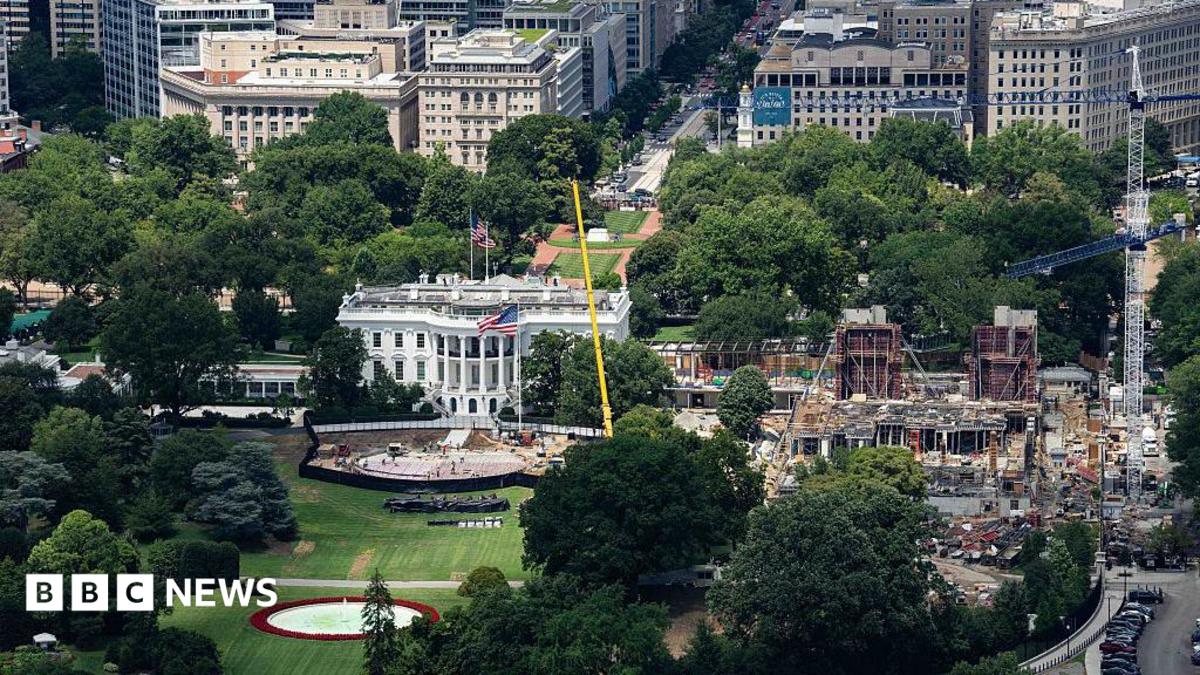
A federal appeals court has issued an injunction against President Donald Trump's controversial $400 million ballroom expansion at the White House. The ruling emphasizes that the President is a 'temporary tenant' rather than an owner of the historic residence.
Key Takeaways
- A federal appeals court has halted construction of the $400 million ballroom project at the White House.
- The court ruled that the Executive Branch lacks the authority to redesign the White House without Congressional approval.
- The ruling upholds a preliminary injunction by the National Trust for Historic Preservation.
- The case is expected to head to the Supreme Court.
In a major legal blow to the Trump administration, a federal appeals court on Friday ordered a halt to the construction of President Donald Trump's controversial $400 million ballroom at the White House. This decision directly challenges the President's executive authority and sets the stage for a high-stakes showdown in the Supreme Court.
'A Temporary Tenant, Not an Owner'
The three-judge panel delivered a stinging rebuke to the administration, stating that the White House belongs to the American people. "Each President is a temporary tenant, not the owner, of the White House and its Executive Residence," the panel noted, emphasizing that the property is maintained for all current and future presidents.
Why This Matters
BozokMedia analysis shows that this case transcends a simple construction dispute; it is a fundamental test of the separation of powers. The ruling reinforces the principle that the Executive Branch cannot unilaterally reshape national landmarks that are under the stewardship of the legislative branch and the public trust.
"Whether or not a massive ballroom should be constructed is for Congress to decide and is not a matter for Executive self-help."
The administration has defended the project by citing National Security concerns, arguing that the ballroom and its accompanying underground complex are essential to protect the President from modern threats like drones and ballistic missiles. However, preservationists argue that a ballroom is a luxury, not a security necessity, and does not justify the demolition of the historic East Wing.
Historical Background
The project has been mired in controversy since October, when the administration began demolishing parts of the East Wing—originally built in 1902—to facilitate the expansion. This would have marked the most significant structural change to the presidential residence in over seven decades.
Frequently Asked Questions
1. Why did the court stop the construction?
The court ruled that the administration did not have the constitutional authority to undertake such massive structural changes without explicit authorization from Congress.
2. What can the Trump administration do next?
The administration has the right to appeal this decision to the U.S. Supreme Court.