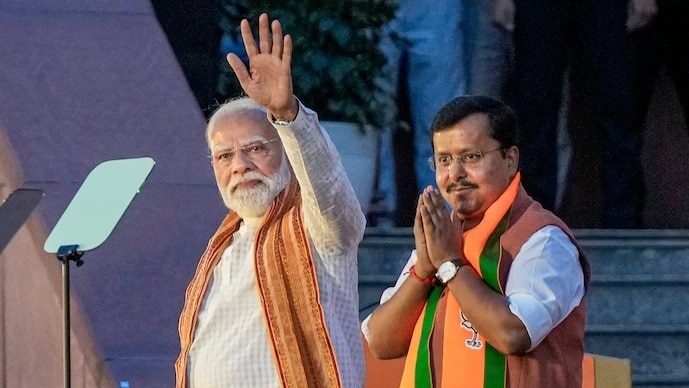
BJP National President Nitin Nabin has unveiled a revamped national executive, blending youth and experience. The reshuffle is strategically designed to secure victories in the 2027 state elections and the 2029 General Elections.
- The new executive consists of 65 officials, featuring 51 new appointments and 14 retained veterans.
- Uttar Pradesh dominates the list with 8 key leaders appointed to strengthen the state's organizational grip.
- Strong focus on inclusivity with 12 women and 6 representatives from minority communities.
- Strategic alignment aimed at the 2027 Assembly elections and the 2029 Lok Sabha goals.
In a decisive move to fortify the party's organizational structure, BJP National President Nitin Nabin has announced the new national executive. This reshuffle is far more than a routine administrative change; it is a calculated electoral blueprint designed to navigate the political landscape from 2027 through 2029. By replacing several old faces with dynamic new leadership, the party aims to rejuvenate its grassroots connect.
A primary focus of 'Team Nabin' is the upcoming 2027 Assembly elections. Leaders from critical states—specifically Uttar Pradesh, Uttarakhand, Gujarat, and Punjab—have been given preferential placement. Uttar Pradesh leads the representation with 8 members, including Tariq Mansoor and Rekha Verma as National Vice Presidents, and Smriti Irani and Harish Dwivedi as National General Secretaries. This move is seen as a strategic attempt to balance caste dynamics and minority outreach in India's most populous state.
Why This Matters
BozokMedia analysis shows that the BJP is currently employing a 'Balance of Power' strategy, merging the seasoned wisdom of former Chief Ministers like Vasundhara Raje and Tirath Singh Rawat with the energy of youth under 40. This hybrid structure is essential for the party to remain relevant in a digital-first political era while maintaining its traditional stronghold.
Organizational restructuring is not merely about distributing portfolios; it is the strategic deployment of assets for an upcoming political war.
Laying the foundation for 'Mission 2029', the party has emphasized social engineering. The inclusion of four members from Scheduled Tribes and six from minority communities (including Sikh, Christian, Muslim, Jain, and Parsi) aligns with the party's broader narrative of inclusive growth. To dominate the digital narrative, Deepak Mhaske has been appointed as the National Social Media Coordinator.
Regional strategies are also evident in the appointments from Punjab and Uttarakhand. The inclusion of former Finance Minister Manpreet Singh Badal as National Vice President signals the BJP's intent to penetrate deeper into Punjab. Similarly, the appointment of Tirath Singh Rawat ensures that the party retains its experienced leadership in the hilly terrains of Uttarakhand.
| State | Number of Reps | Key Appointments |
|---|---|---|
| Uttar Pradesh | 8 | Smriti Irani, Harish Dwivedi |
| Uttarakhand | 4 | Tirath Singh Rawat, Anil Baluni |
| Gujarat | 4 | Varshaben Doshi, Rohan Gupta |
| Punjab | 2 | Manpreet Singh Badal, Tarun Chugh |
Frequently Asked Questions
1. Why does Uttar Pradesh have the highest representation in the new team?
Uttar Pradesh is the political epicenter of India. With the 2027 Assembly elections approaching, the BJP needs a robust, socially balanced team to maintain its dominance in the state.
2. What is the core objective of 'Mission 2029' in this reshuffle?
The objective is to build a diverse and inclusive organizational structure that appeals to women, youth, and minority communities, thereby expanding the party's voter base for the 2029 General Elections.