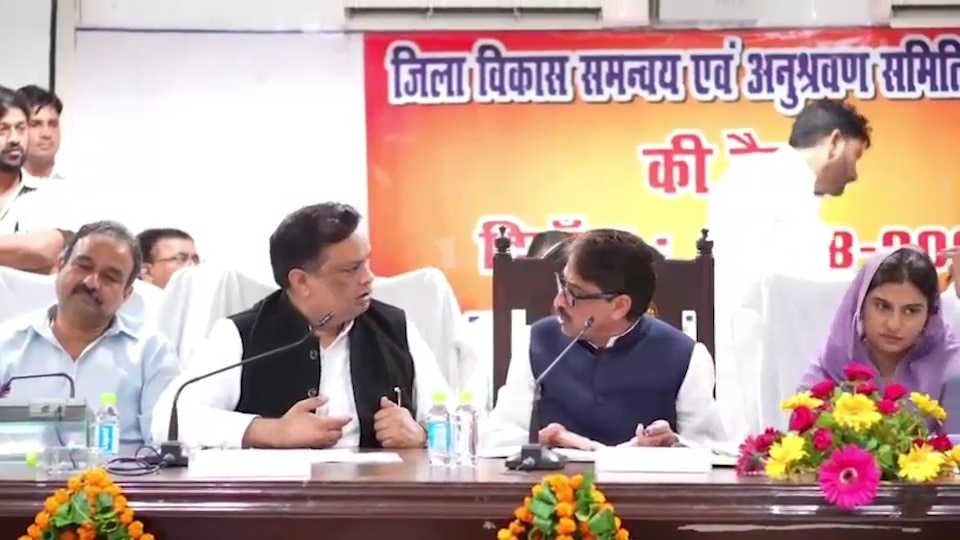
Samajwadi Party chief Akhilesh Yadav has launched a scathing attack on the Centre, questioning the rollout of E20 petrol. Citing the Chief Economic Advisor's remarks, he highlighted the potential damage to older vehicles.
- Akhilesh Yadav raised concerns regarding engine damage caused by E20 petrol.
- He cited CEA V. Anantha Nageswaran's reported support for E10 fuel.
- SP leader labeled E20 as a 'double-edged sword' for motorists.
- Questioned why the government isn't conducting surveys on consumer grievances.
Samajwadi Party (SP) President Akhilesh Yadav on Wednesday launched a political offensive against the Central Government regarding the implementation of E20 petrol. The former Uttar Pradesh Chief Minister pointed out a significant discrepancy between government policy and the advice provided by the nation's top economic experts.
Taking to the social media platform 'X', Yadav shared a graphic citing reported remarks by Chief Economic Advisor (CEA) V. Anantha Nageswaran. The report suggested that the CEA backed the continued availability of E10 petrol, particularly for older two-wheelers, to prevent engine damage. Yadav posed a direct question to the administration: "Who is right: the government or the adviser?"
Why This Matters
BozokMedia analysis shows that the transition to higher ethanol blends is a critical inflection point for India's automotive sector. While the move aims to reduce crude oil dependency, the lack of a transitionary period for older vehicle fleets creates a massive economic liability for the common man.
The mismatch between aggressive biofuel targets and existing vehicle technology creates a significant risk for millions of motorists.
Yadav characterized E20 petrol as a "double-edged sword," arguing that it imposes a "double burden" on citizens. Not only are fuel costs rising, but the maintenance costs for vehicles experiencing engine degradation are also skyrocketing. He criticized the BJP-led government for failing to conduct direct surveys to understand the ground reality of motorists facing technical issues.
Historical Background
The Indian government introduced E20—a blend of 20% ethanol and 80% petrol—as part of a strategic move to lower vehicular emissions and bolster the domestic ethanol industry. As of April 2026, E20 became the primary petrol variant available at fuel stations nationwide. However, many vehicles manufactured prior to the advent of high-ethanol-ready engines are not compatible with this blend, leading to concerns about fuel line corrosion and reduced performance.
Frequently Asked Questions (FAQ)
1. What is the difference between E10 and E20?
E10 contains 10% ethanol, whereas E20 contains 20% ethanol blended with petrol.
2. Why is E20 problematic for old vehicles?
Older engines may not have the material compatibility (seals and hoses) to handle the corrosive nature of higher ethanol concentrations.