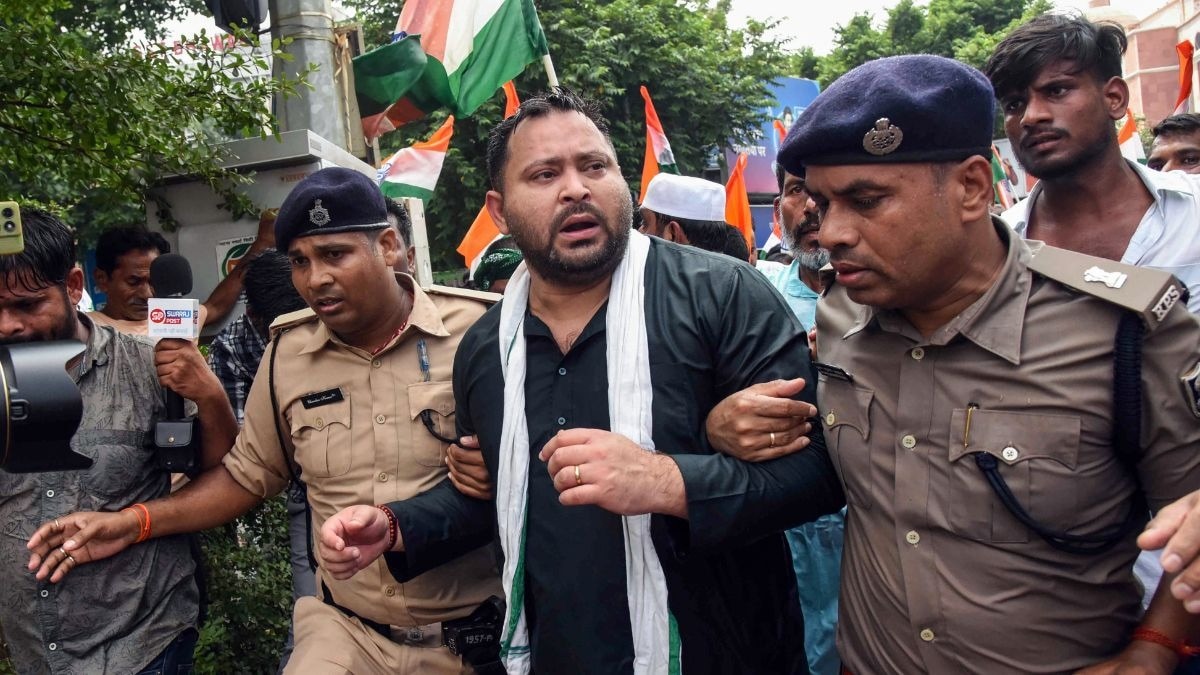
As student protests intensify in Bihar over paper leaks and unemployment, RJD leader Tejashwi Yadav leads a march to Lok Bhavan, attempting to reassert his political dominance.
- Tejashwi Yadav led an RJD march to Lok Bhavan protesting paper leaks and police brutality.
- RJD faces a political crisis following poor performances in the 2025 elections and Bankipur by-election.
- The rise of Prashant Kishor's Jan Suraaj poses a direct threat to RJD's traditional base.
- The protest movement was originally driven by independent student organizations like AISA and RYA.
For Rashtriya Janata Dal (RJD) leader Tejashwi Yadav, the march toward Lok Bhavan—the official residence of the Bihar Governor—on August 19 was framed as a fight for justice. The core grievances included systemic paper leaks in competitive exams, rising unemployment, and the controversial use of an AK-47 by police during a youth demonstration in Siwan. However, beneath the surface, the march was a calculated political maneuver to reclaim relevance in an increasingly volatile Bihar.
The protest saw intense friction, with police deploying water cannons to disperse crowds. During the chaos, Tejashwi Yadav and prominent RJD leader Misa Bharti were briefly detained. This escalation highlights the growing tension between the state government and the opposition regarding the handling of student-led agitations.
A Political Identity in Crisis
BozokMedia analysis shows that Tejashwi Yadav is operating from a position of significant political vulnerability. The RJD suffered a devastating blow in the 2025 Bihar assembly elections, plummeting from 75 seats to just 25. This decline was further compounded by the recent Bankipur by-election, where RJD candidate Rekha Kumari Gupta finished third and lost her security deposit.
The emergence of Prashant Kishor and his Jan Suraaj movement has fundamentally shifted the political landscape. By winning the Bankipur seat, Kishor has demonstrated that there is a growing appetite for alternatives to the traditional RJD-BJP binary, directly threatening Tejashwi's claim as the state's primary opposition voice.
If young protesters view the RJD as merely attempting to appropriate their movement, Tejashwi may gain headlines without gaining actual credibility.
The Struggle for Authenticity
A critical question remains: is Tejashwi Yadav leading a movement, or is he merely riding the coattails of one? The current wave of student agitation was not birthed by the RJD; it was mobilized by organizations such as the All India Students’ Association (AISA) and the Revolutionary Youth Association (RYA). These groups have been at the forefront of demanding accountability for the NEET examination irregularities and subsequent police crackdowns.
While Tejashwi has successfully adopted the rhetoric of the students, accusing the BJP-led government of mortgaging the state's educational future, the BJP has been quick to dismiss his motives. Senior BJP leader Dr. Nikhil Anand characterized Yadav as a 'runaway Opposition leader' attempting to regain relevance after his party's electoral failures.
Comparison of Political Standing
| Metric | 2020 Assembly | 2025 Assembly |
|---|---|---|
| RJD Seats | 75 | 25 |
| Key Challenge | BJP Dominance | Rise of Jan Suraaj (Prashant Kishor) |
Frequently Asked Questions
1. What were the primary reasons for the Lok Bhavan march?
The march was organized to protest against paper leaks in exams, unemployment, and police violence against students.
2. How has the political landscape in Bihar changed recently?
The rise of Prashant Kishor's Jan Suraaj and the RJD's declining seat count have created a new, multi-polar political environment.
