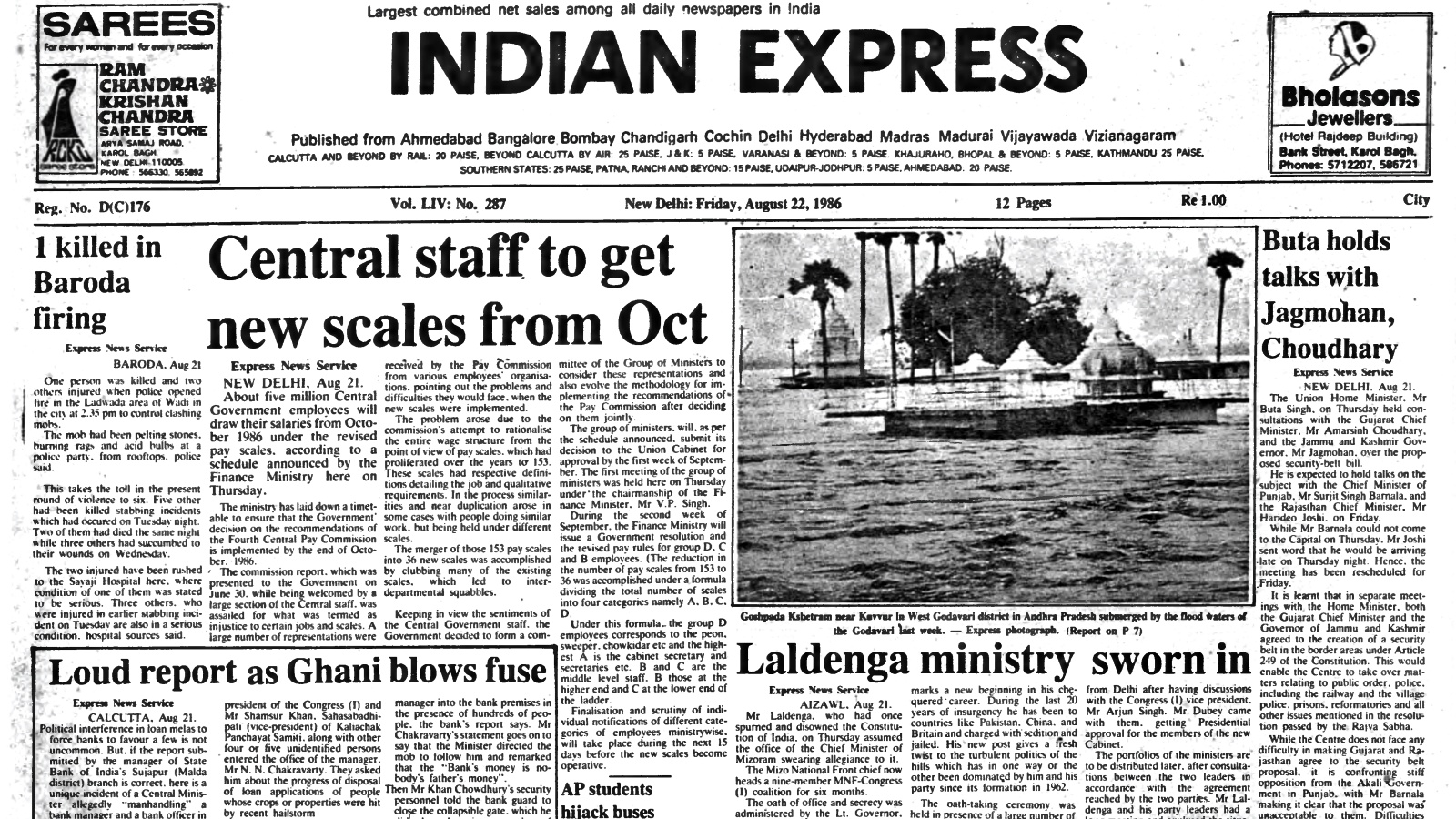
A deep dive into the pivotal events of August 22, 1986, covering the massive central pay scale revision and significant political shifts in India.
- Approximately 5 million central government employees were set to receive revised salaries starting October 1986.
- The Central Pay Commission faced intense scrutiny and representations from employee organizations regarding pay inequities.
- Laldenga took oath as Mizoram's Chief Minister, swearing allegiance to the Indian Constitution.
- Union Home Minister Buta Singh initiated high-level talks regarding the proposed Security Belt Bill.
On August 22, 1986, India stood at a significant crossroads of administrative reform. Under the announcement made by the Finance Minister, nearly 5 million central government employees were slated to draw salaries under a revised schedule effective from October 1986. The Ministry had established an interim timetable to ensure the implementation of the Central Pay Commission's recommended cut-offs by the end of that month.
The implementation was not without friction. While the Pay Commission's report, submitted on June 30, was welcomed by many, it faced significant backlash. Various employee organizations submitted numerous representations, alleging that the new scales resulted in injustice toward specific job categories and pay grades. This tension highlighted the delicate balance the government had to maintain between fiscal responsibility and employee welfare.
Why This Matters
BozokMedia analysis shows that pay commission decisions are more than just budgetary adjustments; they are critical drivers of administrative morale and national economic stability. The 1986 revision set a precedent for how large-scale bureaucratic shifts are managed in a complex democracy.
The friction between commission recommendations and employee expectations remains a perennial theme in Indian governance.
The political landscape was equally dynamic. Union Home Minister Buta Singh was actively engaged in consultations regarding the proposed 'Security Belt Bill.' His discussions included Gujarat Chief Minister Amarsinh Choudhary and Jammu & Kashmir Governor Jagmohan, with further talks planned with the leadership of Punjab and Rajasthan.
In a landmark political transition, Laldenga, who had previously distanced himself from the Indian Constitution, assumed office as the Chief Minister of Mizoram. By swearing allegiance to the Constitution, he led a nine-member MNF-Congress (I) coalition, marking a period of significant integration for the state. Meanwhile, in Bihar, political unrest manifested in a failed attempt to 'gherao' the Legislative Assembly in protest against the Arwal police firing incident.
Historical Background
The mid-1980s in India was a period of transition, marked by efforts to stabilize internal security and manage a growing public sector workforce. The role of the Pay Commission became increasingly vital as the complexity of the Indian bureaucracy expanded, necessitating periodic structural adjustments to match inflation and economic realities.
Frequently Asked Questions
Question 1: What was the primary controversy surrounding the 1986 Pay Commission?
Answer: The controversy centered on perceived injustices in certain job scales and pay categories, leading to widespread representations by employee unions.
Question 2: Who was the Home Minister during these events?
Answer: Buta Singh served as the Union Home Minister during this period.