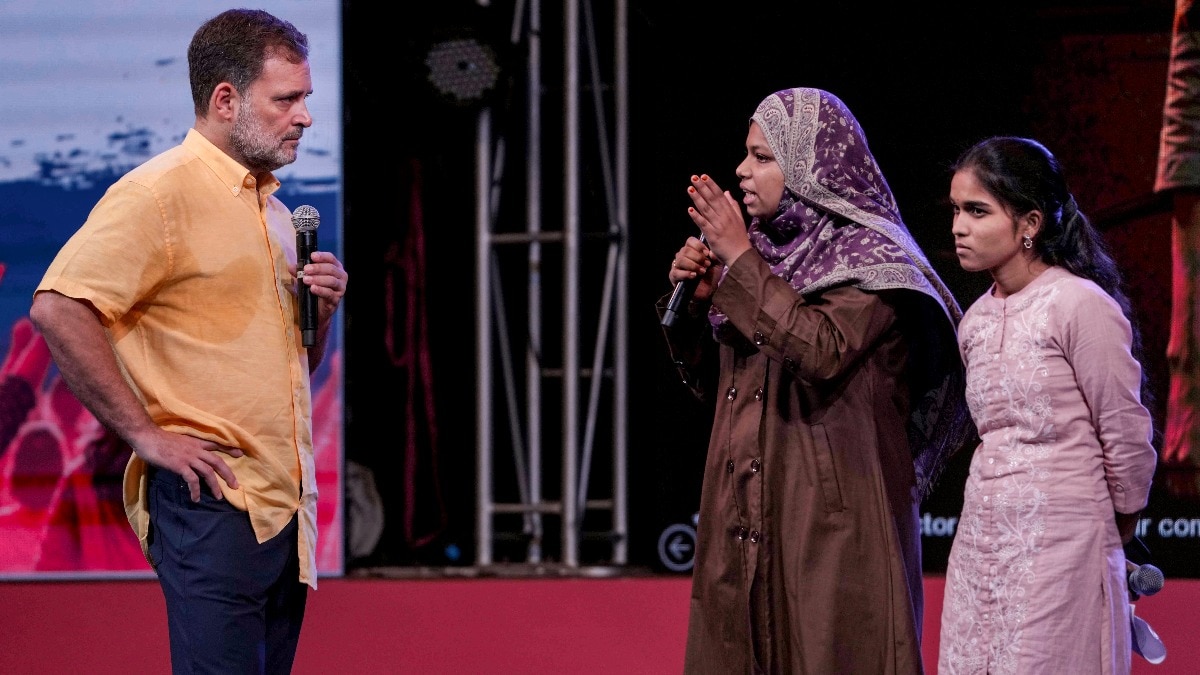
During the 'Chhatron ki Goonj' event in Pune, female students highlighted how sexual harassment, unsafe public transport, and exorbitant fees are preventing women from accessing higher education and economic independence.
- Students identified sexual harassment and unsafe mobility as primary barriers to education.
- Safety concerns in rural areas often lead parents to prioritize male education over females.
- High costs of specialized courses like Cybersecurity make them inaccessible to many.
- Misuse of AI for creating obscene images was highlighted as a rising digital threat.
At the 'Chhatron ki Goonj' programme held in Pune, female students engaged in a profound dialogue with the Leader of Opposition in Lok Sabha, Rahul Gandhi. The students articulated how systemic issues—ranging from sexual harassment and unsafe public transportation to financial hardships—continue to stifle women's access to education and their pursuit of economic autonomy.
Suchitra Pagi, an economics student from Vasai, shared a harrowing account of facing harassment at the age of 13 while walking home from school and later while using public transport. Her testimony highlighted the psychological impact of such incidents, noting that while not all men are perpetrators, the fear instilled by these experiences remains a significant hurdle for young women navigating public spaces.
Why This Matters
BozokMedia analysis shows that the intersection of safety, affordability, and gender norms creates a multi-layered barrier that prevents India from achieving true gender parity in its workforce and academic institutions. Addressing these issues is not just a social necessity but an economic imperative.
The conversation also delved into the socio-cultural dynamics of education. Maitri, a psychology student in Pune, explained that safety concerns often dictate family decisions in rural India. Parents frequently hesitate to send daughters away for higher studies due to safety fears, often opting to invest in their sons' education instead, driven by traditional norms regarding financial support and marriage.
Without safe mobility and affordable access, gender equality remains a theoretical concept rather than a lived reality.
The financial burden of specialized education was another critical point raised. Pradnya Gavande, a student of Cyber and Digital Science, pointed out that specialized courses like cybersecurity can cost upwards of ₹3 lakh, making them unattainable for students from economically weaker backgrounds. She advocated for more such courses in government institutions and increased scholarship opportunities.
Furthermore, the students raised alarms regarding the dark side of technological advancement. The growing misuse of Artificial Intelligence (AI) to create non-consensual obscene images and facilitate extortion was identified as a modern-day threat to women's dignity and safety, necessitating stronger cybersecurity awareness and legal protections.
Historical Background
While India has made significant strides in increasing female literacy rates over the last few decades, the transition from primary schooling to higher education remains a critical juncture where many women drop out due to safety concerns, domestic responsibilities, and financial constraints.
Frequently Asked Questions
1. What are the primary barriers mentioned by the students?
The students identified unsafe public transport, sexual harassment, high tuition fees for specialized courses, and digital threats like AI-driven harassment as major barriers.
2. How does safety affect rural education patterns?
Safety concerns often lead rural parents to restrict their daughters' mobility, resulting in lower enrollment rates for women in higher education compared to men.