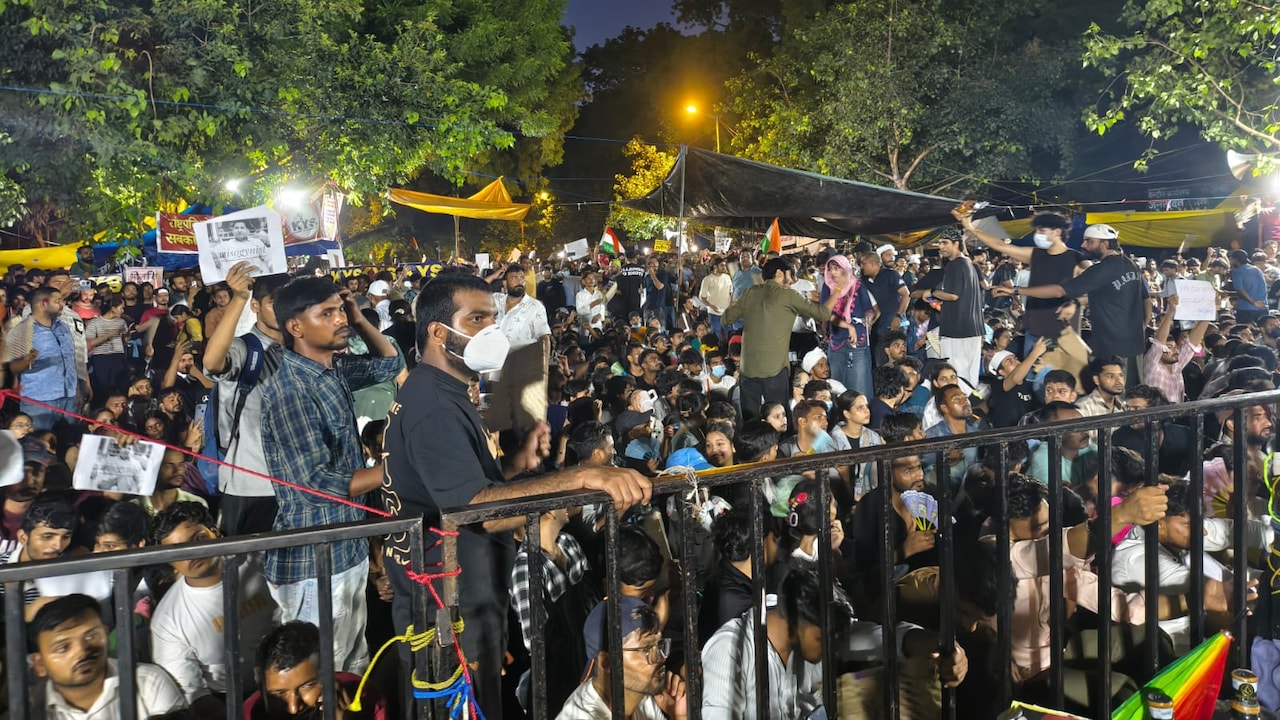
Recent student protests at Jantar Mantar are leveraging 'profanation'—the use of humor, satire, and informality—to challenge the perceived sanctity of political power in India.
- Students are utilizing memes, satire, and trolling as strategic political tools.
- 'Profanation' involves moving objects or ideas from a 'sacred' restricted sphere to a common, playful one.
- This shift represents a move from formal institutional politics to informal 'street politics.'
The recent wave of student protests led by the Cockroach Janta Party (CJP) at Jantar Mantar has ignited a profound debate regarding the nature of political engagement in India. This movement marks a departure from traditional protest methods, embracing what philosopher Giorgio Agamben calls 'profanation.' By using humor, informality, and even absurdity, students are attempting to strip away the aura of invincibility that surrounds modern political institutions.
In his seminal work, Agamben describes profanation as the act of transferring things from the realm of the 'sacred'—those restricted, untouchable spheres managed by religion, the state, or the marketplace—to the common use of the people. Just as a child turns a household object into a toy, or chess turns the mechanics of war into a game, these students are turning the heavy machinery of state power into subjects of satire and memes.
Why This Matters
BozokMedia analysis shows that this is not merely a breakdown of political civility, but a sophisticated response to the closing of traditional democratic spaces. When formal institutions fail to provide accountability, the 'profane' becomes a vital tool for the disenfranchised to reclaim their agency through unconventional means.
When conventional expression is suppressed, humor and satire fill the vacuum, challenging hegemonic structures more effectively than traditional rhetoric.
This strategy of 'desecrating' authority has deep roots in the Indian independence movement. Leaders like Mahatma Gandhi often used subtle satire to diminish the prestige of the British Raj. Whether it was through the public renunciation of colonial titles or Gandhi's witty remarks about his simple attire during his meeting with King George V, the goal was to highlight the disparity between the colonizer and the colonized.
Universally, we see this pattern in resistance movements, from the satirical masterpieces of Charlie Chaplin to the contemporary use of humor by Palestinians to navigate daily suffering. In the digital age, this has evolved into a weaponized form of 'trolling' and 'meme warfare' that can bypass state-controlled narratives.
Frequently Asked Questions
1. What is the difference between 'sacred' and 'profane' in politics?
The 'sacred' refers to the untouchable authority and dignity of state institutions, while the 'profane' refers to making those same institutions subjects of common, playful, or critical discourse.
2. Is 'street politics' effective for long-term change?
While critics argue that informal protests lack institutional power, proponents suggest they are essential tactics to force accountability when formal opposition fails.
| Dimension | Traditional Politics | New Student Politics |
|---|---|---|
| Primary Tool | Formal Policy & Speeches | Satire, Memes, & Informality |
| Structure | Hierarchical & Institutional | Decentralized & Non-Party |
| Perception | Serious & Sacred | Informal & Profane |