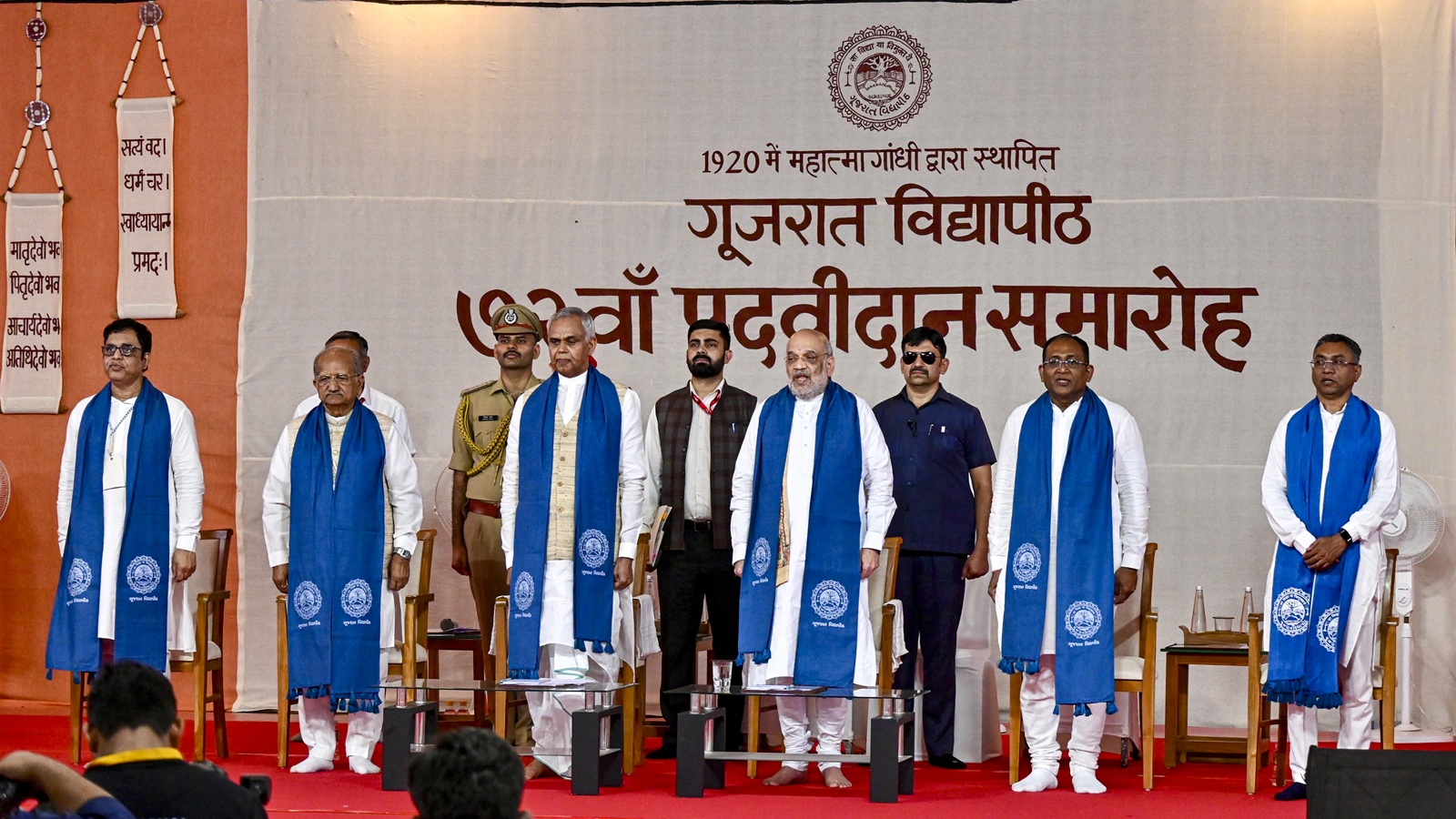
Union Home Minister Amit Shah emphasized that India is undergoing a process of 'reconstruction' guided by Gandhian principles and the leadership of PM Narendra Modi.
- Amit Shah linked Mahatma Gandhi's eternal values with the Modi government's vision of 'Punarnirman'.
- He urged students to set goals for society and the nation rather than personal gain.
- The National Education Policy (NEP) was highlighted as a blend of Indian tradition and global modernity.
- Shah emphasized the importance of Gandhi's 'seven sins' and '11 vows' in modern life.
Addressing the 72nd convocation ceremony of Gujarat Vidyapith in Ahmedabad, Union Home and Cooperation Minister Amit Shah delivered a powerful message on the continuity of Indian values. He stated that Mahatma Gandhi’s message was as relevant in the past as it is today and will remain so even a century from now. Shah noted that the central government, under the leadership of Prime Minister Narendra Modi, is steering India forward through the spirit of 'Punarnirman' or reconstruction.
Purposeful Living and National Duty
In an inspiring address to the 900 graduates, Shah advised students to define their life goals with a focus on national service. He remarked that a truly great person does not worry about whether a task will be completed, but rather whether the task is worth doing. He cautioned that setting goals solely for oneself or one's family leads to despair during hardships, whereas goals set for the nation, society, and the poor provide the strength to persevere through any adversity.
If you have set a goal for society and the nation, the burden of victory or defeat will not rest upon you.
Drawing from his own life experiences, Shah shared how his dedication to the nation allowed him to face numerous challenges without losing enthusiasm. He criticized those who enter politics for personal gain, labeling it a 'sin,' and urged the youth to lead lives rooted in purpose and selflessness.
Why This Matters
BozokMedia analysis shows that Shah's choice of the word 'Punarnirman' (reconstruction) over 'Navnirman' (new construction) is a strategic nuance. It suggests that the current administration is not looking to replace India's foundational cultural identity but is instead focused on modernizing and revitalizing ancient principles. This alignment of Gandhian philosophy with modern governance serves to bolster the cultural legitimacy of the government's developmental agenda.
Education and the Gandhian Legacy
Shah spoke extensively about the National Education Policy (NEP), describing it as a framework built on five pillars: mother tongue, skill development, multidisciplinary study, Indian knowledge tradition, and holistic personality development. He emphasized that the NEP brings back the essence of the education system that India once gifted to the world, infused with global modernity.
Furthermore, the Home Minister reminded the students of Gandhi's 'seven sins'—such as politics without principles and science without humanity—and his '11 vows', including non-violence, truth, and the removal of untouchability. He also noted that the government's focus on village empowerment aligns closely with Gandhi's vision for a self-reliant India.
Frequently Asked Questions
1. What is the difference between 'Navnirman' and 'Punarnirman' as explained by Shah?
Shah explained that 'Punarnirman' implies taking existing, time-tested principles and modernizing them, rather than creating something entirely new and disconnected from tradition.
2. How does the NEP relate to Gandhi's vision?
The NEP incorporates the Indian knowledge tradition and emphasizes mother-tongue education, which aligns with Gandhi's belief that true independence requires our culture and language to be national.
