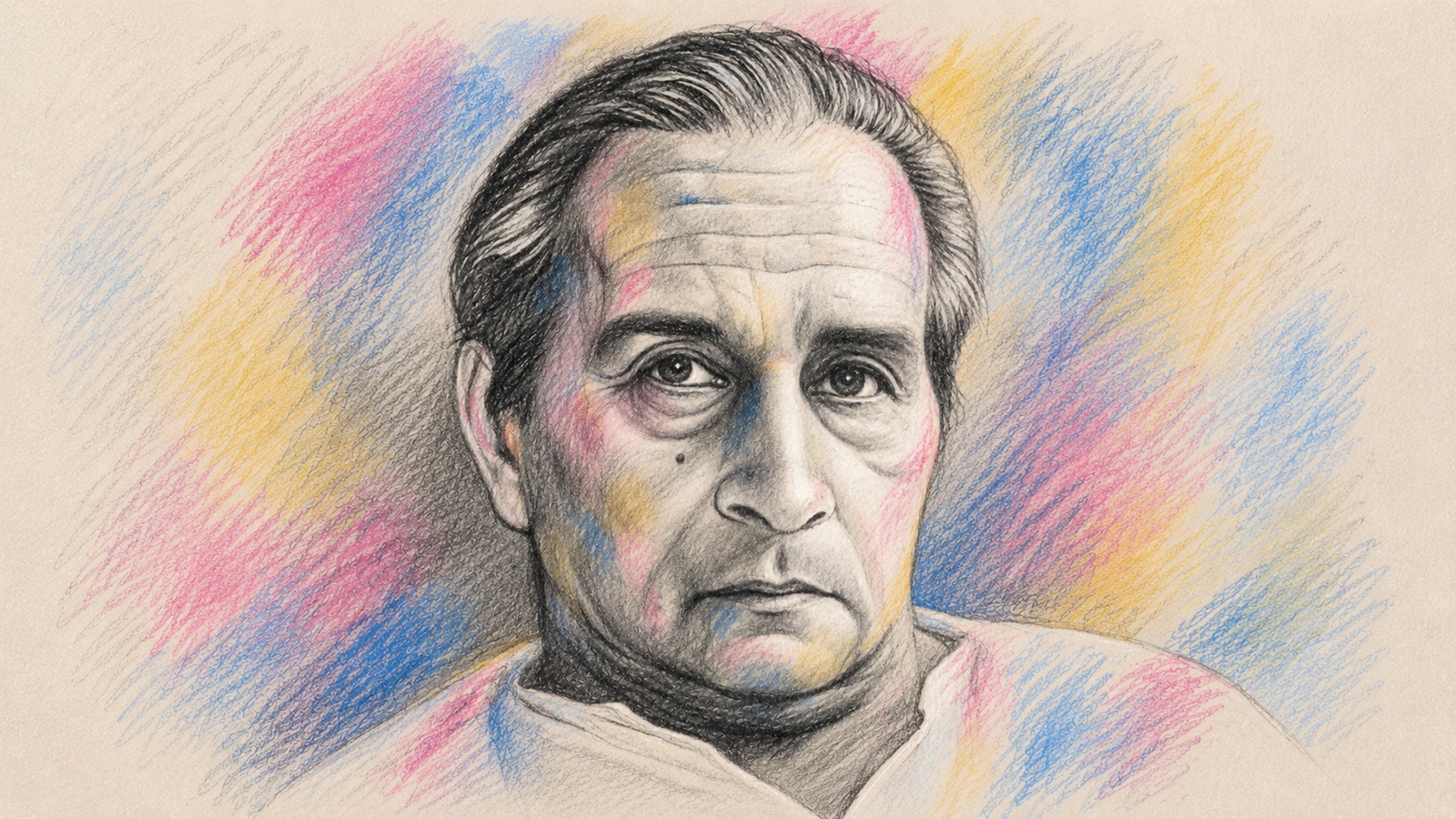
Harishankar Parsai, the pioneer of modern Hindi satire, lived a life of profound personal sacrifice, choosing family duty over his love for Shakuntala. On his death anniversary, we revisit his uncompromising literary journey, his political disappointments, and the physical attacks he faced for his fearless pen.
- Parsai sacrificed his love for Shakuntala to support his widowed sister and her family.
- He faced political betrayal in 1971 when a promised Rajya Sabha nomination fell through due to political apathy.
- His fearless satire led to a physical assault by political extremists in Jabalpur in 1973.
“If I cannot give you the joys of life, then what right do I have to sow thorns in it?” With this single sentence, the satirist in Harishankar Parsai broke free of his cocoon and flew away, but the lover in Parsai, like a butterfly, remained buried forever in that same cocoon. The man whose pen struck such sharp blows at every hypocrisy in society that it set off an uproar across the country, that same man’s own life became an unspoken silence on the front of love.
Amid the rows of books, his beloved Shakuntala had come that day carrying besan laddus. Perhaps the sweetness in her hands had been kneaded from the hope that this chapter of life was now about to turn a sweeter corner. But in that very meeting, Parsai looked straight into her eyes and said, marriage cannot happen. A whole canopy of clouds seemed to descend over Shakuntala’s face. She only asked, “Why?” Parsai placed his weary reality into her palm. His financial condition was not such that he could run two households. His sister Sita had been widowed, and her entire family was now breathing under his shadow. Four children had to be educated and set on their own feet. This responsibility he had taken upon himself, and now, in its very fire, Harishankar was watching his share of dreams burn away.
Why This Matters
BozokMedia analysis shows how Parsai's personal anguish fueled his sharp social critique, proving that great satirists often write from a place of deep personal empathy and pain rather than mere cynicism. His sacrifice highlights the profound moral integrity required to be a true voice of the marginalized, showing that his literary rebellion was not just an intellectual exercise but a lived reality.
Tears rolled down Shakuntala’s eyes. She said only this, “Were I nowhere in your thoughts?” In a choked voice, Parsai said, “You were. Always were. That is exactly why I could not bring myself to say it. But I do not wish to drag you into my sorrow.” After this, no words remained. The world stopped right there, in that very moment, forever. Parsai did not marry. He locked his share of love away inside himself like an unfinished page and fastened a latch on it, its bolts never opening for the rest of his life.
"Parsai did not merely write satire; he lived the friction between societal hypocrisy and personal integrity, proving that the pen's sharpest edge is forged in the fire of personal sacrifice."
August was a strange month in Parsai’s life. On the 22nd of this month, he was born, and on the 10th of this month, his breath stopped. Both ends were tied within the same month, as though his entire life was like two pages of the same book: on one side, the pen that never bowed; on the other, the heart that bowed once and never rose again. Even after this, the political mirage did not leave Parsai’s trail. In 1971, the former Chief Minister of Madhya Pradesh, D P Mishra, proposed sending him to the Rajya Sabha. Parsai gave his consent, but the promise fell through due to political negligence, contrasting sharply with how Siddhartha Shankar Ray in West Bengal promptly secured a seat for Bengali writer Pramathanath Bishi.
| Era/Event | Personal/Political Reality | Literary/Social Impact |
|---|---|---|
| Personal Life | Renounced marriage with Shakuntala for family duty | Infused his writing with raw, empathetic human truth |
| 1971 Rajya Sabha | Denied nomination due to state political apathy | Exposed the shallow nature of political patronage of art |
| 1973 Assault | Physically attacked with sticks by political opponents | Sparked a 5-day protest, solidifying his stance on free speech |
There was also a violent episode in Parsai’s life. At the end of the summer of 1973, following the Jabalpur Municipal Corporation elections and the death of RSS chief Guru Golwalkar, Parsai wrote a satirical column called Suno Bhai Sadho in the newspaper Naveen Duniya. He linked Golwalkar’s death with the Jan Sangh’s electoral success with one sharp remark. This did not sit well with right-wing groups. A few days later, two young men came to Parsai’s home and brutally beat him with sticks. Despite the attack, Parsai remained unwavering, and the city of Jabalpur witnessed massive protests for five days in support of free speech.
Frequently Asked Questions
Q1: Why did Harishankar Parsai never marry?
Answer: Parsai chose not to marry his beloved Shakuntala because of his severe financial constraints and his self-imposed responsibility to support his widowed sister, Sita, and her four children.
Q2: Why was Harishankar Parsai physically attacked in 1973?
Answer: He was attacked by two youth with sticks because of a sharp satirical comment in his column 'Suno Bhai Sadho' linking the death of RSS chief Guru Golwalkar with the political victory of the Jan Sangh.