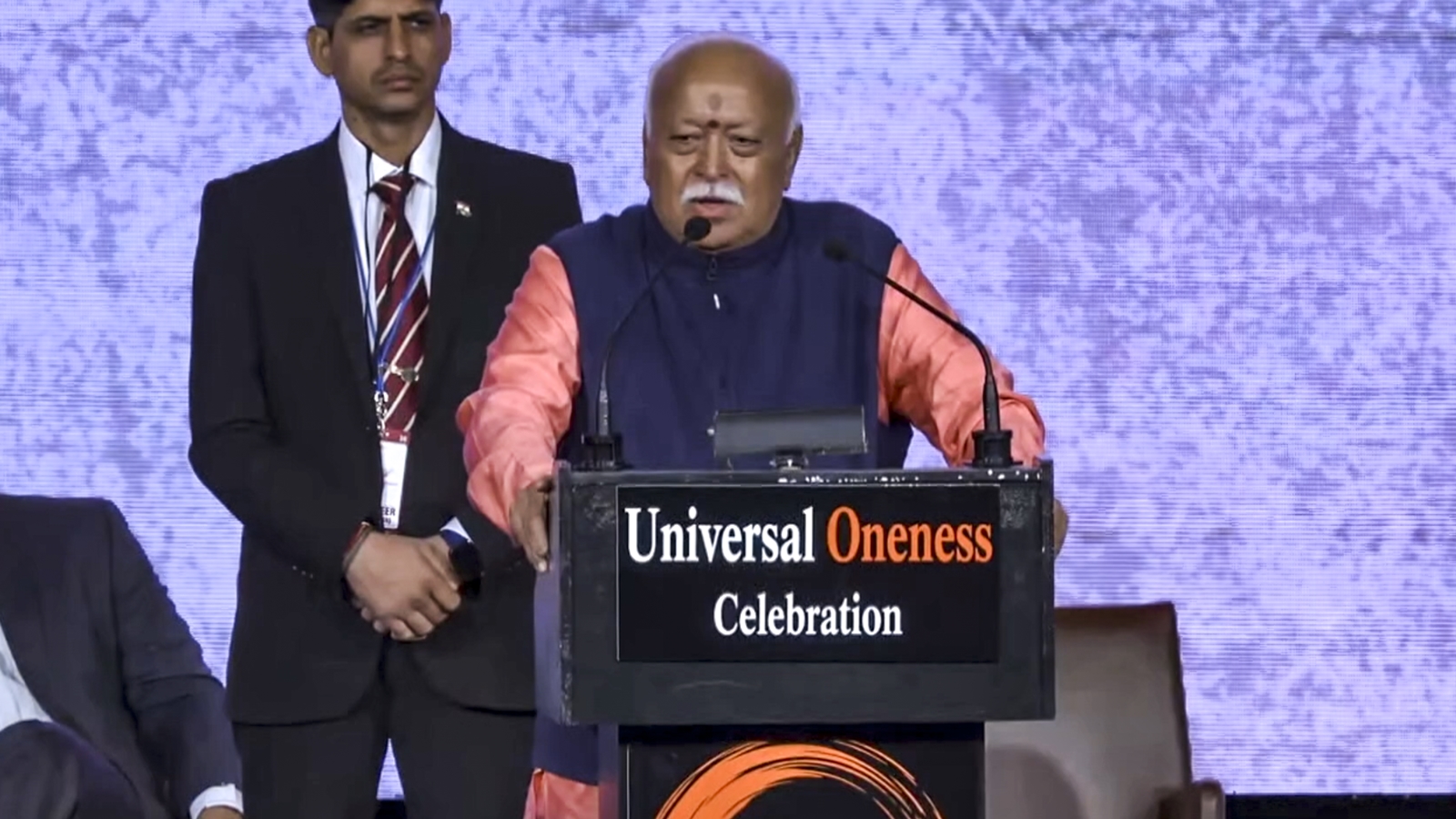
RSS Chief Mohan Bhagwat's recent speech in New York emphasizes diversity and inclusivity, challenging the narrow interpretations of Hindutva and calling for a shift from mere tolerance to active acceptance.
- Mohan Bhagwat defined diversity as the crowning feature of Indian civilization.
- He asserted that Hindus and Muslims share the same 'DNA' and are equal citizens.
- The RSS chief advocated for 'acceptance and respect' over simple 'tolerance'.
- He explicitly rejected the idea of religious dominance in a democratic India.
The recent address by Mohan Bhagwat at Madison Square Garden in New York has sent ripples through political and social circles. In an era marked by increasing polarization, Bhagwat used the international platform to articulate a version of Hindutva that is not narrow or exclusionary. By emphasizing diversity, he effectively countered the proponents of 'one nation, one religion, one language,' positioning variety as the defining strength of the Indian ethos.
This discourse marks a significant departure from the classical Hindutva propagated by V.D. Savarkar. While Savarkar maintained a strict distinction between Hindutva and Hinduism, Bhagwat is weaving a narrative of inclusivity. He argued that any Hindu who believes Muslims should not exist in Bharat ceases to be a true Hindu, asserting that the core of the faith is the belief that all paths lead to the same divine goal.
Why This Matters
BozokMedia analysis shows that Bhagwat is attempting to reposition the RSS as a force for national cohesion rather than communal division. By stating that Hindus and Muslims share the same 'DNA,' he dismantles the long-standing right-wing narrative that portrays Muslims as foreign intruders. If this shift is genuine and not merely for global optics, it could lead to a fundamental restructuring of the socio-political climate in India.
"Diversity is not just something to be tolerated; it is a decoration for our unity that must be respected and protected."
Bhagwat’s critique of 'othering' is particularly poignant. He suggested that the solution to India's frictions lies in shifting from 'me and mine' to 'we and ours.' He further revealed that the RSS has been engaged in active dialogues with Muslim and Christian communities since 2018, signaling a move toward interfaith engagement that contradicts the aggressive rhetoric often seen on the ground.
Despite these positive signals, a deep skepticism remains among liberal intellectuals. They point to the contradiction between Bhagwat's inclusive words and the hate speech frequently employed by affiliated political leaders. The disconnect between the RSS chief's sermons on diversity and the reality of communal tensions suggests that a full-scale 'Hindutva perestroika' may still be a distant goal.
Furthermore, Bhagwat's acknowledgement that many Muslims live in fear due to the behavior of Hindutva supporters is a rare admission of the ground reality. While his urge for Muslims not to be trapped in a 'cycle of fear' is welcome, critics argue that the state's failure to curb provocative slogans undermines the sincerity of these high-level pronouncements.
Frequently Asked Questions
Q1: What is the difference between tolerance and acceptance according to Bhagwat?
Tolerance is a negative concept where one puts up with someone they dislike; acceptance, however, involves respecting and protecting the distinctive identities of others.
By asserting that Hindus and Muslims share the same DNA, Bhagwat logically destroys the argument that Muslims are alien to the Indian soil.

