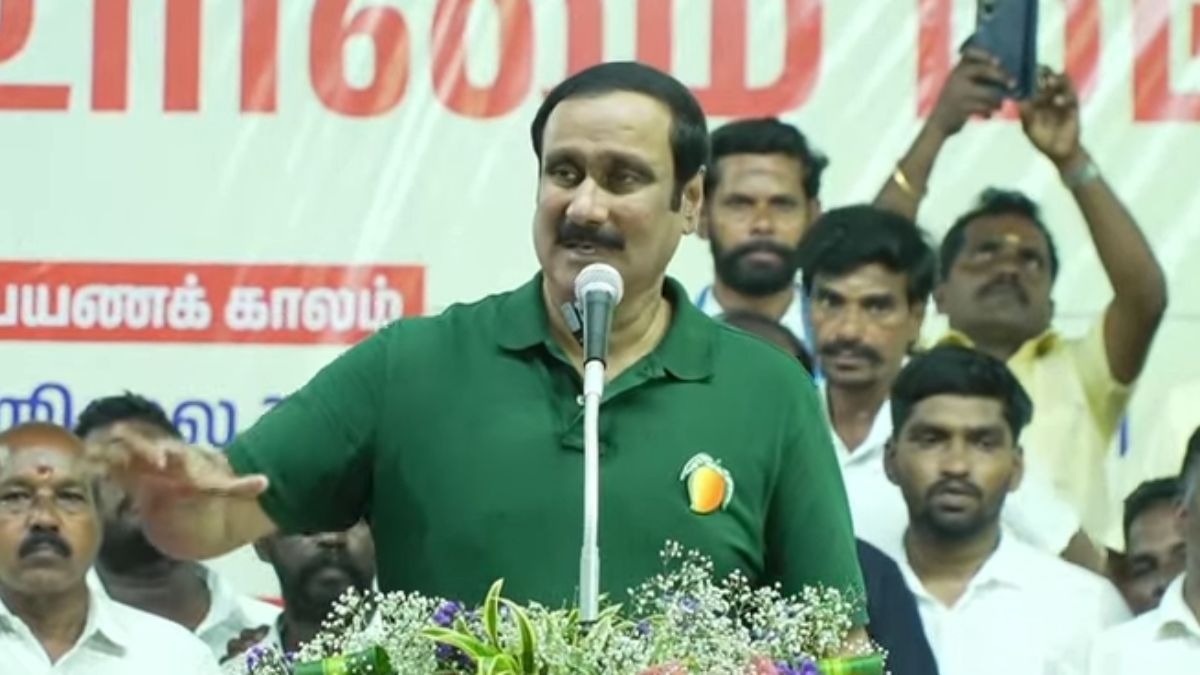
Pattali Makkal Katchi (PMK) chief Anbumani Ramadoss has strongly opposed the central government's decision to exclude official OBC lists from the caste census software. He warned that manual entry of caste names could lead to massive data fragmentation, producing over 46 lakh variations and undermining the delivery of social justice.
- PMK chief Anbumani Ramadoss has rejected the Centre's justification for leaving caste fields blank for manual entry.
- He warned that manual text entry could produce over 46.7 lakh spelling and regional variations for India's 4,147 castes.
- The PMK has demanded the integration of central and state OBC lists as a pre-defined dropdown in the census software.
Pattali Makkal Katchi (PMK) president and key National Democratic Alliance (NDA) ally, Anbumani Ramadoss, has strongly rejected the central government's explanation for excluding official Other Backward Classes (OBC) lists from the software used in the ongoing caste census. Ramadoss urged the Centre to withdraw its current notification and implement a pre-defined dropdown system in the software to ensure caste details are recorded with absolute accuracy.
In an official statement, Ramadoss highlighted that a nationwide caste census is being conducted for the first time in 95 years, with 1931 being the last time such an extensive exercise covered the entire population. He emphasized that this census is commencing after decades of relentless advocacy by social justice organizations, including the PMK, and its execution must not be compromised by technical oversights.
The Core Dispute: Dropdown List vs. Manual Entry
The controversy stems from the Centre's decision to leave a blank text field in the census software, allowing enumerators to manually type in the caste names provided by respondents. The PMK was the first political party to oppose this open-ended method. 'I wrote to all OBC Members of Parliament regarding this issue, after which the Indian National Congress adopted the same stance,' Ramadoss noted, criticizing the government's official explanation as weak and insufficient.
| Feature / Parameter | Manual Text Entry (Centre's Method) | Pre-defined Dropdown List (PMK's Proposal) |
|---|---|---|
| Data Accuracy | Highly prone to spelling errors, local aliases, and fragmentation. | Standardized and uniform across all states. |
| Expected Variations | Could produce over 46.7 lakh variations for ~4,147 castes. | Strictly limited to the official central/state lists. |
| Social Justice Delivery | Weakened due to diluted and fragmented data. | Precise allocation of welfare and reservation benefits. |
Why This Matters
BozokMedia analysis shows that the integrity of digital data collection is paramount for future policy formulation and governance. If the raw data is riddled with spelling errors and regional variations, targeting welfare schemes and reservation benefits to the correct socio-economic groups will become an administrative nightmare. Ramadoss argued that while India has approximately 4,147 officially recognized caste groups, manual entry could result in over 46.7 lakh distinct entries, comparing the current software design to 'burning down the house to get rid of a bedbug.'
"Allowing manual entries in a nationwide census of this scale defeats the very purpose of digital enumeration, risking administrative chaos and policy paralysis." - Political Analyst
Threat to Social Justice and Policy Implementation
According to Ramadoss, the fundamental objective of the caste census is to deliver targeted social justice to those lagging behind socio-economically. Recognizing distinct regional classes and integrating them into the census software via numeric codes and dropdown lists would not distort the exercise but would instead guarantee a fair distribution of resources. He demanded that the Centre immediately drop the manual text-entry method and integrate both central and state OBC lists into the digital platform.
Frequently Asked Questions
Q1: Why is PMK opposing manual entry in the caste census software?
A1: PMK argues that manual entry will lead to spelling errors and regional variations, creating over 46 lakh entries for just 4,147 castes, which will fragment and ruin the census data.
Q2: What is the Centre's justification for not using a dropdown list?
A2: Government officials claim that central and state OBC lists include broader 'classes' and local groups rather than strictly defined 'castes,' which could cause technical confusion.