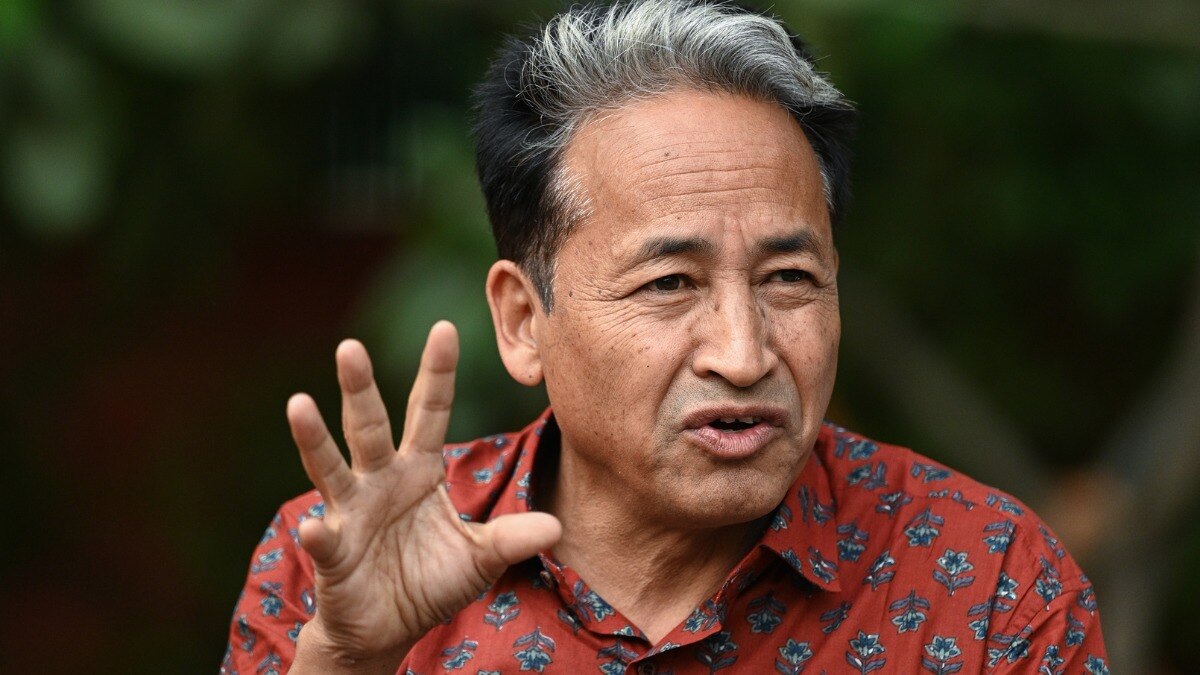
Social activist Sonam Wangchuk has set a one-year deadline for the Indian government to implement the Ladakh Bill and establish a local legislative assembly. He also raised alarms over new liquor licenses in the region.
- Sonam Wangchuk demands the introduction and passing of the Ladakh Bill in the upcoming Winter Session.
- He seeks the establishment of a local Legislative Assembly and government within one year.
- Wangchuk criticized the opening of new liquor shops as a threat to the youth.
- He emphasized the urgent need for environmental protection in the Himalayan region.
Prominent social activist and environmentalist Sonam Wangchuk has issued a decisive one-year ultimatum to the Central Government regarding the political status of Ladakh. In an exclusive interaction, Wangchuk demanded that the government must introduce and pass the Ladakh Bill during the upcoming Parliament Winter Session, paving the way for a local government and assembly within the next twelve months.
Wangchuk highlighted a critical administrative flaw: major policy decisions are being made for Ladakh before a local legislative body even exists. He argued that democratic principles dictate that an elected assembly should be established first, with the entire bureaucracy functioning under its authority. He asserted that matters of law and order and financial autonomy should be managed locally rather than being dictated by New Delhi.
Why This Matters
BozokMedia analysis shows that the tension in Ladakh is escalating from purely environmental concerns to a profound struggle for political identity. The government's delay in granting constitutional safeguards like the Sixth Schedule could lead to prolonged civil unrest in a strategically sensitive border region.
"The Legislative Assembly must be supreme, and the entire bureaucracy should function under its mandate to ensure true local governance."
Regarding the demand for full statehood, Wangchuk adopted a pragmatic stance. He noted that while immediate statehood might be challenging if the region is not deemed economically self-sufficient, he is willing to accept a customized democratic framework. He suggested that Ladakh could work towards full statehood within the next 5 to 10 years after achieving economic stability.
The activist also launched a scathing attack on the government's move to open new liquor outlets in Ladakh. He argued that attempting to solve the drug problem by introducing alcohol is counterproductive and dangerous. Comparing this move to certain policies observed in Tibet, he warned that distracting the youth through substance use could be a tactic to prevent them from questioning the government.
Furthermore, Wangchuk addressed the rise of 'Gen-Z' protests, viewing them not as a sign of instability but as a sign of a maturing democracy where the government's 'inaccessibility' is being challenged. He concluded with a plea for environmental urgency, reminding the nation that the Himalayas serve as the lifeline for nearly a quarter of the global population and require immediate protection from climate change.
Frequently Asked Questions
1. What is the primary demand of Sonam Wangchuk?
His primary demand is the implementation of the Ladakh Bill to ensure constitutional safeguards and the establishment of a local legislative assembly.
2. Why is Wangchuk against new liquor shops in Ladakh?
He believes that increasing alcohol availability will distract the youth and undermine their ability to participate in democratic protests.