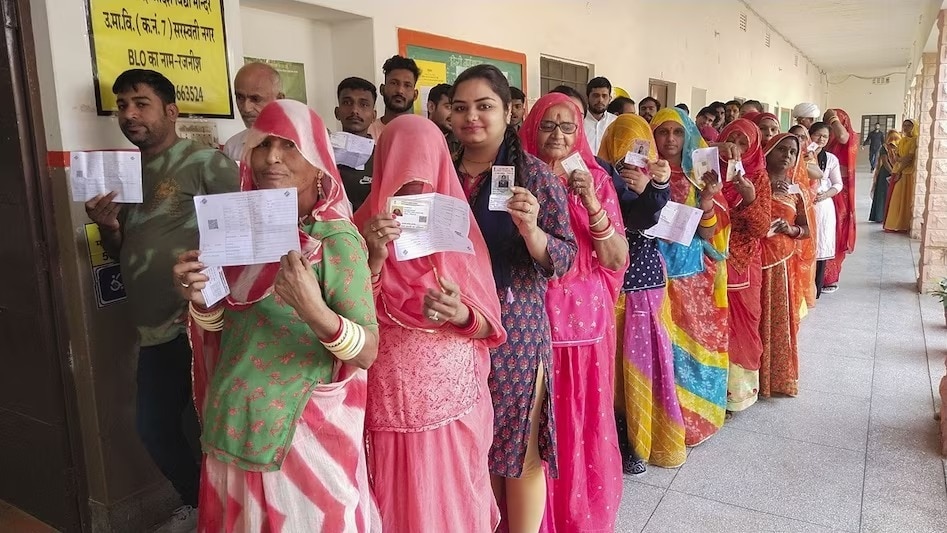
Voting for the first phase of urban local body elections has commenced in Rajasthan under the 'One State, One Election' framework. Over 5.7 million voters will decide the fate of 20,623 candidates across 162 bodies.
- Voting in 5,393 wards across 162 urban local bodies in the first phase.
- 5.75 million voters deciding the fate of 20,623 candidates.
- First major implementation of the 'One State, One Election' model in Rajasthan.
- Gen-Z voters (18-35 years) hold a decisive 25% share of the electorate.
Rajasthan has entered a new political era as voting for the first phase of the urban local body elections has begun. In a pioneering move under the 'One State, One Election' initiative, elections are being conducted across 309 urban bodies. The first phase covers 162 bodies, including 4 municipal corporations, 27 municipal councils, and 131 municipalities.
To ensure a fair and peaceful process, the State Election Commission has deployed stringent security measures. High-sensitivity booths are being monitored via CCTV webcasting and additional police forces. In this phase, voters across 39 districts are casting their ballots, with major municipal corporations like Alwar, Bharatpur, Bikaner, and Bhilwara going to the polls today.
Why This Matters
BozokMedia analysis shows that these elections serve as the first major litmus test for the Bhajanlal Sharma government since assuming power in December 2023. Because the BJP has championed the 'One State, One Election' vision, the results will be interpreted as a direct mandate on the state government's policies and administrative performance. While urban areas are traditional BJP strongholds, the party faces the risk of internal sabotage due to the denial of tickets to several veteran councilors.
Urban local polls often act as a precursor to larger political shifts, and the significant Gen-Z turnout in Rajasthan could lead to an unpredictable outcome.
For the Congress party, these elections are a critical opportunity to reclaim lost ground in urban centers. Led by State President Govind Singh Dotasra and former CM Ashok Gehlot, the party has pivoted its campaign toward grassroots issues such as sanitation, electricity, and the failures of local administration to attract disgruntled urban voters.
A pivotal factor in this election is the influence of Gen-Z voters. There are approximately 5.8 million voters in the 18-35 age group, with those aged 18-29 alone making up nearly 25% of the electorate. This demographic is likely to prioritize development and employment over traditional caste-based politics, potentially acting as a kingmaker for the contesting parties.
| Factor | Bharatiya Janata Party (BJP) | Indian National Congress (INC) |
|---|---|---|
| Core Strategy | Double-engine growth and governance | Focus on local civic failures |
| Major Challenge | Rebellion from denied candidates | Rebuilding urban voter base |
| What's at Stake? | Urban dominance and policy mandate | Organizational revival and recovery |
Frequently Asked Questions
Q1: Which major cities are voting in the first phase?
A: Voting is taking place in Alwar, Bharatpur, Bikaner, and Bhilwara municipal corporations, among other bodies.
Q2: Why are Gen-Z voters considered decisive?
A: With nearly 5.8 million voters aged 18-35, their 25% share can shift the balance of power away from traditional voting patterns.