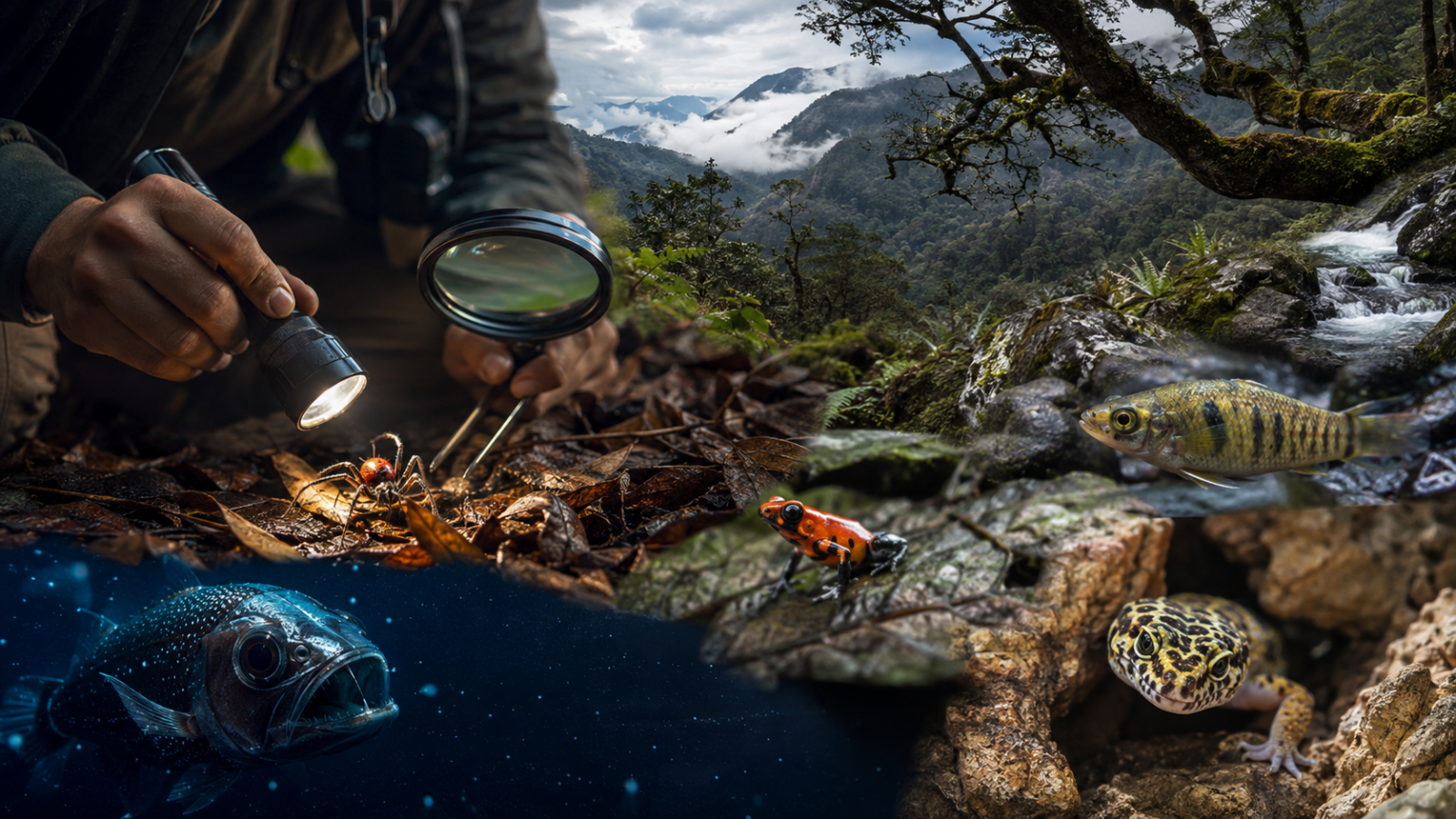
From smiling spiders in Uttarakhand to deep-sea fish in the Arabian Sea, discover the 5 incredible species found by chance in India.
- A 'smiling' spider discovered during an ant survey in Uttarakhand.
- A thumbnail-sized frog found in Kerala's Western Ghats.
- A new leopard gecko species identified in Bihar's Kaimur Plateau.
- The 'Indian Dory' deep-sea fish identified from fishing landings.
Scientific discovery is not always a result of a targeted mission. Often, it is the byproduct of curiosity, a routine survey, or a second look at something seemingly familiar. India's vast and varied landscape has recently yielded several such accidental wonders, proving that much of our natural world remains undocumented.
Unforeseen Encounters in the Wild
In the montane forests of Uttarakhand, researchers were conducting a survey focused on ants when they stumbled upon a tiny, striking spider. Featuring a red, smile-like marking on its back, this creature was eventually named Theridion himalayana, or the Himalayan happy-face spider. This finding is particularly significant as such patterns were previously thought to be characteristic of spiders in Hawaii.
Further south, in the shola forests of Kerala, a nighttime walk led to the discovery of a minuscule frog. Measuring only about 20 to 29 mm, the species Astrobatrachus kurichiyana was distinguished by its bright orange belly and blue star-like markings. It was named after the Kurichiyan community of Wayanad, where it resides.
Why This Matters
BozokMedia analysis shows that these accidental findings highlight the critical importance of continuous ecological monitoring. Every 'accidental' find strengthens our understanding of evolutionary biology and emphasizes the need to protect even the most seemingly insignificant habitats.
Accidental discoveries often bridge the gap between what we think we know and the complex reality of nature.
The discovery trend extends to species that were hiding in plain sight. In the Periyar Tiger Reserve, a population of fish long thought to be a known barb species was revealed through detailed examination to be Eechathalakenda incognita. Similarly, the rocky terrains of Bihar's Kaimur Plateau surprised scientists with the discovery of Eublepharis jhuma, a new leopard gecko species.
Even the deep ocean has yielded surprises. Scientists from ICAR-CMFRI identified a new deep-sea fish, Cyttopsis indica (the Indian dory), from specimens brought in by fishing trawlers in the Arabian Sea. This species was confirmed as genetically distinct through rigorous DNA analysis.
| Animal | Location | Key Feature |
|---|---|---|
| Happy-face Spider | Uttarakhand | Smile-like red marking |
| Tiny Frog | Kerala | Thumbnail size, orange belly |
| Leopard Gecko | Bihar | Nocturnal, rocky habitat |
| Indian Dory | Arabian Sea | Deep-sea species |
Frequently Asked Questions
1. Why are these called 'accidental' discoveries?
Because the scientists were originally searching for different species or conducting routine tasks when they encountered these new animals.
2. How do scientists confirm a new species?
Through a combination of morphological examination (physical traits) and advanced DNA analysis.