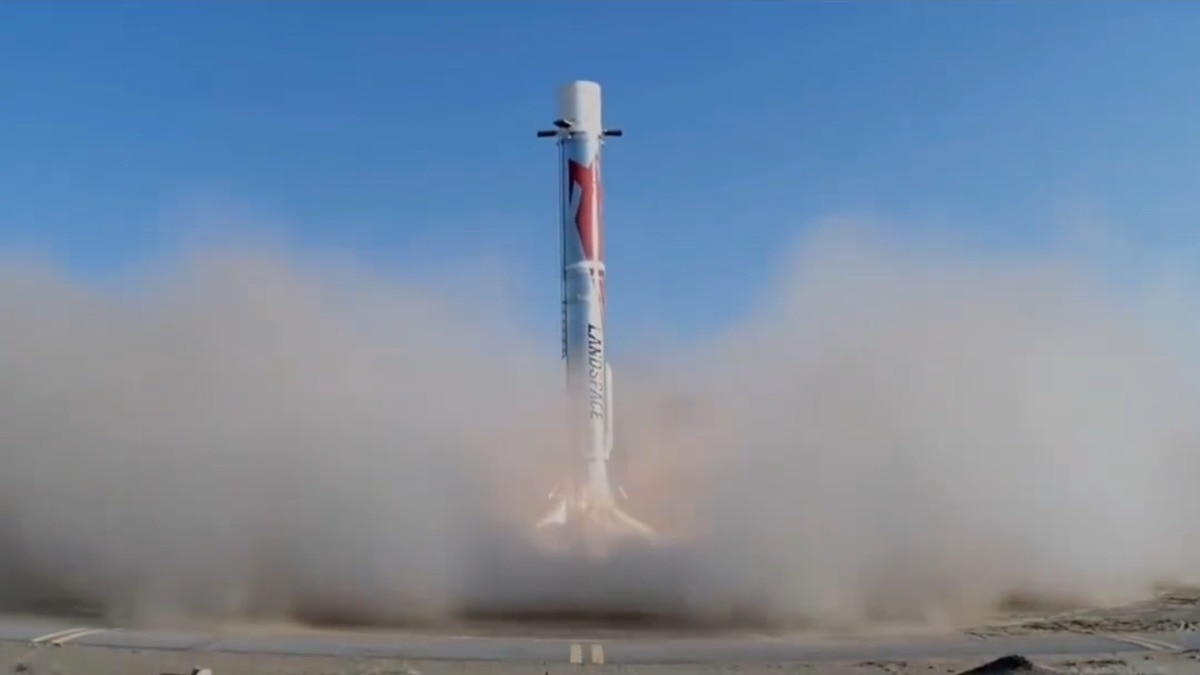
In a landmark achievement, Chinese private company LandSpace successfully landed the first stage of its Zhuque-3 rocket. This breakthrough brings China closer to the era of low-cost, reusable space exploration.
- LandSpace successfully recovered the first stage of the Zhuque-3 rocket.
- The mission successfully deployed the Honghu-03 satellite into orbit.
- The rocket is designed for up to 20 reuses, significantly cutting costs.
China has taken a massive leap toward the era of reusable rocketry. Private aerospace firm LandSpace has successfully landed the first stage of its Zhuque-3 rocket following an orbital launch. This milestone, achieved on the rocket's second attempt, marks a significant victory for China's private space sector.
The 66.1-metre-tall Zhuque-3 rocket did more than just land; it successfully placed the Honghu-03 satellite into orbit. By mastering the recovery of an orbital-class booster using deployable landing legs, LandSpace has positioned itself as a formidable player in the global space race, mirroring the capabilities of international giants.
Why This Matters
BozokMedia analysis shows that the ability to reuse rocket components is the single most important factor in reducing the cost of space access. Traditionally, rockets are discarded after a single use, wasting millions of dollars in hardware. LandSpace's technology aims to refurbish and fly the same booster up to 20 times, which could fundamentally change the economics of satellite deployment.
The transition from expendable to reusable launch vehicles is the defining shift of the 21st-century space economy.
The journey to this success was not without obstacles. In December 2025, LandSpace attempted a similar feat, but an abnormal combustion event prevented a controlled landing. This time, however, the booster traveled approximately 390 km to a landing site in Gansu province, touching down upright and intact.
The Global Context and India's Role
While China bolsters its private capabilities, the global landscape remains highly competitive. SpaceX, led by Elon Musk, remains the industry benchmark after successfully landing Falcon 9 boosters routinely since 2015. Other players like Blue Origin and Rocket Lab are also pushing the boundaries of reusability.
India is also making strides in this domain. ISRO is actively developing Vertical Take-off, Vertical Landing (VTVL) technology. Simultaneously, India's private sector is heating up, with Agnikul Cosmos announcing its 'Agnibaan Mission-02' to demonstrate orbital-class booster recovery, signaling that the race for low-cost space access is truly global.
Frequently Asked Questions
1. What makes the Zhuque-3 landing unique?
It is the first time a Chinese private company has successfully recovered an orbital-class booster using landing legs.
2. How does reusability help space exploration?
It allows expensive rocket hardware to be used multiple times, drastically lowering the price of launching satellites and missions.