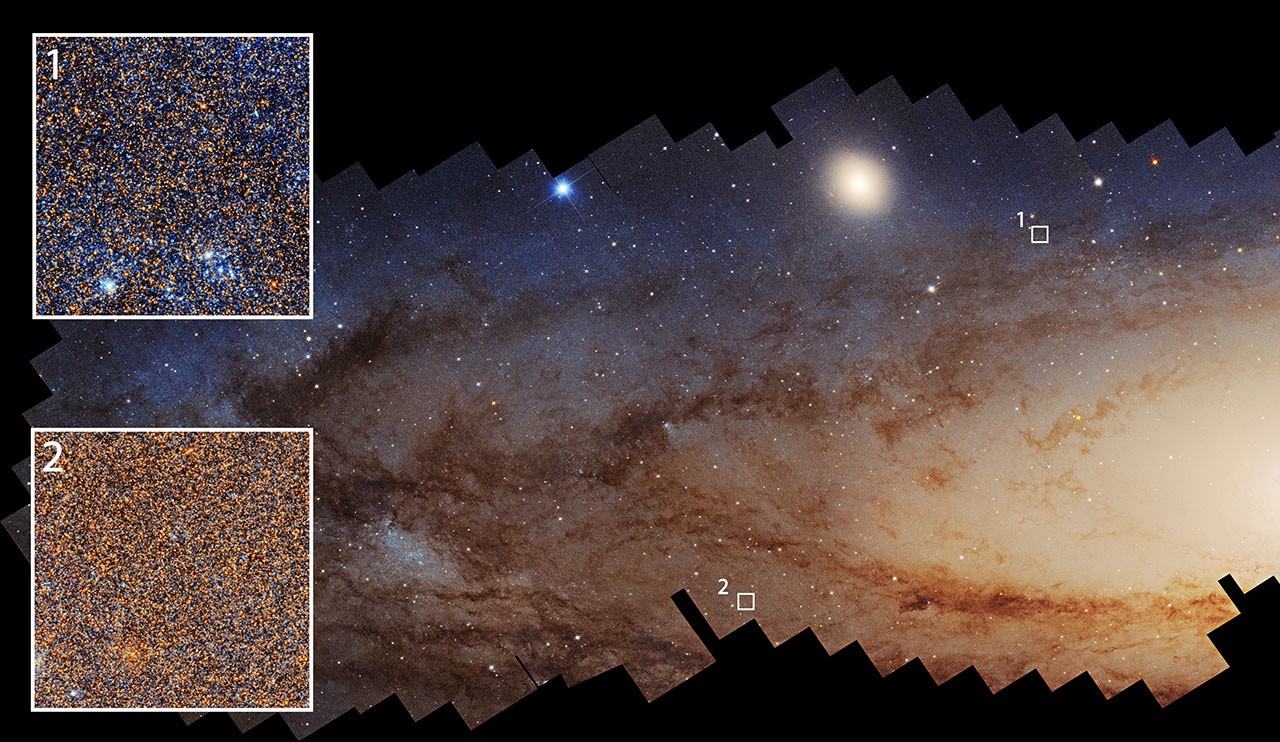
New data from NASA's Hubble Space Telescope reveals that the Andromeda galaxy has seen a steady decline in star formation over the last 500 million years, with a sharp drop in recent millennia.
Key Takeaways
- Star formation in Andromeda has declined steadily over 500 million years.
- The rate of decline accelerated significantly in the last 40 million years.
- The satellite galaxy M32 is considered a likely suspect for this slowdown.
- Hubble analyzed 200 million individual stars to map this cosmic history.
A groundbreaking study utilizing data from NASA’s Hubble Space Telescope has revealed that the nearby Andromeda galaxy is undergoing a significant transition. For the past 500 million years, the rate at which new stars are born in this massive spiral galaxy has been in steady decline, with an even more dramatic plunge occurring in just the last 40 million years.
A Cosmic Slowdown
Located approximately 2.5 million light-years away, Andromeda is our cosmic neighbor and a vital subject for astronomical study. According to findings published in The Astrophysical Journal, the galaxy’s star-forming activity has plummeted from producing about one solar mass of stars per year to just one-fifth of that today. This shift is primarily driven by decreasing activity within a massive star-forming ring located 32,000 light-years from the galactic center.
Why This Matters
BozokMedia analysis shows that observing Andromeda provides a unique 'fossil record' of galactic evolution. By studying the distribution of blue (young) and red (old) stars, astronomers can reconstruct the life story of galaxies. Understanding why Andromeda is winding down helps scientists predict the long-term fate of our own Milky Way.
It’s just like after running a marathon, sometimes you’ve got to take a bit of a breather.
To achieve this level of precision, researchers combined data from the Panchromatic Hubble Andromeda Treasury surveys, mapping two-thirds of the galaxy's disk. This allowed the team to measure roughly 200 million individual stars, providing an unprecedented resolution of the galaxy's past stellar populations.
The M32 Connection
The study also investigates the role of M32 (Messier 32), a satellite galaxy located near Andromeda. While a direct causal link is still being debated, the decline in star formation near M32 suggests that past gravitational interactions between these two bodies may have disrupted the gas and dust necessary for star birth.
Frequently Asked Questions
1. What causes star formation to decline in a galaxy?
It is typically caused by the depletion of available gas and dust or gravitational disturbances from neighboring galaxies.
2. How did Hubble detect this change?
By analyzing the color and density of millions of individual stars, which act as indicators of the galaxy's age and activity level.