Scientists have uncovered a startling secret behind the longevity of China's Huashan rock art. The ancient pigments were fortified with human blood, potentially sourced from women during childbirth.
Key Takeaways
- China's Huashan Rock Art has survived 2,000 years of extreme weather.
- Researchers discovered human blood proteins within the ancient pigments.
- The blood was likely sourced from women immediately after childbirth.
- The mixture created a calcium carbonate bond, fusing paint to the rock.
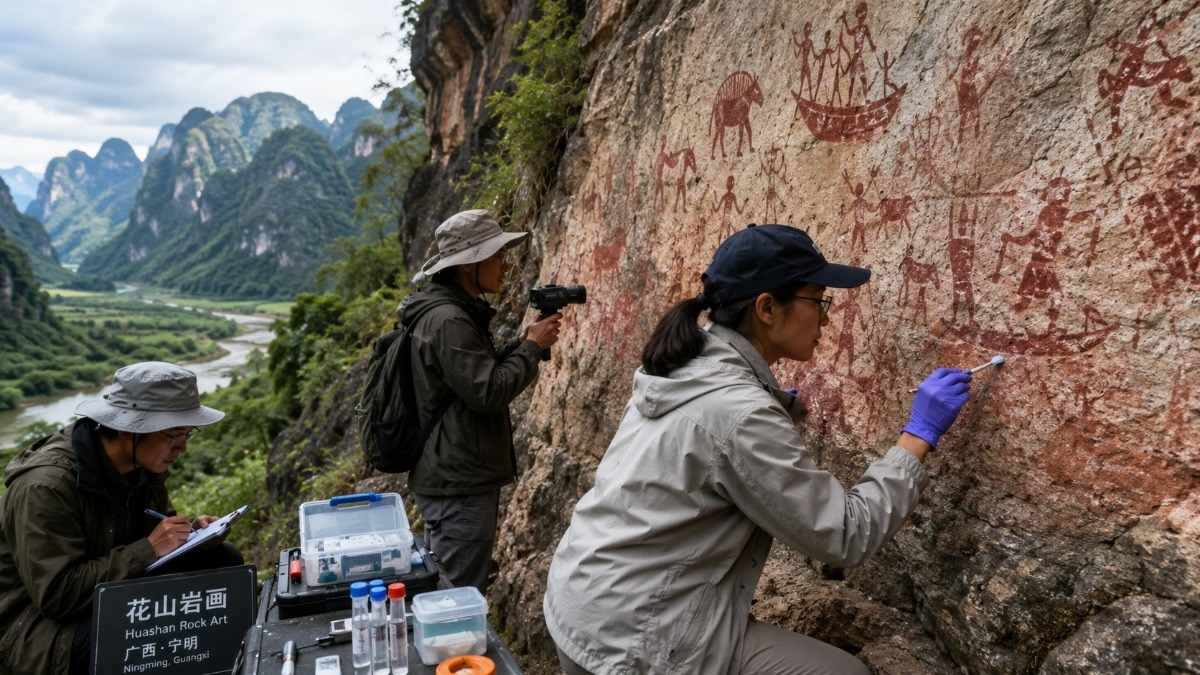
The Huashan Rock Art in southern China has long puzzled archaeologists. Located near the Vietnam border in the Guangxi Zhuang Autonomous Region, these 2,000-year-old paintings have defied extreme heat, torrential rains, and intense humidity. A recent groundbreaking study has finally revealed the biological secret behind their incredible durability.
According to reports, researchers from Shandong University and the Guangxi Museum of Anthropology found traces of human blood in the paint samples. Specifically, they identified serum proteins associated with childbirth and lactation. This leads scientists to believe that the ancient Luoyue people may have used blood from women who had recently given birth to create their pigments.
Why This Matters
BozokMedia analysis shows that this discovery redefines our understanding of ancient chemical engineering. The use of biological matter wasn't just ritualistic; it was highly functional. When blood was mixed with lime and red ochre, it triggered a chemical reaction that produced calcium carbonate. This effectively turned the paint into a part of the rock surface itself, rather than just a layer sitting on top of it.
The ancient Luoyue civilization utilized a sophisticated biological-chemical bond that rivals modern industrial coatings.
The durability was so profound that researchers had to use electric drills to extract paint samples from the rock face. Interestingly, the composition varied across sites; while some areas showed up to 97% human blood, others contained a significant amount of animal blood, suggesting a nuanced recipe used by ancient artists.
Historical Background
The Huashan Rock Art spans a 260-kilometer area and depicts humans, animals, boats, and musical instruments. Recognized as a UNESCO World Heritage site in 2016, it serves as a vital record of the Luoyue culture, a group that inhabited the borderlands of present-day China and Vietnam.
Frequently Asked Questions
Question 1: Who created these ancient paintings?
Answer: The paintings are attributed to the ancient Luoyue people, who lived in the border regions of China and Vietnam.
Question 2: Why was human blood used?
Answer: While the chemical benefit was durability, it is believed the use of postpartum blood was also tied to cultural or religious beliefs regarding fertility and sanctity.