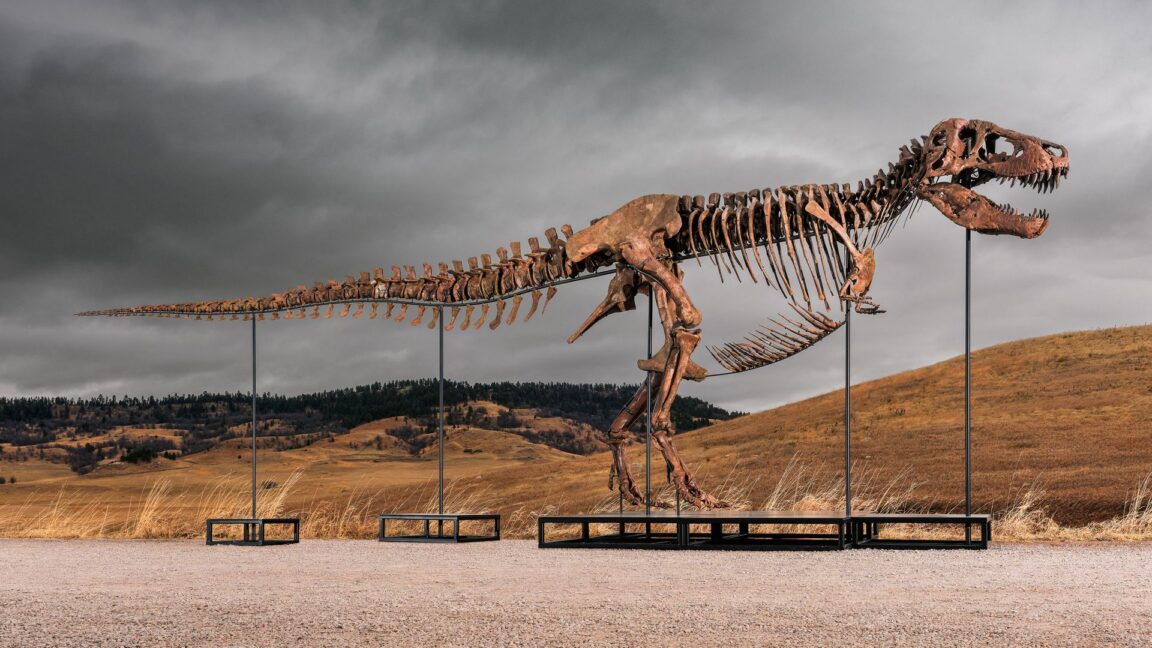
The high-stakes auction of 'Gus,' a rare 67-million-year-old T. rex skeleton, highlights the growing tension between private collectors and scientific institutions.
Key Takeaways
- A rare 67-million-year-old T. rex specimen named 'Gus' is up for auction, expected to fetch up to $30 million.
- Private collectors are increasingly outbidding museums, treating fossils as luxury assets.
- The privatization of fossils limits access for paleontologists and hinders global scientific research.
The prestigious auction house Sotheby’s has ignited a fierce debate within the global scientific community. On July 14, the house commenced bidding on a variety of fossils, but the undisputed star of the show is Lot 20: a magnificent, 67-million-year-old Tyrannosaurus rex skeleton, affectionately dubbed 'Gus.'
The Splendor of 'Gus'
Discovered on a ranch in South Dakota, Gus is being marketed as one of the most significant T. rex finds in history. According to Sotheby’s, the specimen boasts an incredible 183 fossil bone elements, making it approximately 61% complete. Mounted on a custom steel armature and supplemented with replicas to complete its predatory silhouette, the skeleton is poised to command a staggering price of up to $30 million.
A Crisis for Paleontology
While the auction represents a triumph for the art and luxury market, it signals a looming crisis for paleontology. Experts warn that the trend of private collectors swooping in to purchase fossils as high-end assets is fundamentally altering the landscape of prehistoric research. Unlike museums, which prioritize public education and peer-reviewed study, private collectors often keep their acquisitions behind closed doors.
The Cost of Privatization
The implications of this shift are profound. When a specimen of Gus's caliber enters a private collection, it is effectively removed from the scientific record. The data, the bones, and the opportunity for future technological analysis become inaccessible to the researchers who need them most. As auction houses build hype around these ancient creatures, they inadvertently fuel a market where history is sold to the highest bidder, often leaving science in the shadows of extreme wealth.