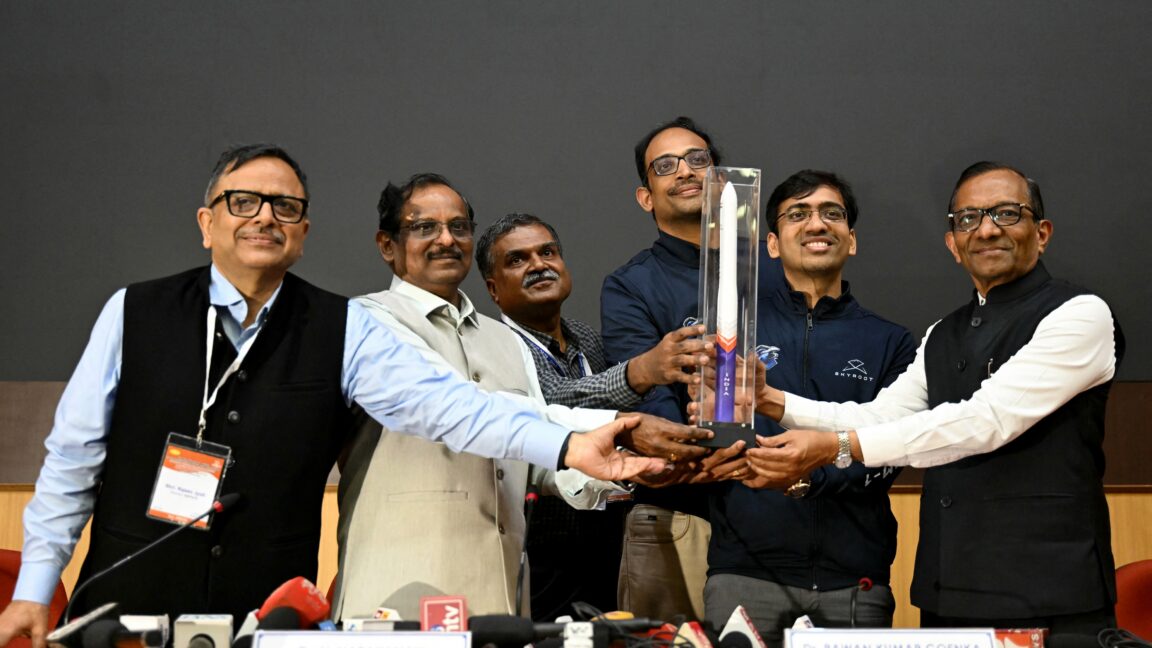
Skyroot Aerospace’s Vikram‑1 achieved orbit on its maiden flight, marking India’s first fully commercial satellite launcher to succeed. The 280‑mile‑high orbit demonstrates the growing capability of private Indian space ventures.
Key Takeaways
- Vikram-1 successfully reached orbit on its maiden flight
- It is India’s first fully commercial private launch vehicle
- Capable of delivering up to 350 kg to a 280‑mile low‑Earth orbit
Skyroot Aerospace launched Vikram-1 from the Sriharikota spaceport at 06:35 UTC on Saturday. After a half‑hour technical delay, the solid‑fuel first‑stage booster ignited, propelling the 22‑metre (72‑foot) rocket toward a 280‑mile (≈ 450 km) orbit. This marked the first successful orbital insertion by a wholly private Indian satellite launcher.
Standing at roughly 22 m tall, Vikram-1 can place payloads of up to 350 kg into low‑Earth orbit. Its capacity places it just above Rocket Lab’s Electron vehicle, which has become the world’s most prolific small‑satellite launcher. While smaller than ISRO’s workhorse PSLV or GSLV, Vikram‑1’s private‑sector agility and lower launch cost position it as a niche yet strategic alternative.
Historical Background
For decades, the Indian Space Research Organisation (ISRO) held a monopoly over all launch activities in India. In 2016, the government introduced a regulatory framework that opened the door for private players, leading to the emergence of firms such as Skyroot, Agnik, and Bellatrix Aerospace. Skyroot was founded in 2018 with a focus on small‑satellite launch services, and its Vikram‑1 is the culmination of years of private‑sector research and development. This maiden orbital success represents a watershed moment in India’s space liberalisation.
Why This Matters (इसके मायने क्या हैं)
According to BozokMedia analysis, Vikram‑1’s achievement expands the launch‑service ecosystem in India, offering cost‑effective options for domestic satellite manufacturers and attracting international small‑satellite customers. The ripple effect could boost job creation, spur technological innovation, and draw foreign direct investment into the Indian space sector.
Moreover, the milestone diversifies India’s strategic capabilities. Frequent private launches will enable faster deployment of communication, weather‑monitoring, and defense satellites, strengthening national security and improving services for millions of citizens.
"Vikram‑1’s success marks a new era of commercialization in India’s space landscape," says Dr. Renu Sharma, former ISRO scientist.
Product Comparison
| Rocket | Height | LEO Payload | First Flight | Approx. Cost (USD) |
|---|---|---|---|---|
| Vikram-1 | 22 m | 350 kg | 2024 | ≈ $4 million |
| PSLV | 44 m | 1,750 kg | 1993 | ≈ $15 million |
| Electron | 18 m | 300 kg | 2017 | ≈ $5 million |
Frequently Asked Questions (अक्सर पूछे जाने वाले प्रश्न)
- How much payload can Vikram-1 carry? It can deliver up to 350 kg to a low‑Earth orbit of about 500 km.
- Will future versions handle heavier payloads? Skyroot has announced plans to increase payload capacity and develop reusable technologies in upcoming variants.