Rising temperatures and climate variability in the Himalayas are transforming once-stable ice masses into highly dangerous 'hanging glaciers.' A landmark study warns that over 200 of these precarious formations in the Alaknanda basin pose catastrophic risks of avalanches and flash floods to downstream Indian communities.
- Hanging glaciers are ice masses perched on steep mountain slopes that can detach suddenly and trigger massive avalanches.
- A landmark study has identified 219 unstable hanging glaciers in the Alaknanda basin of the Garhwal Himalayas.
- Downstream exposure is projected to surge by 2030, with 120% more infrastructure and 17% more population at risk.
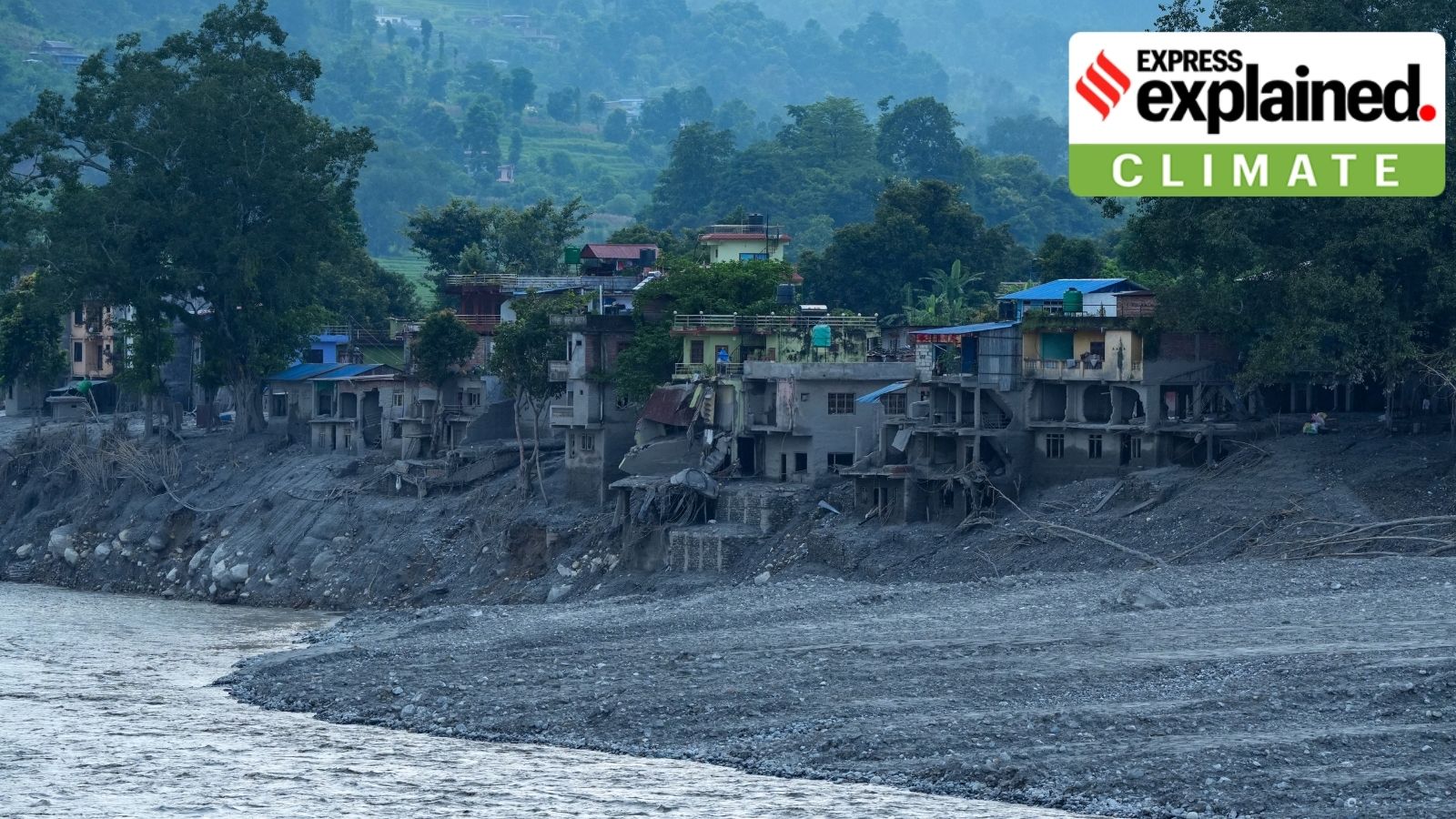
The devastating flooding recently witnessed in Nepal shares striking similarities with at least four major disasters in India over the last decade and a half. Each of these events involved a sudden, catastrophic release of massive volumes of water into mountainous rivers. However, scientists are now sounding even louder warning bells for India. As rising global temperatures and shifting regional precipitation patterns destabilize Himalayan glaciers, many are evolving into dangerous "hanging glaciers"—unstable ice masses perched precariously on steep slopes.
An April 2026 study published in the prestigious journal Nature has revealed that there are as many as 219 hanging glaciers in the Alaknanda basin of the Garhwal Himalayas. Shockingly, nearly a third of this highly unstable ice is concentrated in the Upper Alaknanda basin. The study was co-authored by Ashim Sattar of the School of Earth, Ocean and Climate Sciences at the Indian Institute of Technology (IIT), Bhubaneswar, and Nandu Krishnan of the Divecha Centre for Climate Change at the Indian Institute of Science (IISc), Bengaluru, alongside other colleagues.
How Do Hanging Glaciers Form?
According to the researchers, Himalayan glaciers are increasingly exhibiting "geometric and dynamic instability" due to rapid warming and climate variability. Unstable glaciers are those whose velocity can change by an order of magnitude or more over a relatively short period. This sudden acceleration redistributes the ice mass, causing structural, geometric, and tectonic shifts. This instability leads to the development of hanging glaciers on steep gradients. While these formations have been extensively studied in the European Alps, basin-scale assessments in the Himalayas have historically been extremely limited.
Why This Matters
BozokMedia analysis shows that the rapid, often unregulated urbanization of India's Himalayan valleys, combined with climate-induced cryosphere degradation, has created a ticking ecological time bomb. The intersection of critical infrastructure development—such as dams, highways, and pilgrimage facilities—with highly unstable glacial topography means that future disasters will have exponentially higher human and economic costs unless immediate mitigation strategies are deployed.
| Feature | Hanging Glacier | Valley Glacier |
|---|---|---|
| Slope Gradient | Extremely steep slopes (perched) | Gentle valley floors and troughs |
| Stability Level | Highly unstable; prone to sudden detachment | Relatively stable; moves slowly over decades |
| Primary Hazard | Catastrophic avalanches and sudden GLOFs | Gradual melting and long-term water resource changes |
When hanging glaciers break off, the physical consequences are catastrophic. The study’s simulations indicate that the resultant avalanche flows could exceed 50 meters in height in Uttarakhand’s highly sensitive Badrinath-Mana sector. Such an extreme event would instantly swallow major settlements, historical temples, and vital infrastructure. Furthermore, the debris from these break-offs can block rivers, triggering secondary hazards such as Glacial Lake Outburst Floods (GLOFs) further downstream.
"This study underscores the need to monitor such 'hanging glaciers' closely to give better warning of such catastrophes in future to vulnerable downstream communities." - Pam Pearson, Director of ICCI
The exposure to these avalanche-related risks in the Alaknanda basin is projected to increase dramatically over the next decade. The study estimates that by 2030, there will be 120% more buildings and infrastructure land area at risk compared to the year 2000. Meanwhile, the population living in these high-risk areas is projected to surge by 17% over the same period. This highlights the urgent need for systematic monitoring and risk-informed land-use planning in mountain regions.
Frequently Asked Questions
Q1: What exactly is a hanging glacier?
Answer: A hanging glacier is a body of ice that originates high on the walls of a glacial valley and descends only partway down the slope, ending abruptly at a steep cliff where it is highly prone to breaking off.
Q2: Why is the Alaknanda basin particularly vulnerable?
Answer: The Alaknanda basin in the Garhwal Himalayas houses 219 identified hanging glaciers, and its lower valleys are densely populated and host crucial pilgrimage sites like Badrinath, making any glacial collapse highly destructive.