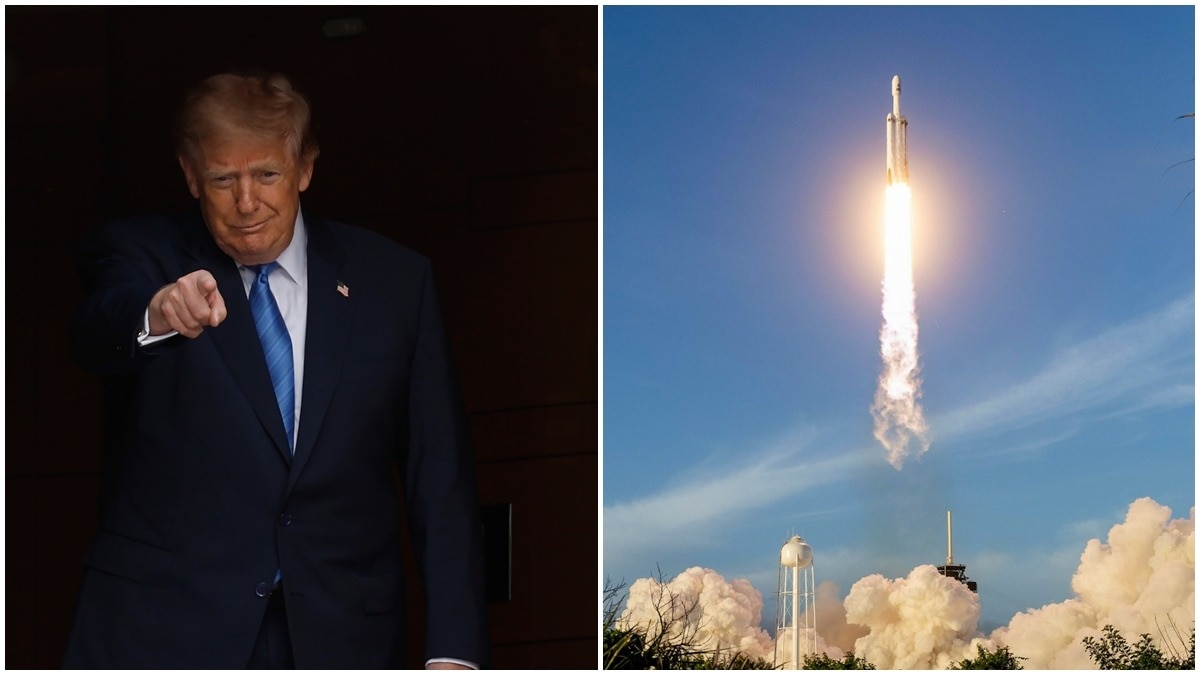
In a surprising turn of events, President Donald Trump congratulated NASA on the launch of the Nancy Grace Roman Space Telescope, a mission his own administration repeatedly attempted to defund.
- Nancy Grace Roman Space Telescope successfully launched via SpaceX Falcon Heavy.
- President Donald Trump called NASA Administrator Jared Isaacman to offer congratulations.
- The Trump administration previously proposed canceling the mission multiple times between 2019 and 2025.
- The observatory aims to uncover the mysteries of dark energy and dark matter.
In a moment defined by both celebration and stark irony, NASA officials held a post-launch press conference following the successful deployment of the Nancy Grace Roman Space Telescope. As the agency celebrated the start of this cosmic journey, NASA Administrator Jared Isaacman received a direct phone call from US President Donald Trump, who praised the mission and the team's achievements.
The congratulatory tone, however, masked a turbulent history. The very administration now applauding the achievement had, on several occasions, sought to dismantle the project. The tension between political budgeting and scientific ambition nearly ended the project before it ever left the launch pad.
Mission Capabilities and Scientific Goals
The Roman telescope lifted off at 4:56 pm IST on August 30 from NASA's Kennedy Space Center in Florida, propelled by a SpaceX Falcon Heavy rocket. The observatory is currently navigating toward the second Sun-Earth Lagrange point (L2), located approximately 1.5 million kilometers from Earth.
While it shares a 2.4-meter primary mirror size with the legendary Hubble Space Telescope, the Roman telescope is a different beast entirely. Its Wide Field Instrument allows it to capture an area of the sky at least 100 times larger than Hubble's in a single shot. This capability is critical for surveying vast stretches of the universe to investigate the nature of dark energy and the evolution of galaxies.
Why This Matters
BozokMedia analysis shows that the Roman telescope's survival is a testament to the critical role of legislative oversight. By rejecting the White House's proposed budget cuts, Congress ensured that a generational leap in astronomical data would not be lost. The telescope will create a massive data pool that will serve as a foundation for countless future studies in exoplanets and cosmology.
"The Roman Space Telescope represents a paradigm shift in how we map the cosmos, moving from targeted snapshots to wide-scale cinematic surveys of the universe."
A History of Funding Threats
The relationship between the Trump administration and the Roman telescope has been fraught with uncertainty. Between 2019 and 2021, the administration proposed canceling the mission in three separate budget requests. The threat resurfaced in 2025, when proposed budget documents aimed to slash NASA's science spending, potentially endangering over 50 missions.
| Feature | Hubble Telescope | Roman Telescope |
|---|---|---|
| Primary Mirror | 2.4 Meters | 2.4 Meters |
| Field of View | Narrow/Deep | 100x Wider than Hubble |
| Primary Focus | Detailed Galactic Images | Dark Energy & Wide Surveys |
Frequently Asked Questions
Q1: What is the primary mission of the Roman Space Telescope?
A: It is designed to study dark energy, dark matter, and the evolution of galaxies through wide-field surveys.
Q2: Where is the telescope heading?
A: It is traveling to the second Sun-Earth Lagrange point (L2), about 1.5 million kilometers from Earth.