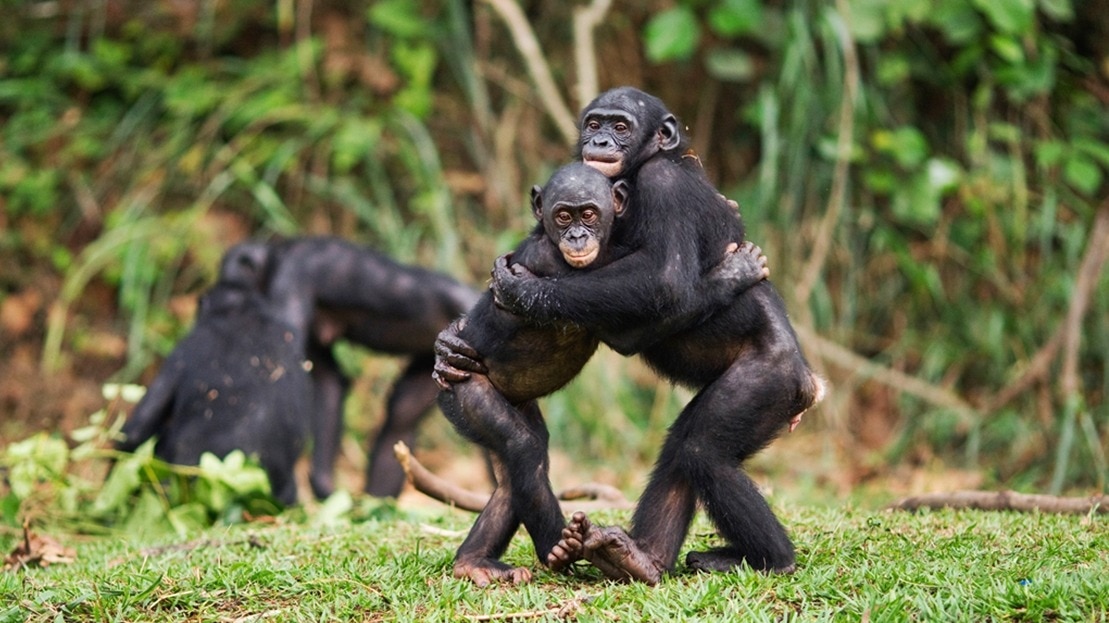
A groundbreaking study reveals that chimpanzee vocalizations are not just genetic, but are shaped by social environments, allowing them to develop unique regional dialects.
- Chimpanzee vocalizations are learned through social interaction rather than being purely genetic.
- Distinct vocal patterns (dialects) were identified between different geographical populations.
- The study challenges the long-held belief that primate communication is entirely innate.
In a landmark scientific discovery, researchers have found that chimpanzees can develop unique ways of communicating based on their specific social and environmental surroundings, much like humans develop regional accents. This research suggests that the sounds chimpanzees make—such as laughter, grunts, and whimpers—are not fixed at birth but evolve as they grow.
The study, published in the journal PLOS One, involved a detailed analysis of chimpanzee populations in the Chimfunshi Wildlife Orphanage in Zambia and the Gombe National Park in Tanzania. Despite being geographically separated, the researchers identified distinct 'vocal patterns' or dialects unique to each group, indicating a capacity for cultural transmission of sound.
Why This Matters
BozokMedia analysis shows that this finding fundamentally shifts our understanding of primate cognition. It suggests that chimpanzees possess a level of social learning and communicative flexibility that was previously thought to be a uniquely human trait, bridging the gap between human linguistics and animal behavior.
"Understanding how communication styles develop in early life is crucial for understanding animal behavior." — Cassandra Giragosian, Doctoral Researcher at Queen Mary University of London.
The research highlights that while some population-specific vocal traits appear in infancy, others become more pronounced during adolescence. This mirrors the human experience, where children learn the same fundamental language but adopt the specific accent and cadence of their local community.
Historical Background
For decades, the scientific consensus held that primate vocalizations were largely instinctual and genetically predetermined. Evolutionary biologists believed that while humans developed complex language through culture, other primates relied on a fixed set of innate calls. This new evidence provides a significant challenge to that paradigm.
Frequently Asked Questions
1. Does this mean chimpanzees have a complex language?
Not exactly. They do not use structured grammar like humans, but they use distinct vocal dialects to communicate social information within their groups.
2. How does the environment affect their sounds?
The social environment dictates which sounds are reinforced and imitated by young chimpanzees, leading to the development of group-specific patterns.

