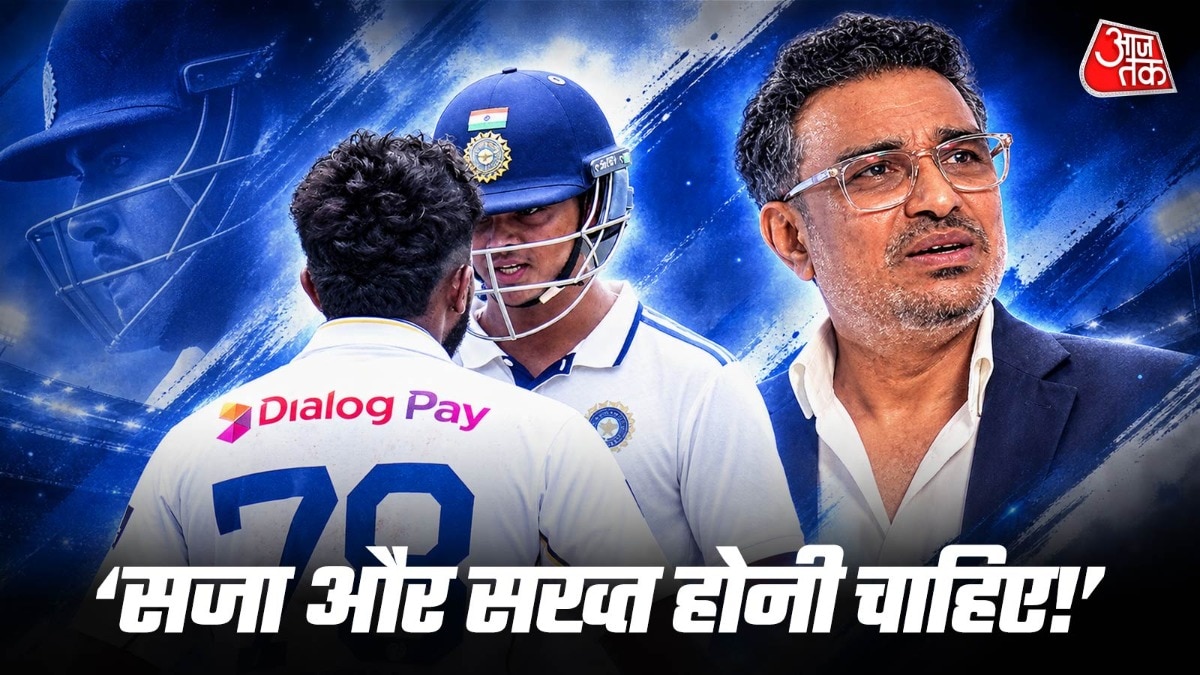
Former Indian cricketer Sanjay Manjrekar has questioned the ICC's penalties by linking the recent controversy involving young batsman Yashasvi Jaiswal with that of Vaibhav Suryavanshi from June. Manjrekar believes that the lenient punishments handed to these players will encourage them to repeat such mistakes in the future.
- Sanjay Manjrekar has deemed the ICC's ruling insufficient for the altercation between Yashasvi Jaiswal and Sri Lankan bowler Asitha Fernando during the Galle Test.
- Manjrekar drew parallels between this incident and the one involving Vaibhav Suryavanshi and Sri Lankan player Vishan Halambage in June.
- His argument is that players will repeat aggressive behavior on the field if they are not given strict punishments.
- Manjrekar expressed concern that this 'it's okay' culture could be detrimental to Indian cricket.
New Delhi: The fine line between aggression and discipline on the cricket field is often a subject of debate. While passion, sledging, and responding in kind can be part of the game, when it escalates to physical confrontation, it becomes more than just an individual player's mistake; it raises questions about the effectiveness of the actions taken by cricket's governing bodies. Recently, the altercation between young Indian batsman Yashasvi Jaiswal and Sri Lankan fast bowler Asitha Fernando during the Galle Test has once again brought this issue to the forefront.
Following his dismissal, as Jaiswal was returning to the dressing room, an argument ensued between him and Fernando, which allegedly escalated to Jaiswal making head contact with Fernando. Following this incident, the International Cricket Council (ICC) fined Jaiswal 25 percent of his match fee and issued one demerit point. However, the ICC stated in its press release that Fernando had moved his head towards Jaiswal, and in response, Jaiswal leaned in, resulting in their heads making contact.
Sanjay Manjrekar's Sharp Attack
Former Indian batsman and commentator Sanjay Manjrekar finds the ICC's penalty insufficient. Manjrekar, rather than targeting a specific player, has questioned the root cause of the entire issue on social media. His argument is clear: if players are allowed to get away with such behavior easily, they will have no fear of repeating their mistakes in the future.
He tweeted, “Vaibhav for Ind A recently & now Jaiswal… if you keep letting them get away with such behaviour, you train them to repeat such behaviour. It’s not good for the sport & crucially their own future too.” Manjrekar tagged @ICC and @BCCI in this tweet.
Vaibhav Suryavanshi's Case and Fear of 'It's Okay' Culture
Manjrekar recalled the case of Vaibhav Suryavanshi because this is not the first time a young Indian player has had a confrontation with a Sri Lankan player on the field. A few months ago, in June, a similar controversy erupted after a match between India 'A' and Sri Lanka 'A'. Following a closely contested super-over match, an altercation occurred between Indian young batsman Vaibhav Suryavanshi and Sri Lanka 'A's Vishal Halambage, where Suryavanshi pushed Halambage.
In that incident, both players were fined 50 percent of their match fees, and Tilak Varma and Niroshan Dickwella were also penalized for their roles in the dispute. Even then, Manjrekar had questioned Suryavanshi's behavior, stating that if he were on the selection committee, he would drop the young player for the next match. This sequence of events further fuels Manjrekar's concern that the increasing aggression on the field in Indian cricket might gradually turn into an 'it's okay' culture.
The 'Respond' Attitude and Boundaries
Yashasvi Jaiswal's aggressive on-field demeanor has also been a hallmark of his game. During the Test series against Sri Lanka, commentator Harsha Bhogle also commented on Jaiswal's on-field behavior. While praising his talent, Bhogle advised him to be mindful of his conduct. Jaiswal, in response, stated that if people don't know what was said, they shouldn't pass judgment, implying that if someone crosses a line, India will respond.
This aggressive stance makes Jaiswal a batsman who doesn't back down from sledging. He was also involved in a verbal exchange with Niroshan Dickwella during the Galle Test. However, the point Manjrekar is raising starts precisely here: responding and being physically aggressive are two entirely different matters.
Not Just Punishment, But a Message
The tension in the match against Sri Lanka was not limited to Jaiswal and Fernando. During Sri Lanka's innings, there was also a heated exchange between Mohammed Siraj and Kamil Mishara, which required intervention from the umpires. Subsequently, substitute fielder Sarfaraz Khan was also seen getting involved with Dhananjaya de Silva and Niroshan Dickwella. This escalating tension paints a picture that has deepened Manjrekar's concern.
The 25 percent match fee fine and one demerit point given to Jaiswal is a penalty under the rules. But Manjrekar's question goes beyond the rulebook. He is asking: Is this punishment severe enough to make a player think twice before resorting to physical contact? Because maintaining the distance between verbal exchanges and physical altercations on the field is crucial for the integrity of the sport.
Why This Matters
BozokMedia analysis shows that the repeated instances of on-field altercations involving young Indian cricketers, coupled with what is perceived as lenient penalties, raise concerns about the development of sportsmanship and discipline within the national team. Sanjay Manjrekar's critique highlights a potential gap between the ICC's disciplinary actions and the message they send to players regarding acceptable on-field behavior, impacting the long-term integrity and reputation of the sport.
Expert quote: "The line between passion and aggression in sports is thin, and disciplinary bodies must ensure their actions send a clear message that physical confrontation will not be tolerated, regardless of the player's stature or potential."
Frequently Asked Questions
- What exactly happened between Yashasvi Jaiswal and Asitha Fernando during the Galle Test?
- Why does Sanjay Manjrekar believe that the penalties given to players like Jaiswal and Vaibhav Suryavanshi are insufficient?